


 Subscribe
Across the globe, transport regulations are becoming stricter at a pace that many fleet operators do not fully anticipate.
Authorities are placing growing emphasis on safety oversight, data transparency and service responsibility to ensure that public transport systems remain dependable and earn long-term trust from passengers.
This trend has already reshaped regulatory frameworks in Europe and Asia, and it is now clearly influencing the Middle East as well.
Saudi Arabia finds itself at a pivotal stage of this transition. For Saudi Arabian taxi operators and Saudi Arabian luxury transport companies, regulation can no longer be treated as a secondary concern.
It now has a direct impact on everyday operations, licensing stability and sustainable business growth.
Even with rapid digital transformation across the sector, many fleets continue to handle compliance through disconnected systems and manual routines.
This is where hidden operational risk begins to accumulate. Audits, fines and service limitations rarely appear without warning, yet many operators only respond once the consequences are already affecting their business.
In this article, we explore how global regulatory trends intersect with Saudi transport legislation, what authorities are truly aiming to achieve and how fleet operators can remain prepared by adopting a practical taxi compliance guide mindset.
Read also: Why Taxi Businesses Must Upgrade to Modern Taxi Dispatch Software in 2025
The Global Push Toward Stricter Transport Regulations
Worldwide, the transport industry is entering a new era defined by tighter control and clearer accountability.
Processes that were once limited to basic permits and occasional inspections are now evolving into systems of ongoing regulatory supervision.
Rather than reacting after issues arise, governments are building continuous frameworks designed to keep mobility services safe, equitable and transparent within fast-growing cities, digital platforms and increasingly complex transport networks that handle millions of passenger journeys every day.
Why Governments Are Tightening Transport Oversight
Passenger safety remains the leading reason behind tighter transport oversight. As urban populations expand and trip volumes continue to rise, the room for operational error becomes increasingly narrow.
Platform accountability has also moved to the forefront. Digital booking and dispatch systems now influence pricing models, service availability and market access on a large scale, which makes regulatory clarity essential.
Data protection has become a central concern as transport services generate vast amounts of sensitive information, including passenger locations and personal identification records.
Pressure from urban planning authorities is another driving factor. When transport growth is left unmanaged, cities face higher congestion levels, increased pollution and long-term strain on infrastructure.
Finally, fair competition must be protected. Regulators aim to ensure that licensed operators are not disadvantaged by unregulated services operating outside established legal and safety frameworks.
What This Means for Fleet Operators Worldwide
For fleet operators, this regulatory shift is redefining what compliance actually means. It is no longer something addressed periodically or tied only to license renewals.
Compliance now extends into day-to-day dispatch processes, driver behavior and fare management, regardless of whether a fleet operates ten vehicles or several hundred.
Regulatory audits are also changing in nature. Authorities are increasingly proactive, relying on system-based monitoring rather than waiting for passenger complaints to trigger inspections.
Traditional paper records are being replaced by digital evidence. Industry insight from Gartner highlights how safety compliance and governance now sit alongside digital transformation as core priorities for transport operations.
The Real Objective Behind Transport Regulations
Transport regulations are often viewed solely as a system of rules and penalties. However, a closer look reveals that their true purpose goes far beyond enforcement.
At its core, regulation is not meant to punish operators. It exists to create a transport environment that people can trust and rely on every single day.
From Public Safety to Market Trust
Public safety is always the starting point. When millions of journeys take place across cities each day, even minor operational gaps can result in serious consequences.
For this reason, governments aim to ensure that every passenger, every driver and every vehicle can be traced within a dependable regulatory framework.
Over time, this traceability develops into market-wide trust. Passengers feel protected when using licensed services. Corporate clients gain confidence when assigning business travel. Regulators gain clear visibility into how mobility systems function in real conditions.
This same philosophy is now shaping Saudi Arabian taxi compliance, where trust is becoming just as critical as enforcement itself.
From Informal Transport to Structured Mobility Ecosystems
Globally, informal transport models are gradually being replaced by structured mobility ecosystems.
Unlicensed services may appear flexible on the surface, but they often weaken safety standards and distort fair competition within the market.
By contrast, compliance enables transparent investment and strengthens confidence in tourism and business travel, as visitors increasingly expect regulated transport as a baseline standard.
As the saying goes, an ounce of prevention is worth a pound of cure.
For operators involved in corporate travel or airport transfers, this transition is especially relevant. You can explore how structured systems support this shift through our insights on corporate transport management and airport transfer automation.
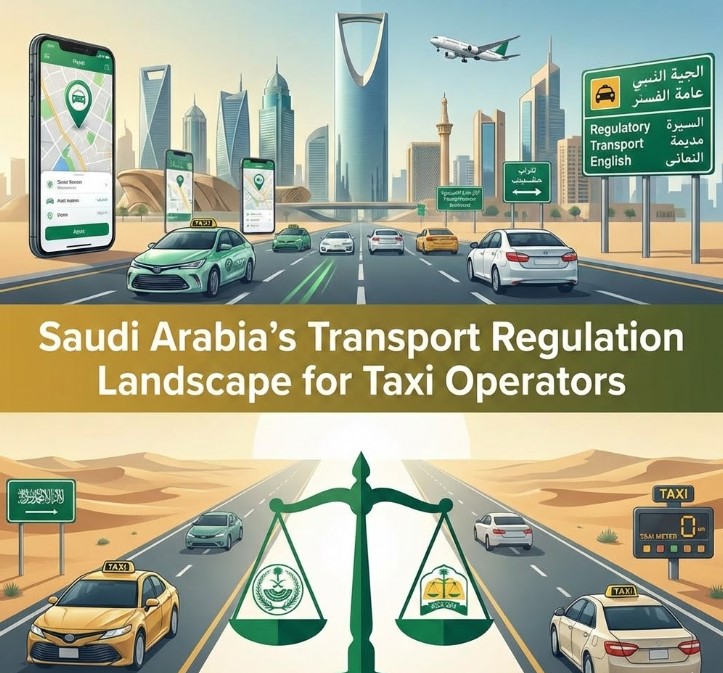
Saudi Arabia’s Transport Regulation Landscape for Taxi Operators
Once the broader reasons behind regulation and global mobility trends are clear, the next question becomes what actually applies on the ground.
In Saudi Arabia, transport regulation now operates within a centralized national framework that directly influences how fleets are licensed, supervised and penalized as part of their everyday operations.
For Saudi Arabian taxi operators and Saudi Arabian luxury transport companies, compliance is no longer a theoretical concept. It is embedded into daily decision making and operational execution.
Who Regulates Taxi and Fleet Operations in Saudi Arabia
Taxi and fleet activities across the Kingdom fall under the authority of the Transport General Authority (TGA).
The TGA is responsible for issuing licenses, defining service categories and setting the compliance standards that operators are required to meet.
In recent years, digital enforcement has expanded alongside traditional physical inspections. Regulators now rely not only on roadside checks, but also on system-based monitoring that uses trip records, meter data and structured operational reports.
As a result, visibility into daily fleet activity continues to increase, regardless of whether an operator manages a small local fleet or a large-scale operation.
Key Compliance Categories for Taxi and Chauffeur Fleets
Saudi transport regulations clearly distinguish between different service models. The most common compliance categories include:
- Public taxi licensing
- Airport taxi service rules
- Family taxi classification
- Chauffeur and luxury transport permits
Each category comes with its own operational boundaries, vehicle standards and driver qualification requirements. Misclassification is no longer viewed as a commercial workaround and is now treated as a direct regulatory violation.
Enforcement and Penalty Structure (High-Level)
Regulatory enforcement in Saudi Arabia concentrates primarily on unlicensed operations, incorrect or improper meter usage, driver conduct and patterns of repeated violations.
Initial breaches typically result in financial penalties. However, ongoing non compliance can escalate quickly, leading to measures such as vehicle impoundment and license suspension.
Read also: Challenges in Corporate Taxi Services & How Corporate Cab Software Can Overcome Them
High-Level Compliance Areas and Their Risk Exposure
| Compliance Area | Example Violation | Business Risk |
|---|---|---|
| Driver Licensing | Expired permit | Heavy fines |
| Fare Regulation | Meter bypass | Passenger disputes |
| Vehicle Category | Wrong classification | License suspension |
| Data Records | Missing trip logs | Audit failure |
This structure reinforces that compliance is now linked directly to business continuity.
How confident are you that your fleet meets current Saudi transport requirements?
- Fully compliant with documented processes
- Largely compliant, pending formal review
- Uncertain about full compliance status
- No structured compliance framework in place
How Fleet Operators Can Remain Compliant (Overview Only)
Once the regulatory framework is understood, the focus naturally shifts to practice. How can a fleet remain compliant day after day without disrupting operations or slowing growth?
The most effective approach lies in embedding simple, repeatable controls into everyday workflows, rather than responding only after problems become visible.
As the saying goes, the devil is in the details. In transport compliance, those details often determine whether an audit remains a routine review or turns into a costly operational interruption.
Centralizing Operational and Trip Data
A single source of truth sits at the heart of sustainable compliance. When trip data, pricing information and operational records are spread across multiple systems, gaps emerge quickly.
To avoid this, operators should ensure that:
- All bookings are captured within one centralized system
- Complete trip histories are stored with accurate time and route records
- Data retrieval is straightforward during inspections and audits
This level of structured data discipline has become a fundamental element of Saudi Arabian taxi compliance and is increasingly expected by regulators as a baseline standard.
Structuring Driver and Vehicle Onboarding
Many compliance issues originate at the onboarding stage. A clearly structured process helps protect the business long before risks have a chance to escalate.
Key checks at this stage typically include:
- Driver license validation for every onboarded driver
- Background verification, where regulations require it
- Automated tracking of license and permit expiration dates
When onboarding is handled consistently through a dedicated driver management tool, downstream compliance becomes significantly easier to control and maintain.
Aligning Pricing and Trip Records With Regulatory Logic
Transparent pricing is no longer just a commercial preference. It has become a clear regulatory expectation.
Fleet operators are expected to ensure that:
- Fares align with approved pricing structures
- All manual fare adjustments are properly logged
- Digital receipts accurately reflect actual trip behavior
Well-structured fare management helps protect both passengers and operators, particularly when disputes arise or audits are conducted.
Preparing for Audits and Corporate Compliance Checks
Hotels, airlines and corporate travel departments are increasingly requesting clear compliance evidence before committing to recurring transport volumes.
To remain prepared, fleet operators should:
- Maintain well-structured audit trails
- Document standard operating procedures in a consistent and accessible way
- Treat compliance as a long-term trust asset rather than a one-time legal requirement
This mindset helps build credibility not only with regulators, but also with corporate partners who rely on predictable, compliant transport services.
Read also: Revenue Strategies: Increase Your Taxi Fleet’s Profit by 30% Without Hiring More Drivers
Why Every Operator Now Needs a Dedicated Taxi Compliance Guide
As transport regulations become more structured and enforcement more consistent, many fleet operators continue to rely on memory, spreadsheets and informal checks to manage compliance.
This approach often increases risk rather than reducing it. What once felt manageable gradually creates blind spots that only become visible during audits, partner evaluations or customer disputes.
Why Memory and Spreadsheets Are No Longer Enough
Manual compliance management introduces silent exposure. Records are missed, documents expire without notice and procedures begin to vary depending on the person or shift responsible.
Over time, these small inconsistencies accumulate into regulatory and commercial risk that becomes difficult to correct once formal action has already been triggered.
What a Structured Taxi Compliance Guide Should Cover
A well-structured compliance guide brings clarity to daily operations by standardizing essential control areas, including:
- Licensing checkpoints
- Driver audit trails
- Trip record policies
- Data retention rules
- Pricing traceability
By formalizing these elements, fleet operators can move away from reactive control and toward consistent, day-to-day readiness, ensuring that compliance supports operations instead of disrupting them.mpliance Guide – Free Download. It is designed as a working reference that teams can use day after day, not just during inspections.
Compliance as a Foundation for Sustainable Fleet Operations
In a regulatory environment that continues to evolve, compliance is no longer just about avoiding penalties or passing inspections. It has become a reflection of how professionally a fleet operates, how reliably it serves passengers and how confidently it works with corporate partners.
For operators in Saudi Arabia, this shift is especially visible. As oversight becomes more data-driven and expectations continue to rise, fragmented processes and informal controls increasingly work against the business rather than in its favor. What makes the difference today is not reacting faster, but operating with structure from the start.
At Codico, this understanding comes from working closely with fleet operators who manage compliance as part of their everyday operations, not as a separate obligation. When dispatch, pricing, driver management and trip records are aligned within a single operational flow, compliance becomes a natural outcome rather than a recurring challenge. This is where modern tools, such as taxi dispatch software, support consistency, transparency and readiness without adding complexity to daily work.
In the long run, fleets that treat compliance as an operational asset build more than regulatory stability. They build trust with passengers, confidence with corporate clients and a foundation for sustainable growth in a market where reliability increasingly defines success.