


 Subscribe
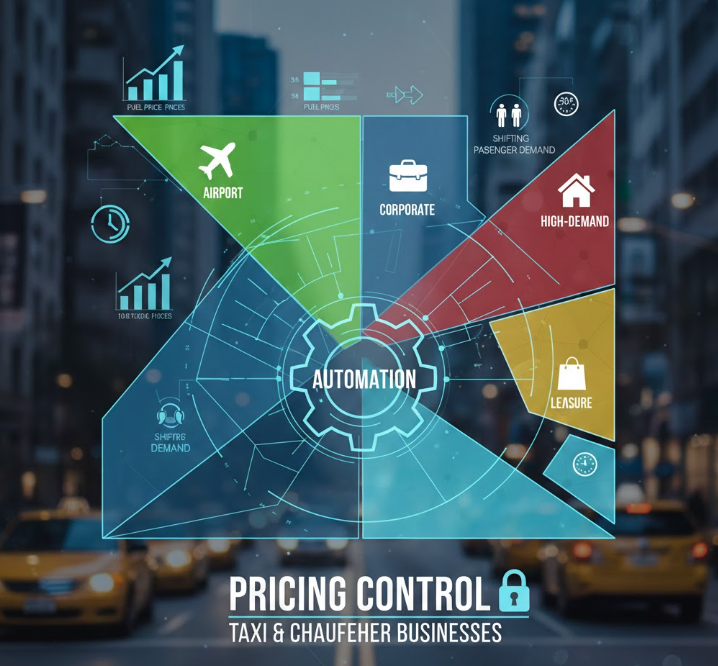
Pricing control has become one of the most delicate operational challenges for today’s taxi and chauffeur businesses, especially as operations expand beyond a single city or service area. Rising fuel costs, shifting passenger demand, airport fixed fares, and strict corporate travel agreements all place constant pressure on how rates are defined and maintained. Without reliable dispatch taxi software, keeping pricing consistent and transparent quickly becomes difficult. This is where platforms like codico.io help operators replace fragile manual workflows with structured and scalable fare control.
On a daily level, pricing decisions are influenced by far more than distance or trip duration. Fuel volatility, time based demand patterns, fixed airport tariffs, and contract bound corporate rates all interact at the same time. Managing these variables manually creates friction between dispatch teams, drivers, and customers, especially as booking volume increases.
In this environment, relying solely on distance based or time based pricing is no longer enough. These models struggle to reflect real world conditions such as congestion, predictable travel corridors, and commercially sensitive routes where price stability matters more than meter accuracy.
This is where zone pricing and structured zone management become essential for modern taxi operations. By defining clear geographic areas and applying consistent pricing logic to them, operators gain tighter margin control while keeping fares predictable for passengers, partners, and corporate clients.
There is a simple rule in transport operations: if something cannot be measured, it cannot be managed. Businesses that continue to rely on manual pricing methods quickly face limits in visibility and flexibility as fleets grow and service areas expand.
Over time, these limitations surface as revenue leakage, recurring billing disputes with corporate customers, and operational delays caused by manual fare corrections or driver clarification requests.
In this guide, you will learn how zone management works in real operations, why manual zone pricing fails to scale in growing taxi and chauffeur businesses, and how automation is reshaping fare control across cities, airport routes, and high demand travel corridors.
To understand how pricing control can remain stable as operations grow, it is important to first clarify what a zone actually represents within transport and fleet management systems.
What Is a Zone and Zone-Based Pricing
A zone is a clearly defined geographic area within a city or service region where specific fare rules apply. Zones are usually built around real travel patterns rather than administrative borders. Airports, city centers, hotel districts, exhibition areas, and business parks are common examples.
Instead of calculating every trip purely by distance or driving time, zone-based pricing sets the fare based on where a ride begins and where it ends. Once the pickup zone and drop off zone are identified, the price is determined by predefined rules.
This approach gives operators far more control over pricing on high frequency routes such as airport transfers, corporate travel corridors, and hotel to venue connections. These are routes where passengers expect clarity and consistency rather than a fare that changes with every traffic fluctuation.
It is useful to clearly distinguish zone pricing from the other pricing models many taxi and chauffeur businesses still rely on.
Read also: Boost Revenue with Key Features of Taxi Booking Software
Comparison of Zone Pricing vs Distance and Time-Based Pricing
| Pricing Model | How the Fare Is Calculated | Key Behavior |
|---|---|---|
| Zone Pricing | Fare is determined by the predefined pickup and drop zones | Fixed, predictable, corridor focused pricing |
| Distance-Based Pricing | Fare changes with every kilometer traveled | Continuously increases with trip length |
| Time-Based Pricing | Fare depends on traffic movement and waiting time | Fluctuates with congestion and delays |
While distance and time based models react to vehicle movement, zone management is driven by location logic. The fare logic is decided before the trip starts, not while the vehicle is already on the road.
This makes pricing far more predictable for operators and noticeably more transparent for customers. Passengers know the fare in advance, and dispatch teams avoid constant recalculations caused by traffic or route changes.
Cities naturally develop demand pockets and travel corridors. Morning airport departures, evening business returns, hotel check in peaks, and event related traffic all follow repeatable geographic patterns. That is exactly why zones perform so well in urban and intercity transport.
In live operations, these pricing models translate into clearly identifiable geographic demand clusters. When zones are defined correctly, pricing aligns with how people actually move through a city, not just how far a vehicle drives.
What a Zone Means in Taxi and Chauffeur Operations
In day to day taxi and chauffeur operations, zones are built around areas with consistently high demand. These are locations where trips repeat throughout the day and pricing needs to remain stable and easy to explain.
Typical examples include:
- Airport zones that handle constant entry and exit traffic
- Central Business District (CBD) zones with dense office and hotel activity
- Suburban belts connected by frequently used travel corridors
For premium fleets in particular, zone management is a critical part of chauffeur operations. Corporate clients, hotels, and event organizers expect fixed, contract aligned pricing on these routes. Any inconsistency quickly leads to questions, adjustments, and lost trust.
Once these high demand areas are clearly defined, fare calculation follows a predictable and repeatable structure that works across the entire fleet.
How Zone Pricing Works in Simple Terms
At its core, the logic is simple:
Pickup zone + Drop zone = Predefined fare
As soon as both locations fall within configured zones, the system automatically applies the correct fare. The driver does not need to calculate anything manually, and the dispatcher does not need to intervene.
Although the logic behind zone pricing is straightforward, executing it accurately at scale was far more challenging before automation became available.
How Zone Pricing Was Traditionally Handled Manually
Before automation became widely available, most taxi and chauffeur businesses relied on manual processes to manage zone pricing. As trip volumes increased, maintaining fare consistency quickly became difficult. The pricing logic itself was simple, but the way it was executed depended almost entirely on people rather than systems.
The entire workflow was built around human input, paper references, and static files. This left very little room for accuracy, flexibility, or scalability once operations expanded beyond a limited service area.
While zone pricing as a concept is easy to understand, applying it reliably across dozens or hundreds of daily bookings was far more complex in a manual environment.
Manual Zone Definition
In a traditional setup, zones were rarely defined digitally inside a pricing engine or dispatch system. Instead, operators depended on a mix of informal tools and personal knowledge, including:
- Physical paper maps with roughly marked service areas
- Excel files listing zone names and approximate coverage
- Strong reliance on dispatcher experience and memory
This approach only worked while operations remained small and relatively static. As soon as service areas expanded, new routes were added, or staff changed, inconsistencies began to appear.
Once zones were loosely defined, every incoming booking still had to go through a manual pricing workflow.
Manual Fare Assignment Process
When a booking request arrived, the pricing process followed a repetitive and highly error prone routine:
- The dispatcher identified the pickup and drop off locations
- The locations were checked against printed or digital pricing sheets
- The fare was manually entered into the booking system
For operators working under zone management for PHO models, this meant that every single booking depended on individual judgment rather than system logic. Even experienced staff could interpret zones differently during busy periods.
This constant reliance on manual input introduced a range of operational risks that were not always immediately visible.
Common Risks in Manual Zone Pricing
Over time, manual zone pricing exposed businesses to several recurring problems:
- Human error during fare entry
- Fare mismatches between what riders expected and what drivers received
- Increasing disputes with drivers and customers
- Ongoing revenue leakage caused by undercharging
- No centralized audit trail to verify how a price was calculated
A common pattern emerged across many operations. Teams spent more time checking and correcting fares than improving service quality or expanding their business.
These inefficiencies highlighted the limits of manual pricing and ultimately created the need for system driven fare automation.
Read also: Essential Dispatch Programs for Running a Successful Taxi Business
How Automated Zone-Based Pricing Works in Modern Taxi Software
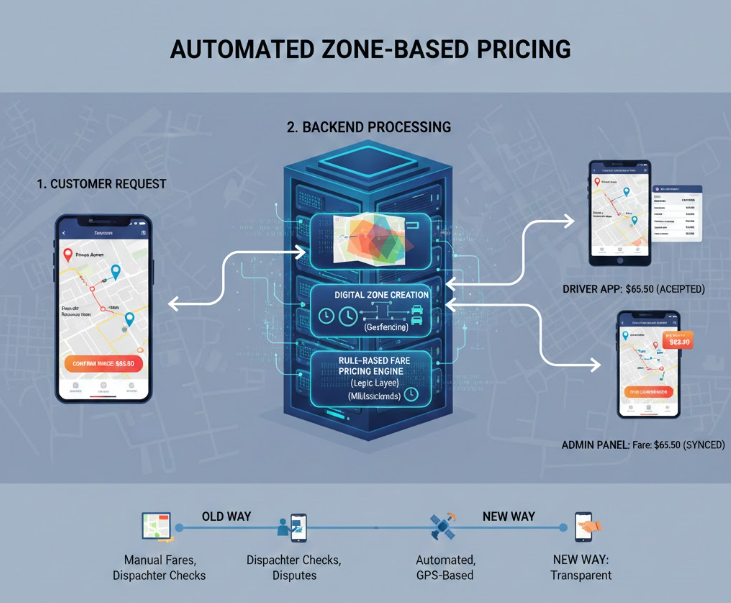
Modern taxi software replaces manual fare handling with map driven automation that operates entirely in the background. Instead of dispatchers checking zones or referencing pricing sheets, fares are calculated automatically at the exact moment a booking is created.
By combining geofencing with system logic, pricing decisions no longer depend on assumptions or human interpretation. Every fare is generated using the same rules, regardless of booking volume or time of day.
At the core of this automation is the shift from physical service areas to digitally defined zones.
Digital Zone Creation with Geofencing
In modern systems, zones are created directly on an interactive live map rather than on paper maps or static spreadsheets. Geofencing tools allow operators to draw precise digital boundaries that reflect how vehicles actually move through a city.
This setup typically includes:
- Polygon drawing to define exact zone borders
- Live map based configuration with street level and zoom accuracy
By mapping zones directly onto real geography, operators eliminate ambiguity around coverage areas. The system always knows whether a pickup or drop location falls inside or outside a specific zone.
This digital foundation is what enables automated zone management. Pricing is no longer based on rough estimates or dispatcher knowledge, but on exact geographic coordinates.
Once zones exist digitally, the next step is attaching pricing logic to them.
Rule-Based Pricing Engine
After zones are defined, pricing rules are layered on top through a rule based pricing engine. Instead of relying on a single variable, the system evaluates multiple conditions simultaneously.
Typical pricing inputs include:
- Pickup zone
- Drop zone
- Service type
- Time band
This allows operators to handle complex real world scenarios, such as higher fares for late night airport transfers, different pricing for premium vehicles, or fixed corporate rates during business hours.
For businesses managing high ride volumes, zone management for taxi operations becomes entirely rule driven. Pricing behavior remains consistent whether there are ten bookings a day or ten thousand.
What Happens at Booking Time
When a customer places a booking, the system executes several steps instantly without manual involvement:
- Automatic zone detection using pickup and drop coordinates
- Automatic fare calculation based on predefined rules
- Real time fare synchronization across the rider app, driver app, and admin panel
All of this happens within milliseconds. The customer sees a confirmed price immediately, the driver receives the same fare details, and the operations team has full visibility without additional checks.
Because pricing is determined before the ride starts, disputes are significantly reduced and billing accuracy improves across the operation.
This fully automated experience reflects how fare systems have evolved over time, moving from human dependent workflows to scalable, system driven pricing logic designed for modern taxi and chauffeur businesses.
How Zone Pricing Evolved from Manual Models to Smart Fare Engines
Zone pricing did not become intelligent in a single step. It evolved gradually as taxi and chauffeur fleets expanded, booking volumes increased, and technology replaced delayed decisions with real time system logic. Each stage of this evolution reflects a growing need for consistency, speed, and control.
Phase 1 – Paper Maps and Fixed Lists
In the earliest phase, zones were drawn by hand on printed maps, and fares were listed on static rate cards. Dispatchers relied heavily on personal experience and memory to interpret these zones during bookings.
This made zone management slow and inconsistent. Pricing accuracy depended on who was on duty, how familiar they were with the service area, and how busy the operation was at that moment.
Phase 2 – Spreadsheet Fare Tables
The introduction of spreadsheets added a basic layer of structure. Zone pairs and corresponding fares were stored in Excel files, making it easier to reference prices and update rate lists.
However, all updates were still manual. As the number of zones, routes, and service variations increased, errors multiplied. Version control issues, outdated files, and accidental overwrites became common problems.
Phase 3 – Digital Fare Tables
With early dispatch software, pricing moved into digital fare tables inside the system. This reduced paperwork and improved access to pricing data.
Despite this improvement, dispatchers still had to manually select the correct fare for each trip. The system stored the data, but human input remained central to execution.
Phase 4 – Rule-Based Automated Zone Engines
True automation arrived with rule based zone engines. Zones were digitally defined, pricing rules were configured centrally, and fares were calculated automatically in real time.
At this stage, automated zone management removed the need for manual fare selection. Pricing logic became consistent across all channels, regardless of booking source or time of day.
Phase 5 – AI-Assisted Pricing Decisions
Modern platforms now build intelligence on top of automated pricing engines. These systems adjust fares using demand patterns, operational load, and historical data, while still respecting predefined zone rules and contracts.
As product teams often note, mature pricing systems do not eliminate human control. Instead, they remove human delay and inconsistency, allowing teams to focus on strategy rather than constant fare validation.
Business Benefits of Automated Zone-Based Pricing
When pricing moves from manual control to system driven logic, the impact goes far beyond simple fare calculation. Automated zone pricing changes how efficiently an operation runs, how reliably revenue is protected, and how confidently a business can scale.
With automation in place, zone pricing becomes faster, cleaner, and far easier to manage across fleets, cities, and customer segments.
Operational Benefits
Once pricing is fully automated, daily operations become more predictable and significantly lighter for dispatch and operations teams.
- No dispatcher involvement is required to calculate or validate fares
- Faster booking confirmation for customers, agents, and corporate partners
- Zero manual fare disputes between drivers and riders
With automated zone management active, teams stop spending time double checking prices and start focusing on service quality, driver performance, and operational efficiency.
Financial Benefits
Automation has a direct and measurable impact on revenue control and margin visibility across the network.
- Revenue leakage is reduced through consistent rule based pricing
- Predictable fares strengthen customer trust and improve contract compliance
- Clear profit visibility by travel corridor and zone pair
Instead of relying on estimates or averages, every route reveals its actual profitability. This allows operators to adjust pricing with confidence and make informed commercial decisions.
Growth and Scaling Benefits
Automated pricing creates a stable foundation for growth without introducing new pricing risks.
- Multi city expansion without rebuilding pricing logic from scratch
- Corporate contract automation using fixed corridor and zone based pricing
- Seasonal pricing control for peak and off peak demand periods
As the business grows, the pricing engine scales alongside it. New zones, routes, and cities can be added without increasing administrative load or introducing pricing inconsistencies.
Read also: Why Taxi Businesses Must Upgrade to Modern Taxi Dispatch Software
General Use Cases Where Zone-Based Pricing Is Applied
Zone-based pricing delivers the most value in environments where travel patterns repeat every day and demand consistently flows through the same routes. In these scenarios, zones help taxi and chauffeur businesses standardize fares, protect margins, and simplify both public and contractual pricing.
Across real operations, zones are not an abstract concept. They are a practical response to how passengers actually move through cities and regions.
Airport to City Fixed Fare Zones
This is the most widely used application of zone pricing. Fixed fares between airports and city zones remove uncertainty for passengers and drivers alike. Customers know the price before the ride begins, and drivers are protected from disputes caused by traffic or route changes.
For premium fleets, zone management for chauffeur operators ensures consistent pricing across terminals, hotels, and key business districts. Whether the pickup is at an arrivals gate or a VIP terminal, pricing logic remains stable and predictable.
Hotel and Tourism Corridor Zones
Cities with strong tourism demand depend on predictable pricing between hotels, attractions, cruise terminals, and transport hubs. Zones help prevent overcharging during peak seasons while still protecting operator margins during quieter periods.
By defining hotel clusters and attraction corridors as zones, operators maintain pricing balance even when demand fluctuates sharply throughout the year.
Corporate Travel Zones
Corporate clients typically expect pre agreed rates for recurring routes such as office commutes, employee pickups, and airport transfers. Structured zones make this possible without manual handling.
With zone pricing in place, corporate billing becomes predictable, auditable, and aligned with contract terms. Finance teams gain clarity, while operations teams avoid constant fare adjustments and explanations.
Event and Surge Based Temporary Zones
Temporary zones are often created around stadiums, exhibition centers, and festival venues to manage short term demand spikes. These zones allow operators to apply controlled pricing adjustments without affecting the rest of the city.
Instead of disrupting regular fare models, temporary zones isolate event demand and keep pricing logic clean across the network.
Intercity Corridor Zones
High frequency routes between cities benefit from fixed corridor pricing rather than fluctuating per kilometer rates. This approach is especially important for regulated operators and aggregators.
In these cases, zone management for PHO models simplifies compliance and ensures fare consistency across regions, even when trips cross administrative or municipal boundaries.
Once zone pricing is standardized across daily operations, the next level of optimization comes from applying artificial intelligence to refine how fares respond to demand and operational signals.
How Automated Zone Pricing Enables AI-Driven Fare Decisions
Once pricing rules are fully automated, artificial intelligence can operate on top of them to continuously improve accuracy, respond to demand shifts, and protect margins in real time. At this stage, automated zone management evolves into intelligent fare control rather than simple rule execution.
Automation creates the stable foundation AI needs. Without consistent zone logic and clean pricing rules, intelligence cannot be applied reliably.
AI for Demand Prediction by Zone
AI analyzes historical booking data at zone level rather than treating the city as a single market. It studies ride volume, booking peaks, weekday and weekend patterns, and seasonal movement inside each defined zone.
By understanding how demand behaves in specific areas, the system can anticipate where pressure will build next. This allows operators to rebalance supply earlier, adjust driver positioning, and avoid service gaps before they impact customers.
In practice, this means fewer last minute shortages around airports, business districts, or event venues, and smoother operations during predictable demand waves.
AI for Temporary Price Adjustments
When unexpected conditions arise, such as large events, traffic disruptions, or severe weather, AI can recommend short term fare adjustments within predefined limits.
These adjustments remain anchored to existing zone rules, ensuring flexibility without breaking fixed fares, corporate agreements, or regulated corridor pricing. Instead of reactive manual changes, pricing adapts in a controlled and transparent way.
This balance allows zone pricing to remain stable while still responding to real world operational pressure.
AI for Detecting Mispriced Corridors
AI also plays a critical role in continuous pricing validation. By monitoring live performance across zone pairs, the system can identify corridors with recurring issues.
If a specific route consistently shows low margins, frequent cancellations, or driver pushback, AI flags it for review. This helps operators correct pricing gaps early instead of absorbing silent losses over time.
Rather than relying on periodic manual audits, pricing stays aligned with actual operating costs, traffic behavior, and service expectations.
Conclusion
Pricing control in taxi and chauffeur operations is no longer about choosing between distance or time based models. As fleets grow, service areas expand, and demand patterns become more complex, sustainable pricing requires structure, visibility, and automation.
Zone-based pricing provides that structure by aligning fares with real geographic demand and predictable travel corridors. When zones are managed manually, the model quickly reaches its limits. Automation removes inconsistency, reduces disputes, and creates a reliable foundation for scaling operations across cities, contracts, and customer segments.
Modern dispatch taxi software takes this one step further by transforming zone pricing into a system driven process rather than a human dependent task. When zones, rules, and fares are defined centrally, pricing becomes consistent across every booking channel and operational touchpoint.
Platforms like codico.io are designed around this exact reality. By combining automated zone management with rule based pricing and intelligent fare logic, Codico helps taxi and chauffeur businesses maintain control as they scale. The result is not just faster pricing, but clearer margins, stronger contracts, and operations that can grow without pricing becoming a risk factor.
As the industry continues to evolve, pricing systems that are measurable, auditable, and adaptive will define which operators can scale with confidence. Zone-based automation is no longer a technical upgrade. It is a strategic requirement for modern taxi and chauffeur businesses.