


 Subscribe

Phone calls are still at the core of many taxi operations. For years, that model has felt reliable. As long as demand stays predictable, it holds together.
A passenger calls. Someone at dispatch picks up. The ride is written down or entered into the system. Car assigned. Done.
It works. Until it doesn’t.
The pressure begins the moment volume increases. During peak hours, phones don’t ring one by one. They ring all at once. Dispatchers try to keep up while screens flash, drivers call back, and passengers wait on hold. Some callers stay patient. Others hang up. A few never try again.
At first glance, this seems like a staffing problem. Hire more people, extend shifts, add another line. But the issue runs deeper than headcount. It’s a structural limitation built into phone-based taxi booking itself.
The model depends entirely on human availability. If someone cannot answer, the booking does not exist. Demand may be there. Drivers may be available. But without a person to catch the call, revenue simply disappears.
Even companies running modern taxi booking software often remain tied to phone confirmations and manual input. The technology sits in the background while calls still drive the process. As volume grows, that dependency quietly turns into friction. Bookings take longer. Mistakes increase. Stress levels rise inside the dispatch room.
What once felt manageable becomes expensive. Not just financially, but operationally.
This article explores why phone-based taxi booking struggles when demand spikes, and what changes once bookings no longer rely solely on someone being available to answer a ringing phone.
Problem 1 – Every Phone Booking Adds to Your Payroll
Every time the phone rings and a booking comes in, someone has to handle it. Not just pick up, but listen carefully, confirm pickup details, repeat addresses, check driver availability, and enter the trip into the system.
Even a short call carries a cost.
In a phone-based taxi booking model, capacity is directly tied to people. If bookings increase, staffing must increase with them. There is no way around that. Ten additional rides mean ten additional conversations. A surge in demand means more agents on shift.
Many operators rely on taxi booking software to dispatch vehicles and monitor trips. The backend may be modern and efficient. But if new requests still come through phone calls, the system depends on human input at the very first step.
That creates a hidden dependency on call agents.
As volume grows, so does the internal pressure:
- More calls require more agents
- Busy hours demand overlapping shifts
- Events and peak periods push overtime
- New hires need training before they become productive
- Staff turnover repeats the entire process
Supervisors step in when mistakes happen. A wrong address entered in a hurry. A missed detail. A duplicate booking. Each correction consumes time and attention that could be spent elsewhere.
Over time, taxi call center cost becomes one of the largest fixed expenses in the business. It does not spike overnight. It expands gradually. A few extra hires this quarter. Longer shifts next month. Another layer of oversight to maintain quality.
What does not expand at the same pace is efficiency.
Booking speed does not automatically improve. Accuracy does not dramatically increase. The operation simply becomes more expensive to maintain.
What started as a practical and manageable phone process slowly turns into a cost structure that scales in the wrong direction. The busier the company gets, the higher the cost per booking becomes. Peak hours amplify the problem, especially during mornings, evenings, weekends, and event-driven demand.
This rising cost does not enhance the service. It increases overhead.
Solution – Decouple Booking Capacity from Human Availability
The issue is not the phone itself. It is the reliance on people to process every single booking request.
As long as booking capacity depends on human availability, growth will always mean higher labor costs. Change that dependency, and the economics shift immediately.
An AI-powered taxi booking system can handle incoming requests automatically. It does not wait for an available agent. It does not slow down when multiple calls arrive at once.
Instead of processing bookings one by one, the system can:
- Answer multiple requests simultaneously
- Capture trip details without manual entry
- Confirm bookings instantly
- Operate continuously without shifts or overtime
Because there are no rotating schedules, no training cycles, and no overtime hours, costs remain stable even as booking volume increases.
Capacity expands without increasing headcount. The business pays for capability, not labor hours. As demand grows, booking does not become chaotic or more expensive. It becomes predictable.
And predictability is what allows real scalability.
Read also: Taxi Business Automation: How to Save 6+ Hours a Day and Stop Losing Clients
Problem 2 – When Peak Demand Hits, the Phone Model Cracks
Peak periods do not increase gradually. They arrive all at once.
In a phone-based taxi booking setup, that is where the strain becomes visible. Calls do not queue politely one after another. They land simultaneously. Three, five, ten at a time.
A dispatcher answers the first call. The others immediately move into a waiting line. Some customers hold. Some hang up within seconds. Others try again later. Most of these lost attempts never show up in reports, which makes the damage easy to underestimate.
Consider a morning airport rush. Several flights land close together. Passengers switch their phones on and start dialing. Or picture a rainy evening when public transport slows down and everyone wants a ride home at once.
Phone lines light up. Agents speed up. Voices get shorter. Typing becomes rushed.
But capacity does not change.
Each agent can still handle only one call at a time. Every unanswered call becomes a missed booking, even though demand is clearly there. The business is busy, yet revenue slips through small gaps in the system.
This is where peak hour taxi booking becomes expensive. The structural limits of phone-based taxi booking appear exactly when reliability matters most.
The typical symptoms are familiar:
- Call queues form within minutes
- Busy tones discourage repeat attempts
- Dispatch teams lose visibility into how many callers abandon the queue
- Staff work under pressure, increasing the risk of errors
Adding temporary staff rarely fixes the problem. Demand spikes faster than schedules can adjust. By the time extra coverage is arranged, the surge has already passed.
What remains is frustration on both sides. Passengers who could not get through. Dispatchers overwhelmed by simultaneous requests. Revenue that quietly disappeared during the busiest hour of the day.
Peak demand reveals limits that stay hidden during calm periods. And those limits are built into the model itself.
Solution – Eliminate the Queue Instead of Managing It
Trying to manage call queues more efficiently does not solve the underlying issue. It simply organizes the bottleneck.
The real shift happens when queues are removed altogether.
An AI-powered taxi booking system answers incoming requests simultaneously, regardless of volume. Ten calls can be processed at the same time. There is no concept of “next in line” waiting for a free agent.
That changes the dynamics immediately:
- No busy tones during peak demand
- No abandoned calls due to long hold times
- No invisible booking losses
- No manual race against ringing phones
Unlike phone-heavy operations, modern taxi booking software can handle concurrent bookings without being constrained by human bandwidth. Capacity expands the moment demand rises and contracts naturally when volume returns to normal.
During peak hours, bookings remain available and predictable. Dispatch teams are no longer consumed by answering calls. Instead, they focus on coordinating drivers, optimizing routes, and maintaining service quality.
The busiest moments stop being failure points.
They become opportunities.
Problem 3 – Long Wait Times Quietly Push Customers Away
Waiting changes how people feel about a service.
When a phone keeps ringing or a caller is placed in a queue, uncertainty creeps in. Will someone answer? Will the booking go through? Is there even a car available?
Some passengers stay on the line. Many hang up after a short pause. Most never complain. They simply move on.
This is how long wait time taxi booking turns into missed taxi bookings without any obvious warning signs. There is no dramatic failure. No system crash. Just silence.
Trust starts to erode quietly.
From the operator’s perspective, everything may look normal. Calls were answered. Drivers completed trips. The day moved forward. But from the passenger’s side, the experience feels unreliable. If reaching the company requires waiting and uncertainty, the next booking may go to a competitor.
There is no dashboard that shows how many callers never tried again. No alert that says confidence just dropped.
Over time, these small delays accumulate. A few abandoned calls here. A few frustrated passengers there. Gradually, repeat bookings decline. Brand reliability weakens. Not because of poor driving or bad service, but because the first interaction felt unstable.
Silence is often the earliest signal that trust is slipping.
Solution – Remove Waiting From the Booking Experience
The simplest way to reduce uncertainty is to remove waiting altogether.
An AI-powered taxi booking system responds immediately. Calls are processed without sitting in queues. Confirmation happens in real time, even during busy periods.
That first interaction feels different. There is no hesitation. No guessing.
With white label taxi booking software, passengers interact with a system that reflects the operator’s own brand voice and identity. It does not feel outsourced or generic. It feels consistent.
That consistency matters.
When response is instant and confirmation is clear, passengers relax. They know the ride is secured. That confidence encourages repeat bookings and strengthens brand reliability, all without increasing pressure on call center staff or dispatch teams.
Read also: How a Taxi Dispatch System Can Transform Radio Taxi Businesses into Successful Digital Enterprises
Problem 4 – Growth Exposes the Limits of Phone-Based Booking
Growth sounds positive. More trips. More demand. More revenue.
But when bookings rely on people answering phones, expansion creates strain.
As trip volume rises, calls increase. Peak periods stretch longer. Demand becomes less predictable. Hiring rarely keeps up. Recruiting takes time. Training takes time. Scheduling adjustments lag behind real-world spikes.
The limitation is basic capacity math:
- 1 call agent handles 1 active call
- 5 call agents handle 5 active calls
- 10 simultaneous incoming calls mean 5 callers are waiting or leaving
Demand does not arrive in neat sequences. It arrives in bursts. That is why phone based taxi booking struggles to support scalable taxi booking. The structure itself resists expansion.
At a certain point, booking becomes the bottleneck. Drivers may be available. Vehicles may be ready. But if calls cannot be processed quickly enough, growth stalls at the entry point.
Everything downstream depends on that first interaction.
Solution – Remove Human Limits From Booking Capacity
The turning point comes when booking capacity is no longer tied to headcount.
An AI-powered taxi booking system handles multiple requests simultaneously. There are no queues forming because of limited staff. Capacity expands instantly when demand increases.
Instead of scaling people, the business scales capability.
With white label taxi booking software, this system operates under the company’s own brand and remains available around the clock. Bookings do not depend on office hours or shift coverage. They do not slow down during holidays or sudden demand spikes.
Growth no longer adds stress to booking teams. It flows through infrastructure designed to absorb volume.
Operators can increase trip numbers without constantly redesigning staffing plans or absorbing higher operational costs each time demand rises. The booking layer stops being a constraint and starts becoming a foundation for sustainable expansion.
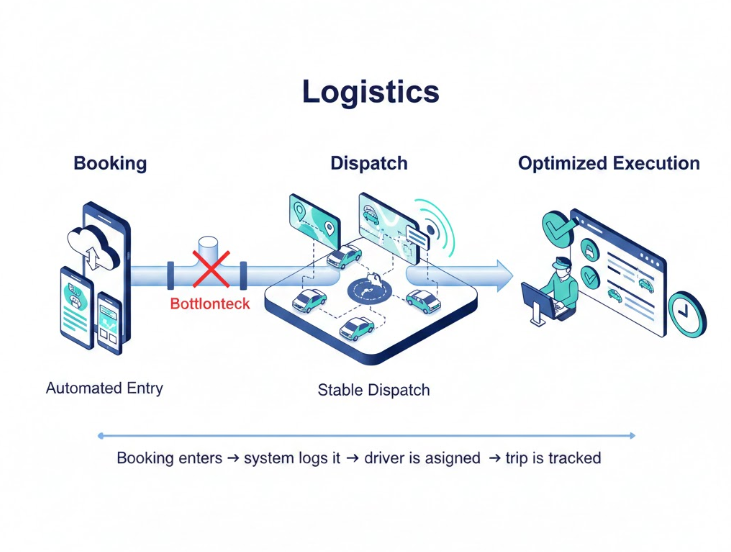
When Booking Stops Being the Bottleneck
Everything changes once booking is no longer the fragile point in the chain.
When the entry point becomes stable, the rest of the operation settles into place. The shift is noticeable, not because something dramatic happens, but because pressure disappears from areas that used to feel tense.
Dispatch Becomes Stable
Bookings enter the system consistently instead of arriving through interrupted phone calls or half-finished conversations. There are no sudden gaps caused by missed calls, and no invisible losses during peak demand.
Dispatch teams work with confirmed requests, not ringing lines.
The rhythm changes. Instead of reacting to interruptions, teams move through a steady flow of trips that are already structured and ready for assignment.
Dispatchers Focus on Execution, Not Interruptions
When booking no longer competes for attention, dispatchers can concentrate on what they are actually trained to do.
They coordinate drivers.
They monitor vehicle locations.
They adjust routes when traffic shifts.
Without constant call handling, busy periods become manageable rather than chaotic. Energy shifts from answering phones to optimizing movement.
Clearer Coordination Between Booking and Dispatch
When trips flow directly into the system, taxi booking software can support assignment and tracking without manual handoffs. There is no retyping of details, no misheard addresses, no need to clarify incomplete information mid-dispatch.
The process becomes linear:
Booking enters → system logs it → driver is assigned → trip is tracked.
That clarity reduces friction across the entire workflow.
Costs Become Predictable
When booking capacity no longer depends on staff availability, volume stops triggering emergency staffing decisions.
There is no last-minute overtime approval because calls spiked. No sudden hiring push because demand increased faster than expected. Resource planning becomes steady instead of reactive.
Costs align with growth instead of jumping unpredictably during peak periods.
Peak Hours Feel Controlled
High demand does not automatically mean overload.
Even when call volume rises sharply, booking capacity remains stable. Requests are processed without forming queues or creating internal bottlenecks.
Peak periods stop feeling like operational stress tests. They become normal parts of the business cycle.
Operations Run With Less Pressure
When the system supports the workflow instead of competing with it, daily operations feel different. Quieter. More deliberate.
This is the practical outcome of booking automation. Not just speed, but stability.
When booking stops limiting capacity, the entire operation shifts from reactive to controlled. Reliability improves across dispatch, drivers, and customer experience. And it happens without adding complexity or layering new stress onto the team’s daily work.
Read also: AI for Taxi Business: 10 Simple Ways to Attract More Clients
The Real Shift Happens When Booking and Dispatch Work Together
Phone lines once defined taxi operations. For years, they were the gateway to every ride. But as demand patterns change and customer expectations tighten, that model shows its limits.
The issue is not technology replacing people. It is about removing friction where it slows growth.
When booking is automated and capacity is no longer tied to headcount, something important happens. Dispatch stops operating under constant pressure. Teams gain visibility. Drivers receive assignments faster. Customers experience immediate confirmation instead of uncertainty.
But automation alone is not enough.
To unlock real scalability, there must be integration. AI integration in taxi dispatch is what connects booking intelligence with real-time fleet coordination. It ensures that requests are not only captured instantly, but also routed, assigned, and monitored with precision.
This is where modern taxi businesses separate themselves from outdated models.
With proper taxi dispatching infrastructure in place, supported by intelligent automation, operators move beyond simply answering calls. They build a system that absorbs demand instead of reacting to it.
That is the direction companies like CoDiCo are focused on. Not replacing dispatch teams, but strengthening them. Not removing control, but giving operators better tools to manage growth without increasing operational strain.
When booking, dispatch, and automation operate as one connected system, scalability stops being a theoretical goal. It becomes operational reality.
The future of taxi operations does not revolve around ringing phones. It revolves around structured flow, predictable capacity, and technology that supports every stage of the ride lifecycle.
And for operators ready to grow without multiplying overhead, the next step is clear: integrate AI into taxi dispatching and build infrastructure designed to scale.