


 Subscribe
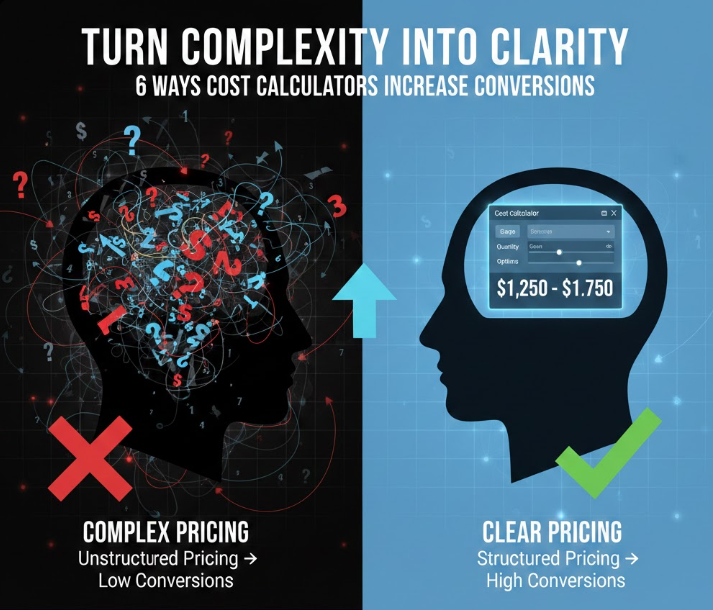
What Happens in a User’s Mind When Pricing Is Unclear
When someone lands on your website, they rarely start with brand perception or feature comparison. The first practical question is simple: How much is this going to cost me? Not after a call. Not after submitting a form. They want at least a reference point immediately.
When that reference point is missing, hesitation appears. And hesitation is not neutral. It changes how the brain evaluates risk.
Unclear pricing increases perceived risk. If users cannot estimate the cost, they fill the gap with assumptions. Most of those assumptions are defensive. Unknown pricing often feels more expensive than transparent pricing, even if the real number is reasonable.
The next step is predictable. Users delay the decision.
When people cannot assess affordability, they postpone action. Online, postponement usually means exit. The user opens another tab, compares alternatives, or simply abandons the idea altogether. Delay reduces conversion probability because the mental momentum disappears.
There is also a control factor. Buyers feel safer when they can evaluate trade-offs themselves. They want to understand how scope, quantity, or options influence cost. If pricing is hidden behind “Contact us for a quote,” control shifts to the business. The user becomes dependent on a sales interaction just to determine basic feasibility.
Perceived lack of control reduces action intent.
At this stage, the issue is not the price itself. It is the absence of structure. People can accept high prices when they understand them. They resist unclear pricing because they cannot evaluate it.
It helps to frame it clearly:
- Complex pricing does not automatically reduce conversions.
- Unstructured pricing does.
- Uncertainty increases perceived risk.
- Higher perceived risk lowers conversion intent.
The number is rarely the real problem. The problem is not knowing what the number might be or how it is formed.
When users cannot form even a rough estimate in their mind, the safest decision is to step away. And in digital environments, stepping away often becomes permanent.
Why a Cost Calculator Changes the Decision-Making Process
When pricing is unclear, users hesitate. But the real shift happens not when a number appears, but when the structure behind that number becomes visible. A cost calculator does not simply display a total. It restructures how the decision is made. Instead of confronting one abstract price, the user moves through a sequence of smaller, manageable choices such as size, material, service level, quantity or duration. Each selection feels simple on its own, and together they build the estimate in a way that feels logical rather than imposed.
This structural shift changes perception. When users see how their inputs affect the total in real time, pricing stops feeling arbitrary. If the cost increases after selecting premium materials, the reason is clear. If the total decreases when reducing scope, the logic is transparent. Visible pricing logic increases perceived fairness, and fairness directly influences trust in online transactions.
Control is another critical factor. A calculator allows experimentation without pressure. Users can test different scenarios privately, adjust variables, and explore budget boundaries before speaking to sales. That sense of control reduces decision stress because the process becomes exploratory rather than confrontational. Instead of asking whether they can afford a fixed number, users start asking how they can configure the offer to match their budget.
Participation also changes commitment. When users actively input data and construct their own estimate, they become cognitively involved in the outcome. Active involvement increases conversion likelihood because people are more inclined to act on results they helped create.
From a sales perspective, the impact is equally practical. A cost calculator answers feasibility questions before direct contact begins. Users already understand whether the offer fits within their approximate budget range. This reduces unqualified inquiries and shortens the sales cycle. A cost calculator increases conversions not because it shows a price, but because it structures uncertainty into a sequence of understandable decisions.
Read also: Quick Guide to Building a Custom Calculator for Your Website in 12 Clear Steps
| Aspect | Static Pricing | Cost Calculator |
|---|---|---|
| Pricing Visibility | Single fixed number | Step-by-step structured estimate |
| User Control | Low | High |
| Perceived Risk | Higher | Lower |
| Lead Qualification | Minimal | Built-in self-selection |
| Conversion Impact | Depends on trust | Driven by clarity |
Where Cost Calculators Have the Strongest Impact
A cost calculator does not create value everywhere. If pricing is fixed and identical for every customer, the effect is minimal. The strongest impact appears when pricing depends on variables and customers cannot confidently estimate the total on their own.
This usually happens in businesses where:
- the final cost depends on multiple inputs
- each order is slightly different
- customers need a rough estimate before contacting sales
- pricing involves trade-offs between scope and budget
Custom manufacturing is a clear example. When price depends on size, material, production method and quantity, customers simply cannot calculate the total mentally. Internal pricing logic may be clear for the company, but for the buyer it feels opaque. A calculator translates that internal logic into visible steps. The user enters dimensions, selects materials, adjusts quantity, and sees how each choice affects the total. What used to be hidden complexity becomes structured interaction.
Service businesses face a similar challenge. Renovation, cleaning or installation work rarely has a flat rate. Scope defines cost. When no reference point is provided, potential clients hesitate because they cannot assess feasibility. A calculator gives them a structured estimate before contact. It answers a simple but critical question: is this within my range? Once that uncertainty is reduced, inquiry becomes more likely.
Customization-based product businesses operate at the intersection of creativity and budget. Florists, designers and personalized goods providers deal with customers who want flexibility but also financial control. When price updates in real time as options change, increases feel logical rather than surprising. Real-time updates reduce price shock because the cause of every adjustment is visible.
Event services amplify the effect of structured estimation. Guest count, menu selection, staffing and additional services all influence the total. Without structure, pricing feels unpredictable. A calculator turns event planning into structured budgeting. As variables change, the total adjusts transparently, making complexity manageable instead of intimidating.
The pattern is consistent. The more variable the pricing, the greater the impact of structured estimation. A cost calculator is most powerful where uncertainty is highest.

Cost Calculators as a Lead Qualification Tool
Most businesses think about cost calculators as a convenience feature. In reality, their impact on lead quality is often more important than their impact on volume.
When pricing is completely hidden, anyone can submit an inquiry. People with unrealistic budgets, vague requirements or no real intent will still fill out a form because they have nothing to filter themselves against. This creates noise in the sales pipeline.
A cost calculator introduces structured self-selection.
When users see an estimate based on their own inputs, they immediately understand whether the offer fits their financial expectations. Some will adjust scope. Some will leave. And that is not a loss. It is qualification happening automatically.
Cost calculators allow users to self-select based on budget and requirements.
This changes the sales dynamic in several ways:
- fewer unqualified inquiries
- clearer expectations before first contact
- shorter explanation cycles
- higher intent at the moment of conversation
Instead of starting with “How much does this cost?”, the conversation begins with “I configured this option and want to move forward.” That difference is significant. It means the feasibility stage has already happened.
There is also an effect on average order value. When users can experiment with options and immediately see how upgrades affect the total, they are more likely to explore higher-tier configurations. The key is transparency. If the increase is logical and proportional, it feels reasonable rather than forced.
Transparent upgrade logic can increase average deal size because the user sees value-to-price alignment in real time.
From an operational perspective, qualification reduces internal pressure. Sales teams spend less time answering basic pricing questions and more time handling serious prospects. This improves efficiency per deal and reduces cost per acquisition.
A cost calculator does not just generate leads.
It filters them.
And filtered leads convert more consistently than raw traffic.
Read also: Why Standard Contact Forms No Longer Work in 2026 — And What Replaces Them
| User Experience Element | Psychological Effect | Business Outcome |
|---|---|---|
| Real-time price updates | Increased perceived fairness | Higher trust |
| Step-by-step inputs | Increased involvement | Higher engagement |
| Scenario testing | Reduced decision anxiety | Faster decisions |
| Visible pricing logic | Lower perceived risk | Higher conversions |
What Makes a Cost Calculator Increase Conversions and What Breaks It
Not every cost calculator increases conversions. Some actually create more friction than they remove. The difference is not in the idea of a calculator. The difference is in execution.
A calculator increases conversions only when it reduces uncertainty. If it adds complexity, hides results or feels manipulative, it has the opposite effect.
There are several common mistakes.
First, hiding the result behind a form.
If users must enter their email before seeing the estimate, the tool stops being helpful and starts feeling transactional. The moment shifts from exploration to obligation. Early obligation reduces trust.
The estimate should appear immediately. Contact information can be requested after clarity, not before.
Second, overcomplicating inputs.
If the calculator asks for too many technical details, users feel overwhelmed. The purpose of the tool is to simplify internal logic, not to expose internal complexity. Inputs should reflect how customers think, not how accountants calculate.
Good calculators translate business logic into user-friendly steps.
Third, unclear next action.
If the estimate appears and nothing happens next, momentum dies. The moment immediately after calculation is the highest-intent point in the entire journey. At that stage, users are mentally engaged and financially oriented.
The next step must be obvious:
- Book consultation
- Reserve date
- Request detailed proposal
- Confirm configuration
Without a clear action, the calculator becomes an interactive toy instead of a conversion mechanism.
Fourth, unrealistic estimates.
If the final sales price significantly differs from the calculator result, trust collapses. Estimates do not need to be exact, but they must be consistent with real pricing boundaries.
Consistency preserves credibility.
In short, a cost calculator increases conversions when it:
- provides immediate clarity
- simplifies rather than complicates
- respects user control
- leads directly to a defined next step
It reduces conversions when it:
- delays results
- overwhelms users
- hides logic
- disconnects from real pricing
The tool itself is neutral.
Its structure determines its impact.
Read also: WordPress Marketing Tools: How to Grow Traffic, Leads, and Sales
| Business Condition | Calculator Recommended? | Reason |
|---|---|---|
| Fixed pricing | No | No variability to structure |
| Variable scope | Yes | Scope defines cost |
| Custom manufacturing | Yes | Multiple pricing inputs |
| Event services | Yes | Dynamic variables |
| Simple digital product | Usually No | Clear fixed pricing |
Final Thought: Clarity Is Not a Feature. It’s a Conversion Strategy.
If there is one practical takeaway from everything above, it is this: conversion rarely fails because people dislike your offer. It fails because they cannot evaluate it fast enough to feel safe.
Complex pricing is not the enemy. Unstructured pricing is.
A cost calculator works when it gives users a clear path through uncertainty. It turns “I’m not sure” into “I can see how this is priced,” and that shift matters because it changes the quality of attention. When people understand the logic, they stop bracing for hidden costs and start making decisions.
This is also why calculators should not be treated as a decorative widget. In real projects, the calculator becomes a core element of Web Development because it shapes the user journey, the pacing, and the moment where intent peaks. It becomes a data engine once it is connected to CRM Systems, because the configuration a user builds is not just a number, it is a structured lead profile that sales can act on. And it becomes smarter over time with AI Integration, because pricing patterns, drop-off points, and common configurations can be used to improve estimates and guide users toward the right options.
In the end, the best pricing experience is not the one that looks impressive. It is the one that makes a complex decision feel simple, fair, and controllable.
Clarity reduces perceived risk.
Lower risk increases confidence.
Confidence is what turns interest into action.