


 Subscribe

A few years ago, building an Uber clone sounded like a bold move. Today it sounds vague. The market has changed, expectations have changed, and the technical bar is much higher than many founders realize.
Ride-hailing is no longer a “startup idea.” In many cities, it’s basic infrastructure. Passengers expect real-time tracking, transparent pricing, smooth payments, and drivers who actually show up. Drivers expect stable demand and a system that doesn’t crash during peak hours. Regulators expect compliance from day one.
So when someone starts researching uber like app development, what they’re really asking is this: how much does it actually take to enter this market without making an expensive mistake?
Because an Uber-like platform is not just a mobile app. It’s a full operational system — passenger app, driver app, dispatch logic, payments, backend infrastructure, reporting, compliance. All of it running in real time. And the complexity behind that system is where costs either stay manageable or spiral out of control.
In this article, we’ll look at what building such a platform really involves in 2026, what it actually costs, where founders usually underestimate risk, and how to approach the launch in a way that doesn’t lock you into the wrong decision from the start.
Reality Check: Building a Ride-Hailing App in 2026 Is Not What It Used to Be
A few years ago, saying “we want to build an Uber clone” sounded ambitious. In 2026, it sounds unfinished.
Ride-hailing is no longer a fresh idea. In many markets, it’s basic infrastructure. People don’t compare you to a taxi company anymore — they compare you to the apps they already use every day.
Passengers expect real-time tracking that actually works, upfront pricing without surprises, smooth payments, and drivers who arrive on time. Drivers expect stable demand and an app that doesn’t freeze in the middle of peak hours. Regulators expect compliance from day one. Investors expect efficiency, not experimentation.
So when founders start researching uber like app development, they’re usually not chasing features. They’re trying to answer a harder question:
Can we enter this market without making an expensive mistake?
Can we build something competitive without burning through hundreds of thousands of dollars?
The answer is yes — but only if you’re clear about what you’re building.
Because an “Uber-like app” is not just a mobile interface with a map and a booking button. It’s a real-time operational system. At minimum, it includes:
- a passenger app,
- a driver app,
- a dispatch and matching engine,
- payment processing infrastructure,
- scalable cloud hosting,
- compliance and reporting layers,
- analytics and monitoring tools.
All of these pieces run at the same time. All of them depend on each other. And this interconnected complexity is where budgets either stay under control — or spiral very quickly.
In this guide, we’re not going to repeat generic startup advice. We’ll look at what a modern ride-hailing platform actually involves in 2026, what it realistically costs to build and maintain, where founders underestimate risk, and how to approach launch decisions without locking yourself into the wrong path.
No hype. No inflated promises. Just a realistic look at what it takes to enter the ride-hailing market today.
Read also: How a Taxi Dispatch System Can Transform Radio Taxi Businesses into Successful Digital Enterprises
How Much Does It Really Cost to Build a Ride-Hailing Platform in 2026?
This is where the conversation usually starts.
What is the real cost to build an Uber-like app in 2026?
The answer isn’t a single number. It depends on what you’re actually trying to build.
For some founders, it’s a one-city test. For others, it’s a fully operational platform handling thousands of rides per day. And some are already thinking about multi-city expansion. Those are very different ambitions — and very different budgets.
Let’s start with what most people call an MVP.
MVP: The Minimum That Actually Works
There’s a common belief that an MVP in ride-hailing can be small and inexpensive. In reality, even a minimal working version still needs:
- a complete passenger booking flow,
- a separate driver app,
- real-time dispatch and ride matching,
- payment gateway integration,
- an admin dashboard for operations,
- basic reporting and monitoring.
If any of these pieces are missing, the system doesn’t function properly. It becomes a demo — not a business.
In 2026, a realistic budget for a working MVP usually starts around $120,000–$180,000, depending on the development team, region, and architecture choices.
At this stage, you’re not paying for design polish. You’re paying for stability. You’re paying for a foundation that won’t fail the moment real drivers and passengers begin using it.
Where the Budget Actually Goes
To understand taxi app development cost realistically, you need to break the number down.
Most of the budget doesn’t go into what users see. It goes into what keeps everything running behind the scenes.
Cost Breakdown in 2026
| Component | Estimated Cost Range | Why It Costs This Much |
|---|---|---|
| Backend development | $80k–150k | Real-time dispatch, pricing engine, scalable architecture |
| iOS app | $40k–70k | Native performance and UX optimization |
| Android app | $40k–70k | Device fragmentation and OS compatibility |
| Admin panel | $25k–60k | Operational logic, reporting, integrations |
| QA & testing | 15–20% of total | Stability, security, load testing |
| Cloud infrastructure | $2k–10k/month | Hosting, APIs, auto-scaling, data storage |
Backend development is almost always the largest cost driver. Real-time ride matching, GPS tracking, and dynamic pricing must work instantly and reliably. The system has to survive peak demand and scale without breaking.
This isn’t a simple CRUD app. It’s distributed system engineering.
Trying to save money on architecture often leads to expensive rewrites later — and that’s usually far more costly than doing it properly from the start.
Development Timeline
Cost is only half the equation. Time is the other half — and it’s just as expensive.
Custom ride-hailing app development rarely happens overnight. Even in well-organized teams, the process usually looks like this: a couple of months for planning and architecture, several more for core development, and then additional time for testing and stabilization. In practice, you’re looking at six to twelve months before the platform is truly operational.
And during that time, the clock is running.
Capital is locked in development. Market conditions can change. Competitors continue improving their products. Driver availability shifts. Regulations evolve. By month four or five, many founders start feeling the pressure — not because development failed, but because reality keeps moving while they’re still building.
That’s when a new question appears: are there costs we still haven’t accounted for?
Read also: Starting a Taxi Business: What You’ll Need and How Much It Costs
The Hidden Costs Most Founders Discover Too Late
The development budget is only the visible part of the investment.
What surprises most founders isn’t how much it costs to build the platform. It’s how much it costs to operate it.
Once the system goes live, expenses don’t stabilize. In many cases, they grow.
Take infrastructure. Cloud hosting isn’t a flat monthly fee. As ride volume increases, so do server usage, database load, real-time GPS processing, mapping API calls, and payment transactions. A platform handling 1,000 rides per day operates under very different infrastructure costs than one handling 20,000. Auto-scaling keeps the system stable, but it also means your monthly bill fluctuates. Founders who only calculate development cost often underestimate ongoing operational expenses by a wide margin.
Maintenance is another area people misjudge. Mobile operating systems update multiple times per year. Small changes in iOS or Android can affect push notifications, background tracking, payments, or permissions. Add security patches, dependency updates, performance fixes — and maintenance becomes continuous, not occasional. A realistic annual maintenance budget is often 15–25% of the original development cost, yet it rarely appears in early financial planning.
Then there’s driver acquisition. Technology doesn’t create supply — drivers do. Incentives, referral programs, marketing campaigns, onboarding, support teams — these all cost money. In competitive markets, acquiring one active driver can easily cost $100–$300. Without sufficient driver density, ride availability drops, and passenger retention follows. No interface design can compensate for weak supply.
Compliance adds another layer. Ride-hailing is regulated in many regions, and requirements can include local transport licenses, data protection compliance, tax reporting integration, insurance validation, and identity verification. Regulations evolve, and expansion into new cities often means adapting to new legal frameworks. Ignoring this doesn’t reduce cost — it increases risk.
Finally, there’s unit economics.
Consider a simple scenario:
| Metric | Example Value |
|---|---|
| Average commission per ride | $2 |
| Monthly rides | 10,000 |
| Monthly gross commission revenue | $20,000 |
| Development investment | $250,000 |
| Estimated break-even period | ~12–15 months |
That projection assumes steady growth and stable demand. If ride volume dips, break-even stretches further. If marketing costs rise, margins tighten. If driver churn increases, operational costs grow.
Many founders calculate development cost. Fewer calculate whether the model can sustain itself once the platform is live.
And at that point, the conversation changes naturally. It’s no longer just “How much does it cost to build?” It becomes a more important question: what is the smartest way to launch without locking yourself into the wrong structure?way to launch?”
Custom vs White-Label vs Hybrid: Choosing the Right Path
Once the numbers are on the table, the discussion usually becomes calmer. It stops being about ambition and starts being about risk.
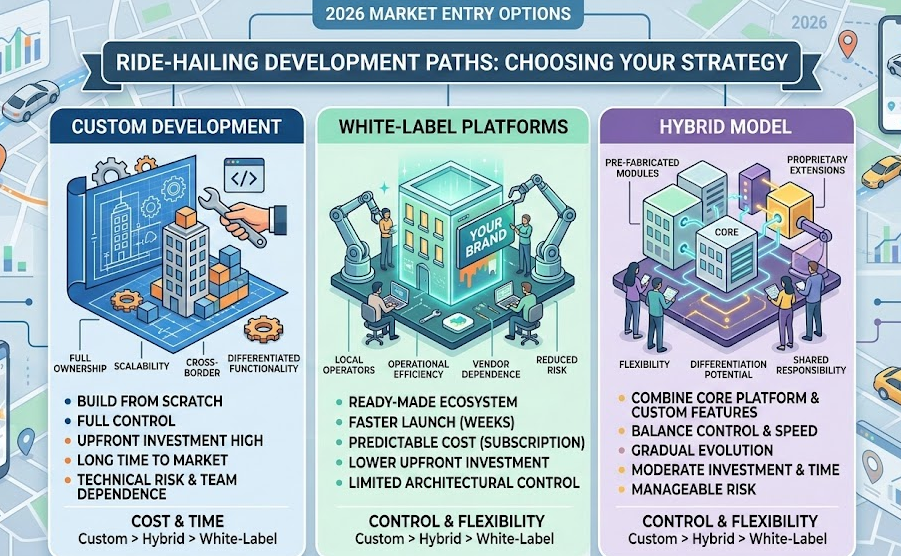
In 2026, there are realistically three ways to enter the ride-hailing space: build everything from scratch, use a white-label platform, or combine both in some form of hybrid model. Each path comes with its own trade-offs — in cost, speed, control, and long-term flexibility.
Custom Development: Full Control, Full Responsibility
Building from scratch gives you complete ownership. You decide how the architecture is structured, how pricing logic works, what integrations are included, how data is stored, and how the system evolves over time.
That level of control makes sense in certain cases — for example, if you have strong funding, if you’re planning multi-city or cross-border expansion, or if your business model depends on proprietary algorithms or differentiated functionality.
But control comes at a price. Upfront investment is higher. Time to market is longer. Technical risk increases. And you remain dependent on a development team for maintenance and iteration. Custom ride hailing app development can absolutely succeed, but it requires disciplined product management and realistic financial planning.
White-Label Platforms: Faster and More Predictable
White-label solutions take a different approach. Instead of building everything from zero, you start with a ready-made ecosystem — passenger app, driver app, admin panel, hosting, updates, and maintenance already in place. You configure, brand, and adapt it to your operations.
The biggest advantage is speed. Launch timelines are often measured in weeks rather than months. Upfront cost is lower, and pricing is usually subscription-based, which makes budgeting more predictable.
The trade-off is flexibility. You’re working within the limits of an existing framework. Architectural control is reduced, and future feature development depends partly on the vendor’s roadmap.
For local or regional operators focused on operational efficiency rather than technological differentiation, this model often reduces risk significantly.
Hybrid Approach: A Practical Middle Ground
A hybrid model sits somewhere in between. You might rely on a stable dispatch core or infrastructure layer, while building custom modules on top — such as analytics tools, pricing models, or integrations specific to your market.
This approach allows you to launch faster than a fully custom build while retaining more flexibility than a standard white-label setup. It can also distribute risk more evenly, especially for companies that want scalability without committing to a full-scale engineering investment from day one.
Here’s how the three paths typically compare:
| Factor | Custom Development | White-Label | Hybrid Approach |
|---|---|---|---|
| Upfront cost | High | Low | Medium |
| Time to launch | 6–12 months | Weeks | 3–6 months |
| Technical control | Full | Limited | Balanced |
| Long-term flexibility | High | Medium | High |
| Operational risk | High | Low | Moderate |
| Maintenance burden | High | Included | Shared |
There is no universal answer. The right decision depends on your market size, funding availability, risk tolerance, technical capacity, and long-term goals.
And that leads to the more important question: if full custom isn’t always justified and white-label isn’t always flexible enough, what does a smarter launch strategy actually look like in 2026?mart launch strategy actually look like in 2026?
The Smart Way to Launch in 2026
By this point, one thing should already be obvious: the biggest risk in mobility platforms isn’t technical complexity by itself. It’s committing to the wrong structure too early.
In 2026, the smartest founders aren’t asking how to build everything at once. They’re asking how to enter the market without trapping themselves in a system they’ll have to rebuild six months later.
A smarter launch starts long before code.
Before committing to full-scale uber like app development, you need clarity on the basics: is there real ride demand in your target area? How saturated is the competition? Is there enough driver supply? What does regulation look like locally? And, most importantly, do the commission margins make sense?
Too many teams invest heavily in architecture before validating unit economics. Technology should follow the business model, not the other way around. A short validation phase can prevent a very expensive correction later.
At the same time, if you do decide to build, the foundation shouldn’t be disposable. Starting small doesn’t mean building something you’ll throw away. It means designing the backend properly from the beginning — modular architecture, clean API layers, scalable cloud infrastructure, flexible pricing logic, and a dispatch system that can grow with demand.
This doesn’t mean overengineering. It means avoiding shortcuts that will cost you later.
Another common mistake is launching everywhere at once. Expanding into multiple cities before stabilizing operations in one almost always creates unnecessary pressure. A more realistic approach is simple: start in one location, optimize ride density, adjust pricing if needed, refine driver onboarding, and only then expand. Growth works best when it’s controlled, not rushed.
Technology also needs to be aligned with business metrics. Your platform should give you visibility into ride acceptance rates, driver churn, customer acquisition cost, average ride margin, and peak-hour performance. If your system can’t show you where money is being made or lost, it becomes a blind investment.
Finally, the build model itself must match your ambition. White-label solutions can reduce early risk and speed up entry. Hybrid models offer flexibility without full engineering exposure. Custom development makes sense when scale and differentiation justify it. The mistake is choosing a structure that doesn’t align with your realistic growth expectations.
In the end, the smartest path in 2026 isn’t about building faster. It’s about building deliberately — with a clear understanding of what you’re entering and what you’re committing to.
Which leads to the final clarity point: who should actually build from scratch — and who shouldn’t?
Read also: How to Choose the Right Taxi Dispatch Software – A Complete Buyer’s Guide
Making the Right Call: Where CoDiCo Fits In
By 2026, launching a mobility platform isn’t about copying Uber’s interface. It’s about building something that can actually operate under real conditions — daily ride volume, peak demand, driver churn, regulatory pressure.
That means thinking beyond design. You need a stable backend, scalable cloud infrastructure, pricing logic that reflects real market dynamics, and a taxi dispatch system that works reliably when demand spikes.
Most failures in ride-hailing don’t happen because the interface looks bad. They happen because the core system wasn’t planned properly. Dispatch logic can’t handle density. Infrastructure wasn’t built to scale. Maintenance wasn’t structured from the start. What looked fine in testing starts breaking under real usage.
At CoDiCo, we don’t start with a predefined solution. We start with the business model.
Sometimes custom development makes sense. Sometimes it doesn’t. In other cases, a hybrid structure is more practical. The point isn’t to push a specific build type — it’s to align the technical decision with the actual scale and ambition of the business.
That may involve designing modular architecture from the beginning. It may involve strengthening dispatch logic to match real ride density. It may involve planning infrastructure in a way that avoids expensive rewrites later.
The principle stays simple: technology should support operations, not complicate them.
Before committing to development, it’s worth stepping back and evaluating technical feasibility, operational readiness, and long-term scalability. That clarity often saves more money than any optimization inside the code.
That’s where experienced guidance makes a difference.
You Should Consider Custom Development If…
1) You have real runway (not just “a budget”)
Custom makes sense when you can fund:
- 6–12 months of build time, plus
- at least 12 months of post-launch maintenance and iteration.
Good signal: you can survive delays without freezing growth.
Bad signal: one missed deadline breaks the business.
2) You’re planning multi-city / cross-border expansion soon
Custom becomes valuable when you need flexibility for:
- different regulations and licensing,
- tax and invoicing variations,
- localization and operational differences across markets.
Good signal: expansion is planned and funded, not “maybe later.”
Bad signal: you’re not sure you’ll even win one city.
3) You need something truly proprietary
Custom is justified when your platform requires:
- unique dispatch or allocation logic,
- advanced pricing models tied to your operations,
- complex enterprise integrations (CRM, corporate billing, SLAs),
- niche compliance requirements that off-the-shelf systems can’t support.
Good signal: your differentiation is operationally necessary.
Bad signal: “we want it to be unique” without a real reason.
4) You can actually operate custom long-term
Custom means you own the responsibility for:
- stability under peak demand,
- OS updates, bug fixing, security,
- infrastructure scaling, monitoring, incident response.
Good signal: you have a technical team or a trusted long-term partner.
Bad signal: you plan to build once and “leave it”.
You Should Think Twice About Custom If…
1) You’re mainly digitizing a local taxi business
If your goal is to modernize bookings and dispatch, custom often becomes an expensive detour. In this case, speed and reliability usually win.
Better focus: operational efficiency, driver adoption, customer retention.
2) Your market is crowded and speed matters
If competitors already run strong apps, waiting 9–12 months can be a real disadvantage.
Rule of thumb: if time-to-market is critical, custom is rarely the best first move.
3) Your unit economics are still unclear
If margins are tight or driver acquisition is unpredictable, large upfront investment amplifies risk.
Better approach: prove traction first, then invest deeper.