


 Subscribe
Taxi companies invest significant effort into attracting customers. They build websites, run advertising campaigns, partner with hotels, and work with travel agencies to increase ride demand.
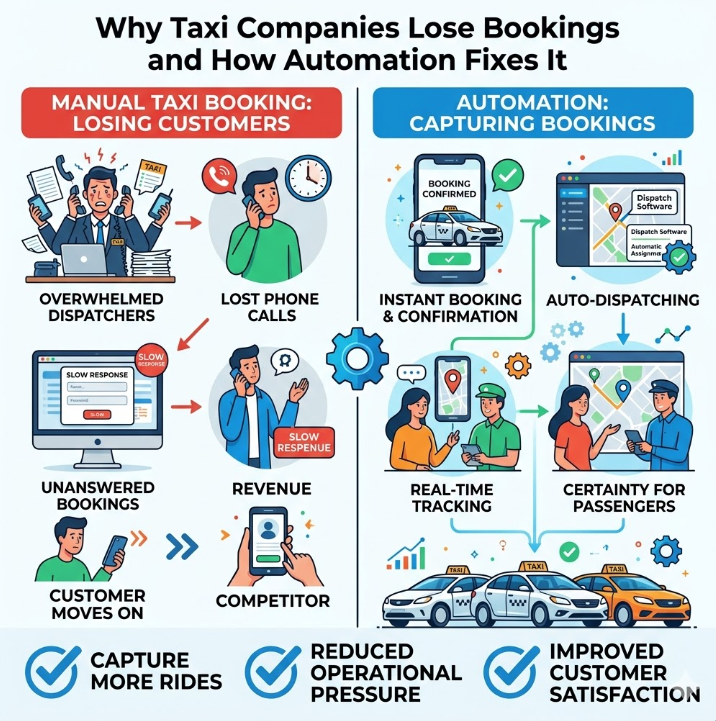
Yet many fleets continue to lose bookings every day.
The surprising part is that these lost rides are not always caused by competitors. In many cases, the problem appears much earlier in the process. A customer tries to book a ride, but the request is not answered quickly enough. A phone call goes unanswered. A website form sits in an inbox for several minutes. A dispatcher is already busy handling other requests.
From the customer’s perspective, the situation is simple. If a taxi company does not respond immediately, they move on and contact another provider.
Over time these missed opportunities accumulate. Even a well-established fleet may lose a significant portion of potential taxi bookings simply because the booking process relies on manual coordination.
Modern passengers expect speed and certainty. They want to know that their ride has been confirmed within seconds, not minutes. When the booking workflow is slow or fragmented, valuable requests slip through the cracks.
In this article, we will explore where taxi companies actually lose bookings, why traditional dispatch methods struggle to keep up with modern demand, and how taxi automation helps fleets capture more rides while reducing operational pressure.
Where Taxi Companies Actually Lose Bookings
Most taxi companies assume that lost rides happen because customers choose another provider with lower prices or faster cars. In reality, bookings often disappear much earlier in the process.
The issue usually starts at the moment a customer tries to request a ride.
A passenger calls during a busy period. The dispatcher is already handling another request. The phone rings for a few seconds and then stops. The customer immediately contacts another taxi company.
A similar situation happens online. A visitor fills out a form on a website or sends a message through a contact channel. The request sits unnoticed for several minutes. By the time someone replies, the passenger has already arranged transportation elsewhere.
These small delays happen constantly. Over time they create a silent gap between demand and actual rides.
Several common situations lead to lost taxi bookings.
- missed calls during peak hours when dispatchers are already managing multiple requests
- delayed responses to online booking forms or emails
- fragmented booking channels such as phone, messaging apps, and website requests
- dispatcher overload during busy periods like airport arrivals or weekend evenings
Another challenge appears when different booking channels are not connected to a central taxi booking system. Phone requests may be written down manually while online bookings arrive through email or messaging platforms. Dispatchers must constantly switch between tools, which increases the chance of delays or mistakes.
From the customer’s perspective, the process is very simple. They are looking for the fastest confirmation possible. If a taxi company cannot respond quickly, they assume the service is unavailable and move on.
For taxi fleets handling dozens or even hundreds of requests each day, these small gaps in the booking process can quietly lead to a significant number of lost rides.
Read also: Where Are Your Leads and Bookings Slipping Away?
The Hidden Cost of Manual Booking Management
When taxi companies think about growth, they often focus on marketing. More advertising, more partnerships, more visibility. The assumption is simple. If demand increases, the number of rides will naturally increase as well.
But this is not always what happens.
If the booking process is slow or disorganized, additional demand can actually make the situation worse. Dispatchers become overloaded, response times increase, and more requests slip through unnoticed.
Many fleets never measure how many rides they lose during this stage. The requests simply disappear. A missed phone call, a delayed message, or a booking request that never reaches the dispatcher in time.
Over weeks and months, these small losses add up.
Consider a simple example. A medium-sized taxi fleet receives around 80 ride requests per day. If only a quarter of those requests fail to convert into confirmed rides because of slow responses or manual coordination, the financial impact becomes significant.
Below is a simplified illustration of how lost requests can affect revenue.
How Lost Bookings Affect Revenue
| Daily Booking Requests | Lost Bookings (25%) | Average Ride Value | Daily Revenue Lost |
|---|---|---|---|
| 40 | 10 | €25 | €250 |
| 80 | 20 | €25 | €500 |
| 120 | 30 | €25 | €750 |
| 200 | 50 | €25 | €1250 |
At first glance the numbers may appear moderate. Yet when these losses repeat every day, the impact becomes substantial. A taxi company losing €500 per day in potential rides could see more than €15,000 in missed monthly revenue.
What makes the situation even more challenging is that most of these losses remain invisible. Without a centralized taxi booking system, it becomes difficult to track which requests were handled, which were delayed, and which were never processed.
Manual booking management may work when request volumes are low. But once a fleet begins receiving dozens or hundreds of ride requests daily, the process quickly becomes difficult to control.
The result is a growing gap between customer demand and the number of rides that are actually completed.
Why Traditional Taxi Booking Methods No Longer Work
For many years, taxi companies relied on a very simple booking process. Customers called the dispatch office, the dispatcher noted the pickup details, and a driver was assigned manually.
When ride volumes were lower, this method worked reasonably well. Dispatchers knew their drivers, calls were manageable, and bookings could be organized without sophisticated tools.
The environment today is very different.
Customers no longer rely on a single communication channel. Ride requests arrive from multiple directions at the same time. A phone call, a website form, a partner platform, or a messaging request may all appear within minutes.
Managing these channels manually creates friction.
Dispatchers must constantly switch between different tools. One request arrives by phone, another through email, another through a messaging platform. Important information may be written down on paper or stored in separate systems. The process becomes fragmented, and response times begin to increase.
Passengers, however, expect immediate confirmation.
When someone books a ride today, they want to know quickly that the request has been received and that a driver is on the way. If confirmation takes too long, confidence disappears and the customer looks for another option.
This growing gap between customer expectations and traditional workflows explains why many fleets struggle with manual dispatch.
The difference between manual coordination and automated processes becomes clearer when the two approaches are compared side by side.
Manual Dispatch vs Automated Dispatch
| Process Step | Manual Booking Management | Automated Dispatch System |
|---|---|---|
| Booking request | Phone call or message | Online booking or integrated request |
| Dispatcher response | Depends on availability | Instant confirmation |
| Driver assignment | Manual coordination | Automatic assignment |
| Ride tracking | Limited visibility | Real-time tracking |
| Booking management | Multiple disconnected tools | Centralized platform |
For fleets handling a high number of daily requests, the limitations of manual coordination quickly become visible. As booking channels expand and customer expectations rise, relying solely on traditional dispatch methods becomes increasingly difficult.
Modern operations require systems that can process requests instantly and keep the entire workflow organized within a single taxi dispatch system.
Read also: Taxi Automation: Two Ways to Handle the Same Booking
How Automation Improves the Booking Process
Automation changes the booking workflow by removing many of the delays that occur in manual dispatch environments. Instead of relying on a dispatcher to notice and process each request, the system reacts immediately.
When a booking arrives, the platform can register the request, confirm availability, and assign a driver within seconds. This speed is often the difference between securing a ride and losing it.
Customers benefit from faster responses. Dispatchers benefit from reduced pressure during busy periods.
A well-implemented taxi automation workflow allows the booking process to run smoothly even when ride demand increases. Rather than manually coordinating every step, the system manages routine tasks in the background.
Automation typically improves several parts of the booking process.
- instant confirmation when a ride request is received
- automatic driver assignment based on availability or proximity
- centralized handling of requests from different channels
- clearer visibility of active rides and upcoming bookings
For example, when a passenger books a ride online, the request immediately appears inside the system. The platform can identify which drivers are available and suggest the most suitable option. The dispatcher can approve the assignment quickly or allow auto dispatch rules to complete the process automatically.
This approach reduces response times dramatically. Instead of waiting for a dispatcher to manually check driver availability, the system already knows which vehicles are active and ready for the next ride.
Automation also improves coordination during peak demand periods such as airport arrivals, major events, or weekend evenings. Rather than creating additional pressure on dispatch staff, the system organizes bookings in a structured way and ensures requests are handled in the correct order.
Over time, this structured workflow allows taxi companies to respond faster, reduce operational friction, and process more bookings without expanding their dispatch team.
What a Modern Taxi Dispatch System Actually Does
A modern taxi dispatch software platform brings structure to the entire booking workflow. Instead of handling requests across multiple tools and communication channels, everything is organized inside a single system.
This centralized approach allows taxi companies to see what is happening across their fleet at any moment. Dispatchers can monitor incoming requests, track drivers, and manage ride schedules without switching between different platforms.
The main advantage is visibility. When all bookings are processed in one place, it becomes easier to react quickly and avoid missed requests.
A typical dispatch platform supports several core functions.
- centralized booking management for phone, website, and partner requests
- automatic driver assignment based on availability or location
- real-time driver tracking during active rides
- scheduling tools for future bookings and airport transfers
- reporting tools that help analyze ride volume and operational performance
For example, when a customer books a ride through a website form or a booking widget, the request appears instantly in the dispatch dashboard. The system identifies available drivers and suggests the best match based on location or schedule.
Dispatchers no longer need to manually call drivers to check availability. The system already displays which vehicles are active, which rides are in progress, and which drivers are ready for new assignments.
Another important advantage is coordination across different booking channels. Instead of handling phone calls, emails, and messaging requests separately, the system organizes them within a unified workflow.
This helps prevent situations where one request is processed while another request is accidentally overlooked.
Over time, a structured dispatch environment allows taxi companies to maintain better control over their operations. The result is fewer missed requests, faster responses, and a smoother experience for both passengers and drivers.
How Automation Helps Taxi Companies Capture More Rides
When the booking workflow becomes faster and more organized, taxi companies begin to notice a clear difference in how many ride requests turn into confirmed trips.
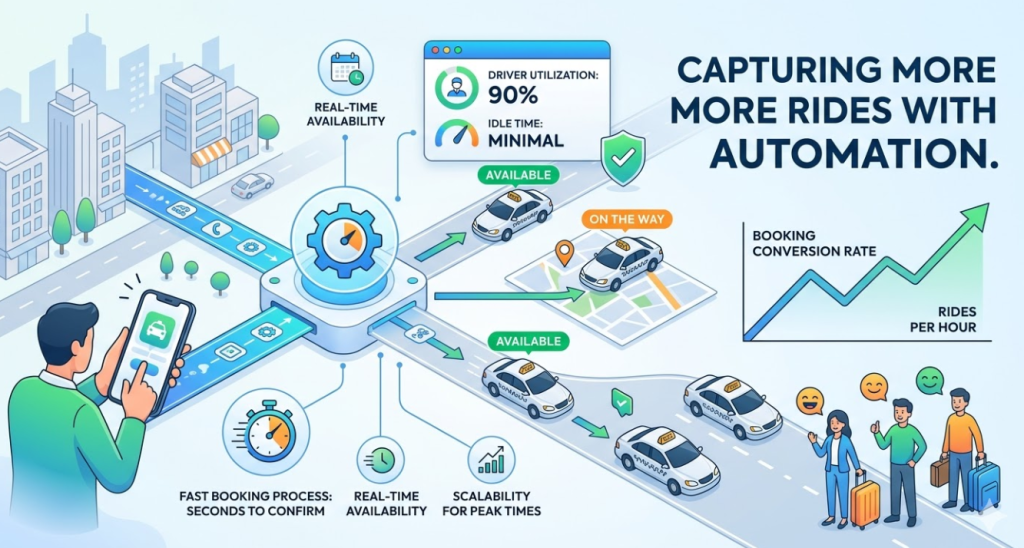
Automation reduces the time between a customer request and the moment a driver is assigned. Instead of waiting for a dispatcher to manually review the booking, the system processes the request immediately. For passengers this speed creates confidence that the ride has been secured.
A faster response alone can dramatically improve booking conversion.
Automation also improves how vehicles are used throughout the day. When driver availability is visible in real time, dispatchers can assign rides more efficiently. Fewer vehicles remain idle while new requests are waiting to be processed.
Several operational improvements usually appear after automation is introduced.
- faster confirmation of incoming ride requests
- fewer missed calls or delayed responses
- improved driver utilization throughout the day
- better coordination during peak demand periods
Over time these improvements translate into measurable business results. Taxi companies process more requests without needing additional dispatch staff, and drivers spend less time waiting between rides.
Another important benefit is consistency. When bookings are managed through taxi business automation, the process remains stable even during high-demand periods such as airport arrival waves or weekend nights.
Instead of struggling to keep up with incoming requests, fleets can maintain a predictable workflow where each ride request moves quickly from booking to driver assignment.
For many taxi companies, the result is simple. More requests are captured, fewer rides are lost, and overall operations become easier to manage.
Read also: Why Phone-Based Taxi Booking Doesn’t Scale and Costs More Than You Think
Signs Your Taxi Business May Be Losing Bookings
Many taxi companies assume their booking process works well simply because rides continue to happen every day. However, certain operational patterns often indicate that requests are being lost before they turn into confirmed trips.
Recognizing these warning signs can help fleets identify where improvements are needed.
Some of the most common indicators include:
- frequent missed calls during busy hours
- customers asking whether their booking was received
- dispatchers feeling constantly overwhelmed
- drivers waiting for assignments while requests are still arriving
- inconsistent response times across different booking channels
These situations may appear normal during peak demand periods, especially for fleets handling airport transfers or large event traffic. Yet when they happen regularly, they often point to gaps in the booking workflow.
Another signal is when dispatch teams rely heavily on messaging platforms or handwritten notes to manage ride requests. While these methods may work temporarily, they become difficult to control as the number of daily bookings increases.
A structured system allows taxi companies to clearly see incoming requests, driver availability, and ride schedules in one place. This visibility helps prevent requests from being overlooked and ensures that each booking moves quickly through the dispatch process.
Recognizing these patterns is often the first step toward improving how bookings are handled and reducing the number of rides that quietly disappear each day.
Conclusion
Many taxi companies focus most of their energy on attracting new customers. They invest in advertising, partnerships, and online visibility in order to increase ride demand.
However, a large portion of lost revenue often comes from bookings that never become confirmed rides.
Missed calls, delayed responses, and fragmented booking channels quietly reduce the number of trips completed each day. When the booking process depends entirely on manual coordination, it becomes increasingly difficult to keep up with modern customer expectations.
Passengers today expect speed and reliability. They want to know within seconds that their ride has been confirmed and that a driver is on the way. If this confirmation does not arrive quickly, they simply move on to another provider.
This is where automation begins to make a meaningful difference.
By introducing a structured taxi dispatch system, fleets can respond to requests faster, manage bookings from multiple channels in one place, and maintain clear visibility across their operations. Dispatchers spend less time handling routine coordination, while drivers receive assignments more efficiently.
For taxi companies looking to improve operational efficiency and reduce missed ride requests, implementing modern digital tools such as CRM systems and dispatch automation can significantly improve how bookings are managed.
In an increasingly competitive market, the ability to process bookings quickly and reliably is no longer just an advantage. For many fleets, it has become a necessary step toward sustainable growth.
FAQ
Why do taxi companies lose bookings even when demand is high?
Taxi companies often lose bookings because their dispatch process cannot handle incoming requests quickly enough. During busy hours dispatchers may miss phone calls or delay responses to online requests.
Customers usually do not wait long for confirmation. If a ride request is not acknowledged within seconds or minutes, passengers simply contact another provider. Without a structured taxi booking system, it becomes difficult to keep track of every request and ensure that each booking is processed in time.
How can automation reduce missed taxi bookings?
Automation improves how ride requests are processed. When a booking arrives, the system can confirm the request instantly and assign a driver based on availability or location.
Instead of relying entirely on manual coordination, taxi automation allows fleets to handle multiple booking channels at once. This reduces response times and ensures that incoming requests are not overlooked during peak demand.
What is a taxi dispatch system?
A taxi dispatch system is a digital platform that helps taxi companies manage bookings, drivers, and ride assignments from a single interface.
The system typically includes tools for booking management, automatic driver assignment, real-time driver tracking, and scheduling future rides. By organizing all ride requests in one place, dispatchers can respond faster and maintain better control over daily operations.
Can small taxi fleets benefit from dispatch automation?
Yes. Even small taxi fleets can benefit from automation. When a company operates with only a few drivers, missing just a handful of bookings each day can significantly impact revenue.
Automation helps ensure that every request is processed quickly, allowing small fleets to compete more effectively with larger operators.
How does automation improve the customer experience?
Passengers expect fast confirmation and reliable pickup times. Automation helps taxi companies respond to requests immediately and assign drivers more efficiently.
As a result, customers receive quicker confirmations, clearer communication, and a more predictable ride experience. Over time this improves trust and encourages passengers to book with the same company again.