


 Subscribe
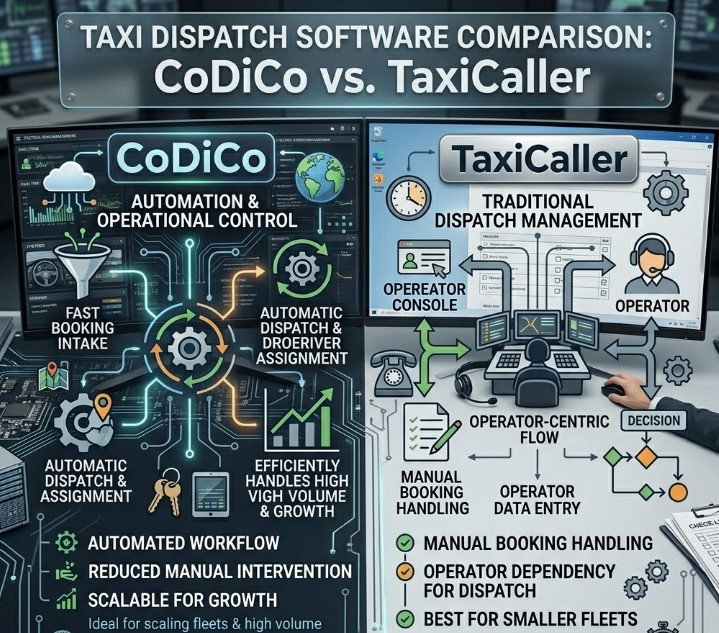
Choosing taxi dispatch software is no longer just a technical decision. It directly affects how a taxi or transfer business handles bookings, assigns drivers, manages daily workload, and prepares for growth.
TaxiCaller and CoDiCo are built for the same market, but they approach operations differently. One is centered on traditional dispatch management, while the other is built around automation, faster booking flow, and reduced manual work.
This comparison looks at both systems from a practical business perspective. The goal is not to list features for the sake of it, but to show how each platform supports day-to-day operations, where limitations appear, and which type of business each solution fits best.
Understanding the Platforms
CoDiCo: Taxi Dispatch Software Built for Growth
CoDiCo is built around automation and operational control. It’s not just a taxi dispatch system that helps assign drivers, but a system that manages the full booking flow with minimal manual involvement.
Bookings are processed faster, driver assignment happens automatically, and the system continues working without constant supervision. This reduces dependency on dispatchers and allows the business to handle more volume without increasing workload.
CoDiCo is designed for taxi and transfer companies that already deal with a steady flow of bookings or are planning to scale and need a system that won’t slow them down.
TaxiCaller: A Traditional Taxi Dispatch System
TaxiCaller is a cloud-based taxi dispatch software focused on core dispatch operations. It provides tools for managing bookings, tracking vehicles, and assigning drivers through a centralized system.
The platform is simple to set up and works well for smaller fleets or businesses transitioning from phone-based booking to digital dispatch.
However, most of the workflow still depends on manual actions. Booking handling, dispatch decisions, and coordination rely on operators, which becomes more noticeable as booking volume increases and operations become more complex.
Read More: Why Taxi Businesses Must Upgrade to Modern Taxi Dispatch Software in 2025
Feature Comparison Table
| Feature | TaxiCaller | CoDiCo |
|---|---|---|
| Dispatch system | Basic dispatch tools | Automated dispatch system |
| Booking handling | Manual-heavy workflow | Automated booking flow |
| Driver assignment | Operator-dependent | Smart automatic assignment |
| Night bookings | Limited without operator | Supports 24/7 automated processing |
| Automation | Minimal | Built-in automation |
| Analytics | Basic reports | Real-time insights |
| Multi-channel bookings | Limited integration | Supports multiple booking channels |
| Scalability | Suitable for small fleets | Designed for growing fleets |
| Pricing model | Per vehicle / subscription | Flexible, growth-oriented |
| Customer experience | Standard booking process | More streamlined booking flow |
Key Differences Explained
Booking Handling and Daily Workflow
In TaxiCaller, booking handling still relies on manual input. Requests need to be reviewed, confirmed, and assigned by an operator. This works when volume is low, but slows down as bookings increase.
In CoDiCo, the taxi booking software processes requests automatically. Orders move through the system without delays, which reduces handling time and keeps the flow consistent even during busy periods.
Dispatch and Driver Assignment
TaxiCaller depends on dispatcher decisions. The speed and accuracy of assignment directly depend on the operator, which creates variability during peak hours.
CoDiCo uses automated taxi dispatch. Drivers are assigned instantly based on availability and location, which reduces idle time and improves response speed without manual intervention.
Night and 24/7 Operations
With TaxiCaller, night bookings usually require someone to monitor and assign rides. Without an operator, part of the demand is simply not processed.
CoDiCo handles bookings continuously. The system processes requests and assigns drivers even when no dispatcher is online, which is critical for airport transfers and late-night demand.
Automation and Operational Load
TaxiCaller keeps dispatch as a manual process with some support tools. As a result, workload grows together with bookings.
CoDiCo reduces operational pressure by automating routine tasks. Dispatchers are not removed, but their role shifts from handling every booking to overseeing the system.
Analytics and Business Control
TaxiCaller provides basic reporting. It shows what already happened, but offers limited support for decision-making.
CoDiCo includes deeper analytics within the taxi fleet management software. Data is available in real time, which helps track performance, identify gaps, and adjust operations faster.
Scalability for Growing Fleets
TaxiCaller works reliably at a smaller scale, but becomes harder to manage as the number of vehicles and bookings increases. More volume means more manual work.
CoDiCo is built for scaling. The system handles higher demand without adding operational complexity, which makes it more suitable for fleets planning to grow.
Read More: Why Taxi Companies Lose Bookings and How Automation Fixes It
Real Business Scenario: Small Fleet vs Growing Fleet
| Fleet Stage | TaxiCaller | CoDiCo |
|---|---|---|
| Small fleet (10–15 cars) | Works without major issues, manual dispatch is manageable | Works well, automation may be less critical at this stage |
| Growing fleet (30–50 cars) | Dispatch slows down, more manual work required | Stable workflow, bookings handled automatically |
| Busy airport transfers | Risk of missed bookings during peak hours and night | Continuous booking flow, no dependency on operators |
| High-volume operations (80+ cars) | Difficult to manage, requires more staff | Helps handle higher demand with less added operational pressure |
At a small scale, both systems can handle daily operations without major problems. The difference becomes visible when booking volume increases and operations become more dynamic.
TaxiCaller starts requiring more manual coordination. More bookings mean more work for dispatchers, and efficiency depends on how quickly they react.
CoDiCo keeps the workflow consistent. As demand grows, the system continues processing bookings and assigning drivers automatically, without adding extra load on the team.
Where Each System Fits Best
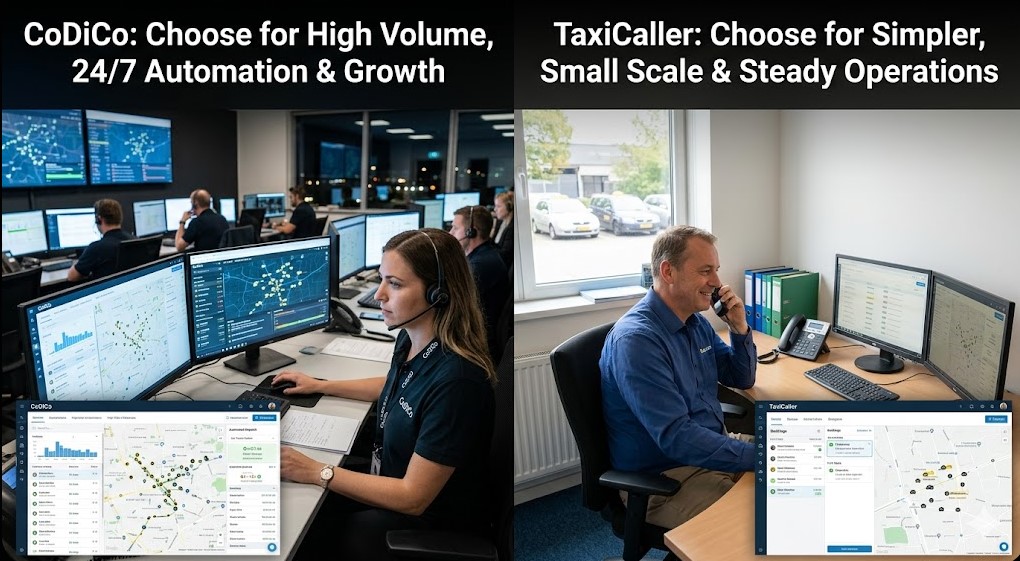
Choose CoDiCo if
CoDiCo fits businesses that are already dealing with steady booking flow or planning to grow. It becomes especially relevant when manual dispatch starts slowing down operations and the team can no longer process bookings efficiently.
It is a strong fit in situations where the system needs to handle demand without constant supervision:
- high booking volume across multiple channels
- regular night bookings and 24/7 demand
- growing fleet size with increasing operational complexity
- need to reduce dispatcher workload
- requirement for automation in taxi dispatch software
It also makes sense for companies that want better visibility and control over their operations. With built-in analytics and automated workflows, it becomes easier to manage performance without increasing team size.
Choose TaxiCaller if
TaxiCaller is suitable for businesses with simpler operations and lower booking volume. It works best when manual handling is still manageable and does not create delays.
It is typically a good fit in the following cases:
- small fleet with predictable workload
- limited number of daily bookings
- dispatch handled mostly during working hours
- no need for full automation
- transition from phone-based booking to digital taxi dispatch system
As long as operations remain stable and relatively small, TaxiCaller can cover basic needs without requiring more advanced tools.
Read More: How to Choose the Right Taxi Dispatch Software – A Complete Buyer’s Guide
Final Verdict
TaxiCaller is a solid option for basic operations. If a taxi business is running a small fleet with predictable demand and most bookings can be handled manually, it does the job without unnecessary complexity. It helps organize dispatch and move away from phone-based workflows, which already gives a step forward.
However, as booking volume grows, the limitations become more visible. Manual handling slows down operations, night bookings are harder to capture, and scaling requires more effort and more people involved in dispatch.
CoDiCo is built for that next stage. It focuses on automation, faster booking processing, and reducing operational pressure. Instead of increasing workload as the business grows, the system keeps processes stable and predictable. This makes it easier to handle more bookings, improve response time, and maintain control without constantly expanding the team.
The decision comes down to the stage of the business. If the goal is to manage a small and stable operation, TaxiCaller is sufficient. If the goal is to grow, handle higher demand, and remove manual bottlenecks, CoDiCo is generally the more practical choice for companies prioritizing automation and growth.
At the same time, growth is not only about dispatch. The way customers interact with your booking flow also matters. With properly structured UI/UX Design, it becomes easier to convert incoming traffic into confirmed bookings. And when demand needs to be scaled further, tools like Google Ads Setup help bring consistent traffic that the system can actually handle without losing requests.
FAQ
Is TaxiCaller good for small taxi fleets?
Yes, TaxiCaller works well for small fleets with a limited number of daily bookings. It covers basic dispatch needs and allows operators to manage bookings manually without major complications. Problems usually start when booking volume increases and manual handling becomes a bottleneck.
What is the difference between TaxiCaller and CoDiCo?
The main difference is in how bookings are handled. TaxiCaller relies more on manual dispatch, while CoDiCo uses automated taxi dispatch to process bookings and assign drivers with minimal operator involvement. This directly affects speed, workload, and scalability.
Can taxi dispatch software handle bookings automatically?
Yes, modern taxi dispatch software can handle bookings automatically. Systems like CoDiCo process incoming requests, assign drivers, and manage booking flow without requiring constant manual input, which is especially important during peak hours and night operations.
How does automated taxi dispatch work?
Automated taxi dispatch matches incoming bookings with available drivers based on location, availability, and system logic. This reduces delays, minimizes human error, and keeps operations consistent even under high demand.
Which taxi dispatch software is better for growing fleets?
For growing fleets, systems that support automation and scalability are more effective. As booking volume increases, manual dispatch becomes less efficient, so solutions like CoDiCo are better suited for handling higher demand without increasing operational complexity.
Can CoDiCo handle night bookings without an operator?
Yes, CoDiCo processes bookings continuously. It can handle night requests and assign drivers without requiring a dispatcher to be online, which helps capture demand that would otherwise be missed.
What should taxi companies look for in taxi dispatch software?
Taxi companies should focus on how the system handles bookings under real conditions. Key factors include automation, speed of dispatch, ability to operate 24/7, scalability, and how much manual work is required to keep operations running.