


 Subscribe

Starting a taxi business in the UK or becoming a private hire operator (PHO) remains one of the most accessible and promising opportunities in the transport sector. Demand for reliable, technology-driven transport services continues to rise as more people rely on on-demand mobility for everyday commutes, airport transfers, corporate travel, and leisure.
According to recent GOV.UK statistics, the number of licensed taxis and private hire vehicles in England has been steadily increasing, reflecting not only the growth of the industry but also a shift in customer expectations. Passengers now look for convenience, transparent pricing, real-time tracking, and professional service—features that modern PHO businesses can deliver when built on the right foundation.
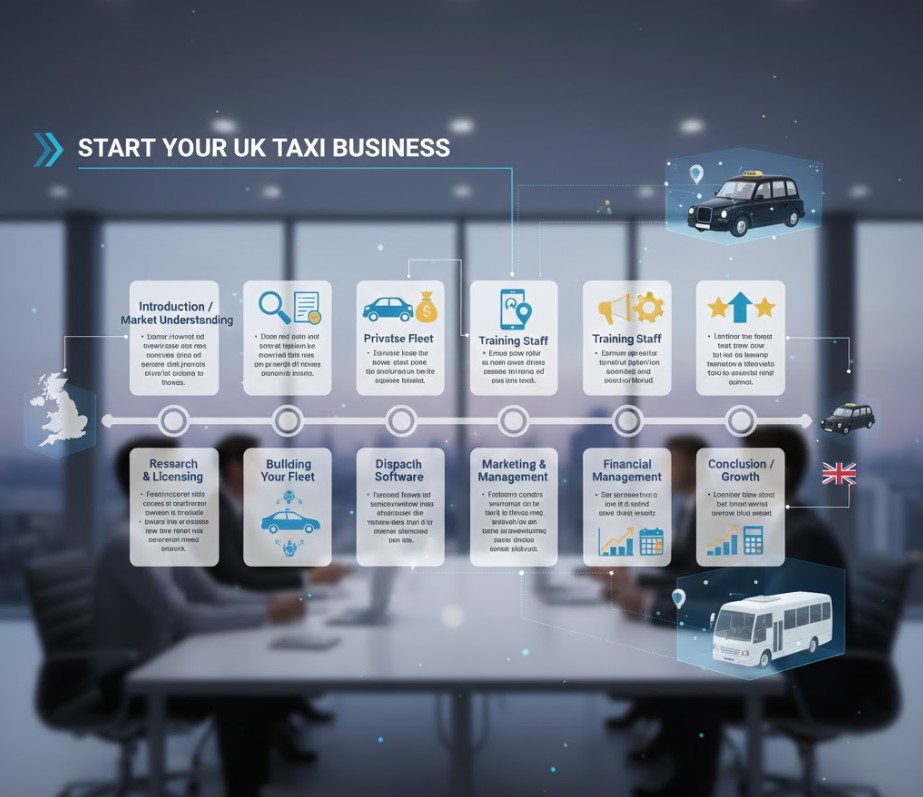
This guide walks you through the exact steps required to start a taxi / private hire business in the UK, from understanding the market and meeting licensing requirements to managing operations and implementing the right taxi dispatch software.
By the end, you’ll have a clear, practical roadmap for launching a compliant, scalable, and profitable PHO business in 2026.
2. Understanding the UK Taxi & Private Hire Operator (PHO) Market
Before you start a taxi business in the UK, it is essential to understand how the industry has evolved, what drives today’s demand, and which opportunities exist for new private hire operators. The PHO market has undergone significant changes in the last two decades, shaped by technology, regulations, and shifting customer expectations.
2.1. How the Market Has Evolved
The traditional model of calling a local taxi firm has gradually transformed into a digital-first experience. Several key milestones influenced this shift:
- In the 2000s, the adoption of GPS and early booking platforms made dispatching more efficient and allowed operators to manage fleets more accurately.
- By the 2010s, ride-hailing giants like Uber and Bolt redefined convenience, introducing app-based booking, transparent fares, and real-time tracking.
- Entering the 2020s, the industry saw rapid digitalisation, pressure for higher service standards, and the integration of electric and hybrid vehicles into fleets.
This evolution created a competitive yet opportunity-rich environment for operators who combine compliance, technology, and customer-focused services.
2.2. Current Landscape and Growth Trends
Recent data shows that the number of licensed taxis and private hire vehicles continues to rise across major UK regions. The increase in licensed PHV operators highlights growing demand for safe, reliable, and flexible transport options—from commuters and tourists to corporate clients.
Key trends shaping the PHO market in 2026 include:
- Higher expectations for digital booking and faster response times
- Strong demand in urban centres like London, Manchester, Birmingham, and Edinburgh
- Increased reliance on PHOs for airport transfers and long-distance trips
- A noticeable shift toward low-emission and electric vehicles
These trends indicate that the PHO sector is not just growing—it is modernising, making it an ideal time for well-prepared operators to enter the market.
2.3. Opportunities for New Operators
Despite strong competition, new operators with a clear strategy can successfully position themselves in the industry. Some of the most promising opportunities include:
- Niche segments such as executive travel, airport transfers, family-friendly transport, or wheelchair-accessible services
- Local areas underserved by existing operators
- Building a fleet around hybrids or electric vehicles to meet environmental expectations
- Offering a higher level of professionalism and reliability than mass-market platforms
The market gaps are real, and customers continue to look for personalised, safe, and dependable transport solutions—especially when supported by efficient dispatch systems and strong customer service.
Read also: Starting a Taxi Business: What You’ll Need and How Much It Costs
3. Pre-Launch Preparation: Research & Licensing Requirements
Before you start a taxi business in the UK, it is crucial to build a solid foundation. This stage determines how well your PHO will perform once operations begin. Thorough market research and full compliance with licensing requirements ensure that you understand your customers, your competitors, and the legal responsibilities that apply to every private hire operator.
3.1. Conducting Market Research
Market research is more than just checking if there are enough customers in your area. It helps you identify who you want to serve, how you will stand out, and where the biggest opportunities are.
Here are the core elements to focus on:
- Define your target audience: Are your customers mainly commuters, tourists, corporate travellers, or airport passengers? Each group has its own expectations for pricing, comfort, and availability.
- Analyse competitors: Look at their pricing, service areas, response times, vehicle types, and customer reviews. This shows where they fall short — and where you can outperform them.
- Identify underserved zones: Some areas rely heavily on private hire services but receive limited coverage. These gaps often become profitable entry points for new PHOs.
- Explore niche services: Airport transfers, executive travel, eco-friendly rides, or wheelchair-accessible transport can differentiate your business from traditional operators and mass-market platforms.
Thorough research gives you clarity on how to position your PHO effectively in a growing but competitive market.
3.2. Understanding Licensing Requirements
To operate legally, a private hire operator must meet specific licensing standards set by local councils. While requirements vary slightly between regions, the core rules remain consistent across the UK.
Here’s what you need to prepare:
- Driver’s license: Drivers must hold a valid UK, NI, or EU driving licence that is at least 12 months old.
- Taxi operator license: You must apply for a taxi operator license or taxi business operator’s license from your local council. This authorises you to accept bookings and manage drivers.
- Business license: Your PHO must be registered as a legal entity before beginning operations.
- Insurance and compliance: Private hire vehicles must meet safety and insurance requirements, including appropriate coverage for passengers and commercial use.
- Record-keeping and data standards: Councils expect accurate logs of bookings, driver details, and dispatch records—another reason why reliable taxi dispatch software becomes essential.
Understanding and fulfilling these licensing requirements at the beginning helps avoid delays, penalties, and operational issues once your business is live.
4. Building Your Fleet: Vehicle Acquisition
Your fleet is at the heart of your taxi business in the UK. The vehicles you choose will shape the type of customers you attract, your long-term costs, and your overall brand image as a private hire operator. A well-planned fleet strategy ensures that your PHO remains efficient, reliable, and competitive from the very first day.
4.1. Buying vs. Leasing
One of the first decisions to make is whether to buy or lease your vehicles. Each option has its own advantages, depending on your budget and long-term strategy.
- Buying:
Purchasing vehicles outright offers long-term value and full ownership. You’re free to customise your cars and keep them as long as you want. However, the initial investment can be high, and maintenance costs become your responsibility over time. - Leasing:
Leasing allows you to start with newer cars and lower upfront costs. It’s also easier to upgrade your fleet as technology evolves or customer expectations change. The trade-off is that monthly payments continue throughout the lease term, and mileage limits may apply.
Choosing between buying and leasing depends on your financial capacity, expected demand, and how quickly you plan to scale your private hire operator business.
4.2. Choosing the Right Vehicles
Selecting the right vehicle types is essential for building a sustainable and attractive fleet. The ideal choice depends on your target audience and the services you want to offer.
- Corporate clients:
Business travellers expect comfort, privacy, and a premium feel. Saloons, executive sedans, and SUVs are strong options for this segment. - Local and short-distance travel:
Compact, fuel-efficient cars are excellent for city rides, daily commutes, and short-notice bookings. They help reduce your operating costs and offer reliable service. - Eco-conscious passengers:
Hybrids and electric vehicles appeal to customers who prioritise sustainability. They can also reduce long-term running costs and help your PHO align with environmental regulations and clean-air initiatives.
Building a balanced fleet ensures that your business stays relevant across different customer needs while maintaining strong profitability.
4.3. Financing Options
If buying vehicles outright seems too costly, several financing models can help you start without overwhelming upfront expenses.
Common options include:
- Bank loans:
Allows you to spread the cost over time while building ownership. - Leasing agreements:
Ideal for flexible expansion and access to newer vehicles. - Hire-purchase plans:
A mix between leasing and buying, giving you ownership after all payments are complete. - Dealer financing:
Often includes promotional offers or lower interest rates, depending on the vehicle model and supplier.
The goal is to choose a financing approach that supports your cash flow and leaves enough room for operational and marketing investments as you grow your PHO business.
Read also: Essential Dispatch Programs for Running a Successful Taxi Business
5. Implementing Taxi Dispatch Software
In today’s market, technology is no longer optional for a taxi business in the UK. Efficient operations, faster response times, and a smooth customer experience all depend on reliable taxi dispatch software. For modern PHO operators, software becomes the backbone of daily operations, enabling better oversight and consistent service delivery.
5.1. Why Technology Is Now a Core Component of PHO Operations
Customer expectations have shifted dramatically. Passengers want clear pricing, instant booking, live tracking, and communication with drivers — features that are nearly impossible to deliver manually.
Implementing robust taxi booking software helps you:
- streamline bookings without phone calls,
- reduce dispatch errors,
- automate driver assignments,
- shorten passenger wait times,
- and maintain full visibility across your fleet.
For operators, technology not only simplifies workflows but also creates a more professional and competitive business.
5.2. Essential Features of Taxi Dispatch Software
A complete dispatch system usually includes separate modules tailored for different users within your PHO business.
Key components include:
- Driver app: Allows drivers to accept trips, navigate to customers, and update status in real time.
- Passenger app: Enables customers to book rides, track drivers, and make secure payments.
- Dispatcher app: Helps your operations team oversee active trips and manage bookings efficiently.
- Admin panel: Gives you control over pricing, reports, vehicle management, and company settings.
- Web booking: Offers customers an alternative to apps, especially helpful for corporate clients and hotels.
Together, these modules create a seamless ecosystem where bookings flow smoothly and data stays synchronised across your business.
5.3. Advanced Tools for Scaling and Automation
Beyond basic functionality, advanced features can significantly improve efficiency and reduce costs:
- Reports and analytics: Track performance, identify busy hours, and measure profitability.
- Automated dispatch: Assigns the nearest suitable driver automatically, improving response time.
- Fare management and smart pricing: Adjust fares dynamically based on traffic, demand, or special events.
- Driver management: Monitor driver behaviour, ratings, and shift performance.
- Multichannel booking: Accept bookings from apps, web, phone, or third-party integrations.
- 3rd-party integrations: Connect with payment gateways, hotel systems, corporate accounts, and more.
These tools help your PHO operate efficiently, maintain service quality, and scale as demand grows — without needing a large administrative team.
5.4. Training Staff and Drivers
Implementing dispatch software is only effective when everyone understands how to use it. Proper onboarding ensures:
- drivers can handle bookings confidently,
- dispatchers manage operations smoothly,
- admins monitor performance without confusion.
Clear training helps prevent errors, increases adoption, and improves the overall experience for both drivers and passengers.
6. Operations Management
Running a taxi business in the UK requires more than vehicles and drivers. The day-to-day operations of a private hire operator determine how efficiently the business functions and how satisfied customers remain. Smooth operations rely on organised workflows, proactive communication, and the right technology to support both staff and passengers.
6.1. Driver Management
Drivers are the face of your PHO. Their professionalism, punctuality, and communication skills directly influence customer experience and retention. Effective driver management helps maintain high service standards while keeping operations organised.
Key areas to focus on:
- Recruitment: Choose reliable, experienced drivers who align with your company values.
- Scheduling: Use taxi dispatch software to assign shifts, distribute jobs fairly, and prevent double bookings.
- Performance monitoring: Track punctuality, customer ratings, completed trips, and driving behaviour through built-in driver management tools.
- Support and communication: Ensure drivers can easily contact dispatchers in case of issues or last-minute changes.
When managed effectively, your drivers become a strong competitive advantage rather than a logistic challenge.
6.2. Fleet Maintenance
Your vehicles must be safe, reliable, and consistently ready for service. Fleet maintenance is essential not only for legal compliance but also for customer satisfaction and business reputation.
A structured maintenance strategy includes:
- Regular inspections: Scheduled checks help identify issues before they lead to breakdowns or failed journeys.
- Servicing and repairs: Routine servicing extends the life of your vehicles and reduces long-term costs.
- Cleanliness and presentation: Clean, well-kept vehicles improve passenger comfort and reflect professionalism.
- Maintenance tracking: With dispatch software or fleet tools, you can track mileage, service dates, and repair history to avoid unexpected downtime.
A well-maintained fleet ensures smooth operations, reduces cancellations, and keeps your PHO running efficiently throughout the year.
Read also: Key Do’s and Don’ts for Building a Profitable Taxi Business
7. Marketing and Promotion for Your Taxi Business
Even the most efficient taxi business in the UK needs visibility to attract customers. Marketing plays a crucial role in building your brand, increasing bookings, and establishing trust. A strong marketing strategy combines digital tools with local partnerships to create a continuous flow of passengers for your PHO.
7.1. Digital Marketing Strategy
Digital marketing is essential for reaching modern passengers who rely on online platforms to book transport. A well-planned online presence helps you appear in search results, engage with potential customers, and showcase what makes your PHO reliable and professional.
Key elements of a digital strategy include:
- SEO (Search Engine Optimization): Improve your visibility on Google by targeting relevant local keywords like “airport taxi service,” “private hire operator near me,” or city-specific terms.
- Social media marketing: Platforms such as Facebook, Instagram, and TikTok help you build brand awareness, share updates, and highlight driver professionalism or fleet quality.
- Paid advertising: Google Ads and social media ads allow you to reach customers looking for immediate rides or pre-booking airport transfers.
- Content marketing: Create helpful blogs, FAQs, or travel guides to position your PHO as a trusted local expert.
Digital marketing increases your reach and credibility, making it easier for passengers to choose your service over competitors.
7.2. Local Partnerships & Offline Promotion
While digital efforts are important, offline partnerships are invaluable for generating steady, high-quality bookings — especially for private hire operators.
Effective partnership opportunities include:
- Hotels and accommodations: Offer reliable airport transfers or pre-booked rides for guests.
- Event organisers: Provide transport for conferences, concerts, sports events, and weddings.
- Tourism companies: Collaborate with travel agencies or tour operators to secure regular bookings from tourists.
- Corporate clients: Businesses often require dependable transport for staff, executives, and visitors — a strong niche for PHO services.
Local partnerships help your PHO build long-term relationships, increase daily bookings, and access customer groups that may not actively search online for transport options.
8. Financial Management & Cost Optimization
Strong financial management is essential for building a sustainable taxi business in the UK. Understanding your expenses, setting profitable pricing strategies, and staying compliant with tax obligations will help your PHO maintain healthy margins while delivering reliable service. This section outlines the core financial considerations every private hire operator must plan for.
8.1. Understanding Operational Costs
Operational costs are the daily expenses required to keep your PHO running smoothly. Understanding and managing these costs early on helps prevent financial strain and ensures long-term stability.
Common operational expenses include:
- Vehicle maintenance: Routine servicing, repairs, and MOT tests.
- Driver wages: Payments based on shifts, completed trips, or commission structures.
- Licensing and permits: Fees for your taxi operator license, driver’s license, and other administrative requirements.
- Insurance: Coverage for vehicles, passengers, and public liability.
- Fuel or charging costs: Depending on whether your fleet includes petrol, hybrid, or electric vehicles.
Monitoring these expenses regularly gives you the insight needed to reduce inefficiencies and optimise spending.
8.2. Pricing Strategies & Profit Margins
Pricing directly influences your profitability and your position in the local market. A well-structured pricing model helps balance competitiveness with healthy margins.
Consider using:
- Flexible pricing: Adjust fares based on demand, time of day, or service type.
- Dynamic pricing: Increase fares during peak hours, special events, or high-demand periods.
- Competitive benchmarking: Review pricing from other private hire operators to ensure your rates remain attractive without compromising profit.
Smart pricing, combined with efficient operations, helps your PHO maintain strong financial performance throughout the year.
8.3. Tax Obligations and Deductions
Every PHO must comply with UK tax regulations. Understanding your obligations early on protects your business from penalties and ensures proper budgeting.
Key tax considerations include:
- VAT: Depending on your revenue, your PHO may be required to register for VAT.
- Payroll taxes: Required if you employ drivers directly rather than contracting them.
- Income tax: Applies to overall business profits.
You may also be eligible for deductions related to:
- vehicle depreciation,
- maintenance and repairs,
- fuel or charging costs,
- software subscriptions,
- office or operational expenses.
Consulting a tax professional is recommended to ensure full compliance and to identify all possible deductions that can improve your bottom line.
9. Conclusion
Starting a taxi business in the UK or becoming a fully licensed private hire operator (PHO) requires careful planning, compliance, and a strong operational strategy. From understanding the evolving PHO market to choosing the right vehicles, managing drivers, and implementing reliable taxi dispatch software, every step plays a role in building a stable and competitive service.
The industry continues to grow, and customer expectations are higher than ever. Passengers now look for convenience, transparency, and consistent quality — all of which can be delivered when a PHO combines modern technology with professional operations.
By following the framework outlined in this guide, you can launch a private hire business that is compliant, efficient, and well-prepared to scale. Whether your goal is to focus on local journeys, airport transfers, corporate travel, or specialised services, the opportunity is there for operators who commit to delivering safe, reliable, and technology-driven transport.
As you move forward, remember that success in this industry comes from continuous improvement — refining your processes, staying aligned with council regulations, understanding your market, and leveraging tools that help your PHO operate more effectively. With the right foundation, your taxi business can grow confidently and sustainably in 2026 and beyond.