


 Subscribe
If you are running a taxi business today, you already know that operations feel heavier than they did a few years ago.
Dispatch is no longer just about assigning trips. It now includes constant coordination, handling cancellations, managing driver availability, and reacting to last-minute changes that can disrupt the entire shift.
As a result, many teams spend more time firefighting than planning ahead.
At the same time, passenger expectations have increased quietly. People expect faster confirmations, accurate ETAs, and fewer mistakes, no matter if you operate 3 vehicles or 300.
When systems remain manual, that pressure shifts directly onto your team. Dispatchers feel stretched, drivers get frustrated by unclear updates, and small errors turn into repeated costs, such as missed pickups, double bookings, and unnecessary phone calls.
This is why more taxi and transfer companies are exploring AI in operations. Not because they want to chase trends, but because manual decision-making is reaching its limit, especially during peak hours, flight delays, and high-volume periods.
This guide will help you understand what AI-powered taxi solutions can realistically do today, how AI-powered taxi software fits into real dispatch workflows, and how you can implement AI step by step without losing control of your business.
Now that the context is clear, let’s look at what AI can actually handle in day-to-day taxi operations.
What AI Is Currently Capable of Doing for Taxi Businesses
Many operators feel skeptical about AI, and that hesitation is justified. AI is often overpromised and poorly explained.
However, in real taxi businesses today, AI is not used to replace people or automate everything blindly.
Instead, it is used to support decisions that are already being made manually, especially during high-pressure situations.
In practice, AI in taxi operations works by processing booking data, driver availability, traffic conditions, and historical patterns at a speed no human team can match.
So instead of relying only on memory and instinct, dispatchers receive structured suggestions that help them act faster and more consistently.
Moreover, final control always stays with your team.
This means AI adds clarity during chaos rather than creating more complexity.
Where AI Is Already Being Used Safely
AI is already being used safely in core operational areas. Dispatch prioritization is a common example.
AI can suggest which trip needs immediate attention based on pickup time, location, and service priority.
ETA accuracy improves because live traffic data and past trip patterns are combined.
In addition to this, demand smoothing helps operators prepare for known peak periods instead of reacting late. Most importantly, AI acts as decision support, so dispatchers remain in charge.
What AI Is Not Meant to Replace
On the other hand, AI is not meant to replace human judgment. Dispatchers still handle exceptions, VIP clients, and unusual situations.
Business rules, pricing logic, and service priorities remain fully controlled by you.
Regardless of how advanced the system is, operator override is always available. AI simply applies your rules consistently, even under pressure.
Expert insight:
“AI works best when it supports dispatchers, not replaces them.”
With this understanding of AI’s real role, let’s now look at how specific AI features fit into everyday taxi workflows.
Read also: Taxi Business Automation: How to Save 6+ Hours a Day and Stop Losing Clients
AI Features Used in Taxi Operations and How They Work
When operators hear about AI features, they often imagine a complex system that requires a full operational reset.
In reality, most AI-powered taxi solutions are built to work quietly inside workflows you already use. Instead of changing how your business runs, they improve how decisions are made and how fast your team can respond.
Below are key AI features used in taxi operations today, and how they support familiar processes.
AI in Booking
In the booking stage, AI helps validate requests before they fully enter your system. It can support multi-channel booking by bringing web forms, phone bookings, and messaging-based requests into one centralized dashboard.
Instead of relying on manual copy-paste, AI can assist with creating trips faster, flagging incomplete details, and reducing the risk of duplicate entries.
It can also help identify booking patterns over time, such as frequent pickup zones, recurring routes, and peak request hours. This makes demand trends visible without relying on spreadsheets or guesswork.
AI in Dispatch
AI-powered dispatch often delivers the most visible value.
It can suggest driver assignments, highlight trips that need urgent attention, and help balance workload across the fleet during peak hours.
Instead of switching between multiple screens and handling constant calls, dispatchers see recommended actions based on real-time conditions like driver availability, pickup timing, and traffic.
Final decisions remain with your team. AI supports the dispatcher, but does not remove control.
AI in Zone and Coverage Management
AI can support smarter zone behavior by adjusting coverage based on real demand.
Instead of relying only on fixed zones that require manual tuning, AI can suggest zone adjustments when demand shifts, for example during events, flight arrival waves, or sudden weather changes.
As a result, coverage improves and driver idle time can be reduced, without constant micromanagement.
AI in Pricing and Fare Management
In pricing, AI supports fare consistency and rule-based adjustments. It can help prevent sudden, unplanned fare spikes while still responding to demand changes.
If your business uses dynamic pricing, AI can apply surge rules in a controlled way, so pricing stays predictable and transparent for passengers and drivers.
The key point is that pricing logic remains yours. AI simply helps enforce it consistently.
AI in Predictive Demand and Heat Maps
AI can analyze historical and live data to forecast demand and generate heat maps.
This helps with staffing decisions and vehicle positioning ahead of busy periods. Instead of reacting late, dispatch teams can prepare earlier, especially for predictable patterns like morning airport demand or weekend city peaks.
AI in Advanced Analytics
AI-powered analytics can highlight dispatcher workload, driver utilization, and operational bottlenecks.
Instead of static reports, you get insights that explain why delays or inefficiencies happen, such as repeated cancellations in a certain zone, long pickup times during specific hours, or underused vehicles on certain shifts.
This makes it easier to take corrective action with clarity, not assumptions.
Now that you know what AI features exist, the next question is how to implement them without disrupting daily operations.
Read also: Essential Dispatch Programs for Running a Successful Taxi Business
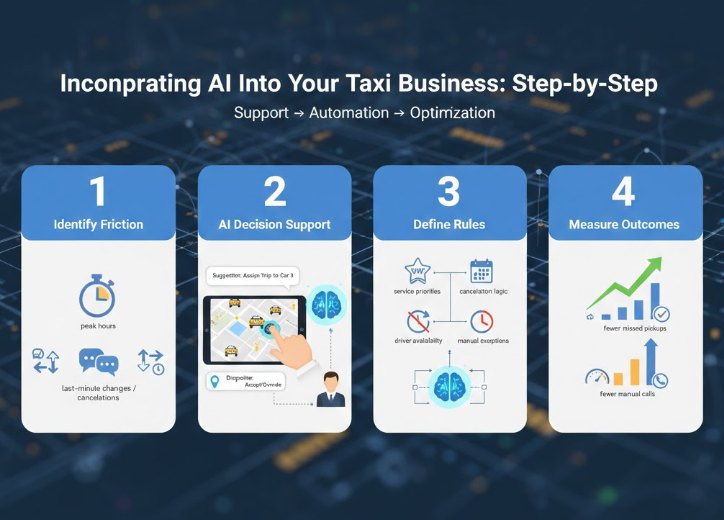
How to Incorporate AI into Your Taxi Business Step by Step
This is where most operators hesitate. The concern is rarely AI itself. It’s the fear of operational chaos. AI only works when it’s introduced gradually, with clear boundaries and full control staying in your hands.
The safest approach is to treat AI as support first, not full automation.
Step 1: Identify High-Friction Manual Processes
Start by mapping out where manual work creates the most pressure. In many taxi businesses, this is usually:
- dispatch overload during peak hours
- repeated follow-ups with passengers and drivers
- last-minute changes that force constant re-planning
- cancellations that trigger confusion across the schedule
These are high-stress areas, and they are often the best starting point for AI in taxi operations.
Step 2: Introduce AI as Decision Support First
In the early stage, AI should recommend actions rather than execute them automatically.
Dispatchers review suggestions, accept what makes sense, and override what doesn’t. This helps your team build confidence naturally, without losing control or changing the workflow overnight.
Step 3: Define Rules Before Expanding Automation
Before moving toward deeper automation, define your operational rules clearly, including:
- service priorities (airport runs, VIP bookings, corporate clients)
- cancellation and reassignment logic
- driver availability rules and shift limits
- exceptions that must always be handled manually
AI performs best when rules are structured and consistent. The more clearly you define your priorities, the more reliable AI support becomes.
Step 4: Measure Outcomes, Not Features
AI success should be measured through operational results, not through the number of features enabled.
Focus on outcomes such as:
- faster dispatch response time
- fewer missed or delayed pickups
- lower driver idle time
- higher trip completion consistency
- fewer manual calls and follow-ups
If these results improve, AI is helping. If they don’t, the setup needs adjustment.
Where does manual work slow your taxi operations down the most?
Once operators start seeing improvements in the daily workflow, the business case for AI becomes much clearer.
Read also: Data-Driven Taxi: How Smart Use of Data Helps You Grow Your Taxi Business
Why Incorporating AI Is Becoming Necessary for Taxi Businesses
AI adoption is not driven by trends. It is driven by operational reality. As booking volume grows, manual systems start to break under pressure, and costs increase quietly through repeated inefficiencies.
Cost Stability and Predictability
AI helps reduce repeated errors and reactive decisions, which supports more stable day-to-day operations. Fewer avoidable mistakes also means fewer hidden costs, such as wasted driver time, duplicated work, and missed pickups.
Dispatcher Sustainability
By supporting dispatchers with smarter suggestions and better visibility, AI helps reduce overload and fatigue. Teams can work with more structure, especially during peak hours, instead of constantly reacting to problems.
Competitive Consistency
Operators using AI-powered taxi solutions can respond faster and more consistently, even without expanding their teams. Over time, that consistency becomes a competitive advantage, because passengers remember reliability more than promises.
Conclusion: Start Small, Stay in Control, Improve Step by Step
AI is not a magic switch that fixes everything overnight. But when it’s implemented gradually, it becomes a practical tool that helps taxi businesses reduce manual pressure, improve consistency, and make faster decisions during busy hours.
The key is to start with the areas that cause the most friction, such as booking validation, dispatch prioritization, and demand forecasting. From there, you can expand only when your team feels confident and the results are clearly visible.
If you want to build a stronger operational foundation first, improving your dispatch taxi workflow and centralizing booking channels is often the smartest starting point. Once your core processes are stable, AI Integration becomes much easier, and your team stays fully in control.
And if you are also investing in better online visibility and smoother customer experience, strong Web Development can support your growth by helping you capture more direct bookings and reduce dependency on third-party channels.