


 Subscribe
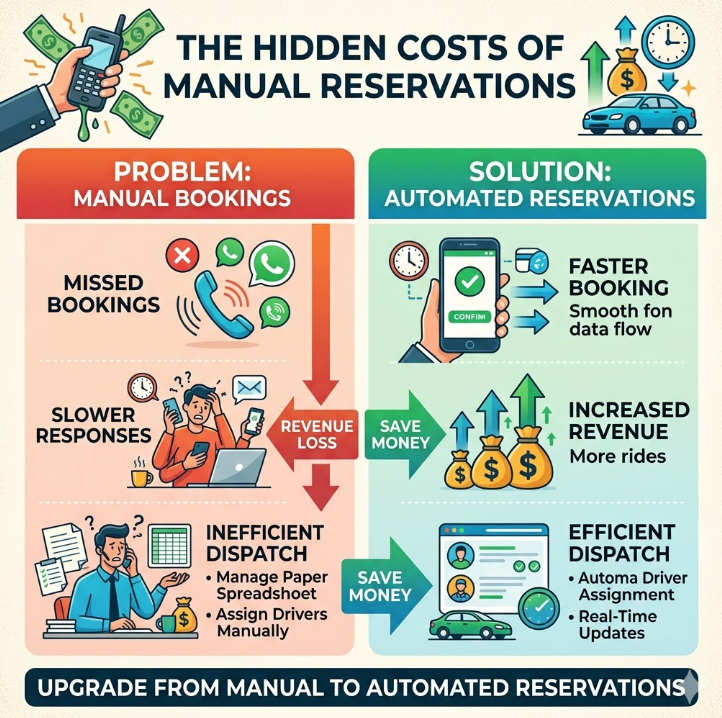
Every day, taxi and transfer companies receive dozens of booking requests — through calls, WhatsApp messages, emails, or website forms. At first glance, this may seem manageable. A dispatcher responds, writes down the details, assigns a driver, and the job gets done.
But as demand grows, this process starts to break down.
Responses become slower. Some requests are missed. Drivers receive incomplete or delayed information. And in many cases, customers simply move on to another service that replies faster.
The problem is not always obvious. You may still be getting bookings, drivers are still on the road, and operations continue as usual. But behind the scenes, small inefficiencies start turning into lost revenue.
Manual ride reservations are not just a matter of convenience. They directly affect how many bookings you actually convert, how efficiently your drivers work, and how your customers experience your service.
And the bigger your business becomes, the more noticeable these gaps get.
Why Many Taxi Businesses Still Rely on Manual Ride Reservations
For many taxi and transfer companies, manual booking systems are not a conscious choice — they are simply the way the business started.
In the early stages, everything feels under control. A few daily requests can be handled through phone calls or messages without much effort. Dispatchers know the drivers, schedules are simple, and there is no urgent need to change the process.
In fact, manual booking often feels faster and more flexible at the beginning.
Most operators rely on a combination of familiar tools:
- phone calls from regular customers
- WhatsApp or SMS messages
- spreadsheets to track bookings and driver schedules
- email requests or basic website forms
These methods work… until they don’t.
As soon as the number of bookings increases, the same process that once felt simple starts creating pressure. More requests come in at the same time, dispatchers have to switch between channels, and keeping everything in sync becomes harder.
What used to be manageable with 5–10 rides a day becomes chaotic with 30, 50, or more.
And this is the point where manual systems stop being a solution and start becoming a limitation.
Read more: Why Taxi Companies Lose Bookings and How Automation Fixes It
The Real Problem Isn’t Manual Booking — It’s What Comes With It
Manual booking is not the problem on its own. The real issue is everything that starts happening around it once your workload increases.
At first, these issues seem minor. One missed message here, a delayed response there. But over time, they add up and begin to affect your entire operation.
Here’s what typically happens:
Missed bookings without noticing
Not every request gets answered. A message comes in during a busy moment, gets buried under other chats, and is simply forgotten.
The client doesn’t complain. They just book somewhere else.
And you never even realize you lost that ride.
Slow response means lost clients
In this industry, speed matters more than most operators think.
If you reply after 5–10 minutes, there is a high chance the customer has already contacted another company. Especially for airport transfers or urgent rides, people don’t wait.
A slightly delayed response can mean a completely lost booking.
Double bookings and scheduling mistakes
When reservations are handled manually, it becomes harder to keep everything perfectly aligned.
Two drivers may be assigned to the same ride. Or worse, no one is assigned at all. Pickup times get mixed up, addresses are entered incorrectly, and small errors turn into real problems.
These mistakes don’t just cost money — they damage trust.
Driver confusion and constant back-and-forth
Without a central system, dispatchers rely on calls and messages to coordinate with drivers.
“Are you available?”
“Where are you now?”
“Can you take this ride?”
This constant communication slows everything down and increases the risk of miscommunication. Drivers may receive incomplete details or updates too late.
No clear overview of what’s happening
One of the biggest limitations is the lack of visibility.
At any given moment, it’s difficult to answer simple questions:
- Which drivers are available right now?
- Which rides are confirmed?
- What’s scheduled for the next hour?
Instead of having a clear overview, dispatchers are forced to piece together information from multiple sources.
These problems don’t always appear all at once. But as your booking volume grows, they become more frequent and harder to control.
And this is exactly where manual booking starts costing you more than it seems.
The Hidden Cost Nobody Calculates
Most taxi operators are aware of operational issues. Missed messages, delayed responses, scheduling mistakes — all of this is visible.
What’s less obvious is how much money these small issues actually cost.
Because lost bookings are rarely tracked.
A customer who didn’t get a reply doesn’t call back to say you were too slow. They simply choose another provider. And that lost opportunity never appears in your reports.
But it adds up.
Let’s break it down in simple terms.
If your average ride is worth €40–€80, even a few missed bookings per day make a difference:
- 2 missed rides → €80–€160 lost
- 5 missed rides → €200–€400 lost
- over a month → thousands in unrealized revenue
And this doesn’t include:
- underutilized drivers waiting for assignments
- inefficient routing due to poor coordination
- repeat customers who never return after a bad experience
What makes this even more critical is that these losses are silent. You don’t see them in your system because they never become confirmed bookings.
From the outside, your business may look stable. Drivers are working, rides are happening, operations continue.
But in reality, part of your demand is constantly slipping away.
And the longer you rely on manual booking, the more this gap grows between the bookings you handle… and the bookings you could have had.
Read more: Switching from WhatsApp to a Taxi App: Why It’s the Smart Move for Your Business
What Happens During a Busy Day
Everything may feel under control during quiet hours. But the real pressure shows up when demand increases.
A typical busy period looks something like this.
Several booking requests come in almost at the same time. One client is calling. Another is sending a message. A third has submitted a form on your website. Each request needs attention, and each customer expects a quick response.
The dispatcher starts switching between channels.
A call is answered first. Details are written down. Then a WhatsApp message is opened. Another request is checked in the inbox. At the same time, a driver calls back with a question about a current ride.
In this flow, small things start slipping.
A message is left unanswered for a few minutes. A pickup time is noted incorrectly. A driver assignment is delayed because availability is unclear. Someone has to double-check who is free and who is already on a job.
The more requests come in, the harder it becomes to keep everything aligned.
Instead of managing bookings, the dispatcher is constantly reacting. Jumping between tasks. Trying to keep up.
And this is where the system starts to break.
Not because the team isn’t capable. But because the process itself doesn’t scale.
When everything depends on manual coordination, even experienced operators reach a limit. And once that limit is reached, the quality of service begins to drop.
Customers wait longer. Drivers receive updates later. And some bookings simply never make it through.
What a Smart Reservation System Actually Changes
Switching to a digital reservation system is not just about replacing manual work with software. The real difference is in how your daily operations start to feel.
Instead of reacting to every request, the system handles the flow for you.
A booking comes in — it is instantly recorded. No need to rewrite details or check multiple channels. Everything appears in one place, clear and structured.
Driver assignment no longer depends on back-and-forth communication. The system identifies who is available and assigns the ride based on location, schedule, or predefined rules. What used to take several minutes now happens in seconds.
Customers don’t have to wait for confirmation. They receive updates automatically. Pickup details, driver information, status changes — all delivered without manual follow-up.
At the same time, you gain full visibility over your operations.
You can immediately see:
- which drivers are available
- which rides are ongoing
- what is scheduled next
There is no need to piece together information from calls, messages, and spreadsheets.
Errors become far less frequent. Double bookings are avoided. Missing details are no longer an issue because the system standardizes how reservations are created and managed.
Most importantly, the pressure on dispatchers drops.
Instead of constantly coordinating and fixing issues, they can focus on overseeing operations and handling exceptions when they actually matter.
The entire process becomes more predictable. More controlled. And significantly more scalable.
Manual vs Automated — The Difference You Feel Every Day
The difference between manual and automated booking is not theoretical. You feel it in daily operations, especially during busy hours.
Tasks that used to take time, attention, and constant coordination become structured and predictable. Instead of reacting to problems, you start preventing them.
Here’s how the two approaches compare in practice:
| Situation | Manual Booking | Automated System |
|---|---|---|
| Booking response | Delayed, depends on availability of dispatcher | Instant confirmation |
| Missed requests | Common during busy periods | Rare, all requests are captured |
| Driver assignment | Manual, requires calls or messages | Automatic, based on availability and location |
| Scheduling accuracy | Prone to errors and overlaps | Structured and consistent |
| Dispatcher workload | High, constant multitasking | Reduced, focused on control not coordination |
| Visibility | Limited, spread across tools | Centralized, real-time overview |
| Customer experience | Inconsistent | Predictable and reliable |
The most noticeable change is not just speed, but control.
With manual booking, you are always catching up. With an automated system, you stay ahead of demand.
And once you experience that shift, going back to manual coordination no longer makes sense.
When You Know It’s Time to Switch
Many taxi businesses don’t decide to automate because they want to. They do it because at some point, manual booking simply stops working.
The signs are usually clear, even if they are easy to ignore at first.
You start noticing that your team is always busy, but things still feel disorganized. Requests are coming in, drivers are working, yet there is a constant sense that something is slipping through the cracks.
Here are the most common signals:
- you handle more than 15–20 bookings a day and it already feels difficult to keep track of everything
- customers ask for confirmation again because they didn’t get a clear response
- drivers call frequently to check assignments or clarify details
- you occasionally miss requests or respond too late
- dispatchers spend most of their time switching between calls, messages, and spreadsheets
None of these issues seem critical on their own. But together, they create friction that slows down your entire operation.
Another important sign is growth becoming harder.
You may have demand. You may even have more drivers available. But increasing the number of bookings starts requiring more manual effort instead of becoming easier.
At this point, the limitation is no longer the market. It’s the system you are using.
And this is usually when operators realize that continuing with manual booking will only make things more complex, not more profitable.
Who Benefits the Most from Automated Ride Reservation Systems
Automation is not limited to large fleets or complex operations. In reality, different types of transport businesses benefit from it in different ways.
What changes is not just how bookings are managed, but how efficiently each segment can operate on a daily basis.
Taxi companies managing daily demand
For traditional taxi operators, the main challenge is volume.
Handling multiple bookings at once, assigning drivers quickly, and avoiding overlaps becomes difficult without a centralized system. Automation helps keep everything structured, especially during peak hours when speed matters most.
Airport transfer services with scheduled rides
Airport transfers require precision.
Pickup times are fixed, delays are costly, and customers expect reliability. With automated systems, reservations are organized in advance, and drivers are assigned accordingly, and the risk of missed pickups is significantly reduced.
Corporate transport and contract-based services
Businesses that work with corporate clients often deal with recurring bookings, scheduled trips, and specific billing requirements.
Managing this manually takes time and increases the chance of errors. A digital system simplifies recurring reservations and keeps all trip data organized in one place.
Ride-hailing startups and growing fleets
For newer companies, automation is not just an upgrade — it is a foundation.
Instead of building processes around manual coordination, they can scale from the start using structured booking and dispatch systems. This allows them to handle growth without constantly increasing operational complexity.
Chauffeur and premium transport services
In premium services, customer experience is critical.
Accurate scheduling, clear communication, and smooth coordination all contribute to how the service is perceived. Automation helps maintain consistency without relying on manual follow-ups.
Across all these segments, the benefit is the same: fewer errors, faster response times, and better control over operations.
The difference is in how quickly those improvements become noticeable.
The Smarter Way to Handle Bookings Today
At some point, improving manual processes is no longer enough. Writing things down more carefully or responding faster does not solve the core issue.
The only real shift happens when booking management becomes structured.
A modern reservation system brings everything into one place. Requests from different channels are no longer scattered across calls, messages, and emails. Instead, every booking follows the same flow, from the moment it is created to the moment the ride is completed.
This changes how decisions are made during the day.
You no longer need to check multiple sources to understand what is happening. The system shows you the full picture in real time. Which drivers are available, which rides are active, what is coming next.
Driver assignment becomes predictable. Instead of manually coordinating each ride, the system handles it based on availability and location. This removes delays and reduces the chance of human error.
At the same time, communication becomes more consistent.
Customers receive confirmations without waiting. Drivers get clear trip details without needing follow-ups. Fewer messages, fewer calls, fewer misunderstandings.
What you get is not just automation, but control.
Operations become easier to manage, even as demand grows. You can handle more bookings without increasing pressure on your team. And most importantly, you stop losing requests that never turn into confirmed rides.
This is what makes the shift from manual to automated booking not just a technical upgrade, but a practical one.
Read more: Taxi Automation: Two Ways to Handle the Same Booking
Conclusion
Manual ride reservations may work in the early stages of a taxi or transfer business. But as demand grows, they quietly start limiting your potential.
Not because your team isn’t working hard enough. And not because there is a lack of clients.
But because the process itself cannot keep up.
Missed requests, delayed responses, and constant coordination create gaps that directly affect your revenue. Some of these losses are visible. Many are not.
And over time, those invisible losses become the most expensive ones.
Moving to a structured reservation system changes that dynamic. You gain clarity, faster response times, and better control over how bookings are handled from start to finish.
Solutions like CoDiCo are built specifically for this shift. Instead of patching manual processes, they provide a complete environment where bookings, drivers, and dispatch are managed in one place.
This is where tools like CRM Systems become essential, helping you organize customer data, track bookings, and build long-term relationships with repeat clients. At the same time, AI Integration allows you to automate decisions, improve response speed, and reduce the need for constant manual input.
Together, these technologies don’t just improve operations. They change how your business grows.
Because once your booking process becomes reliable and scalable, you are no longer limited by how much your team can handle manually.
Ready to Stop Losing Bookings?
If you are still managing reservations through calls, messages, or spreadsheets, there is a high chance you are already losing rides you never even see.
Not because demand is low, but because the process cannot capture it all.
The good news is that this is one of the easiest problems to fix once you recognize it.
FAQs
Why do manual ride reservations fail during busy hours?
Because they depend entirely on human response time. When multiple requests come in at once, it becomes difficult to track, prioritize, and respond quickly, which leads to missed or delayed bookings.
Can small taxi companies benefit from automation?
Yes. Even with a small number of daily bookings, automation helps reduce errors, improve response speed, and create a more professional customer experience.
How quickly can a taxi business switch to a digital system?
Most modern platforms are designed for quick setup. Depending on the complexity of your operations, the transition can take from a few days to a couple of weeks.
What is the main advantage of automated dispatch?
The biggest advantage is speed and accuracy. Drivers are assigned automatically based on availability and location, which reduces delays and eliminates manual coordination errors.
Will automation replace dispatchers?
No. It changes their role. Instead of handling every booking manually, dispatchers focus on monitoring operations and managing exceptions where human input is needed.