


 Subscribe
One dispatcher tries to keep up with several incoming calls at the same time. A driver is waiting for confirmation of the next trip. Meanwhile, a customer gives up after sitting on hold for too long. By the time midnight arrives, you have either missed valuable bookings or pushed your night staff to the limit.
If you run a taxi fleet, you already understand that demand does not disappear once evening comes. Airports continue landing flights late into the night. Concerts and events finish after midnight. Corporate travelers still expect dependable pickups at any hour. The real challenge is not demand itself. The challenge is managing that demand without relying on a full call centre team.
This is where a clear operational structure becomes more important than adding more staff.
In this guide, you will learn how to manage night-time taxi bookings step by step without call centre dependency.
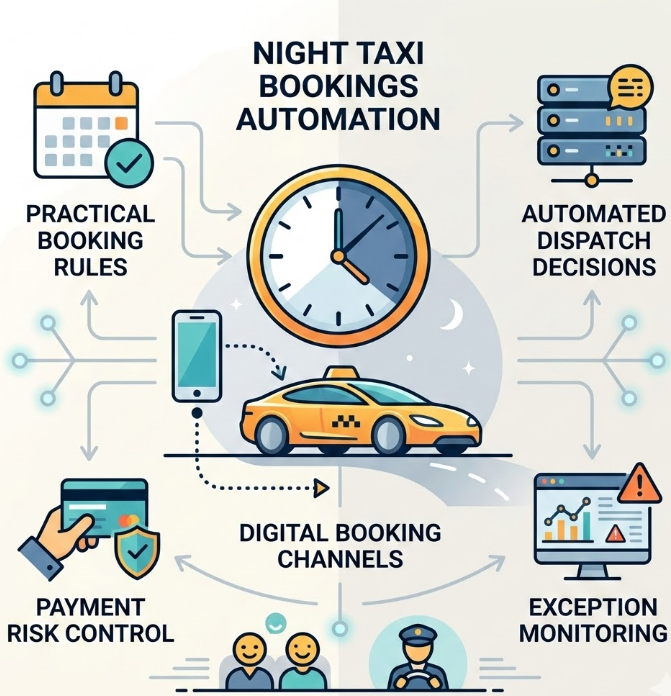
We will explain how to set practical booking rules, move booking intake toward digital channels, automate dispatch decisions, control payment risk, and monitor exceptions using a modern 24/7 taxi booking system designed for reliable taxi booking automation.
Step 1: Set Clear Night Operation Rules Before Removing Staff
Night operations should never depend on improvisation. Once call centre coverage is reduced, every booking must follow a clear and predictable process. If these rules are not defined in advance, drivers end up unsure about which trips to accept, and customers quickly lose patience.
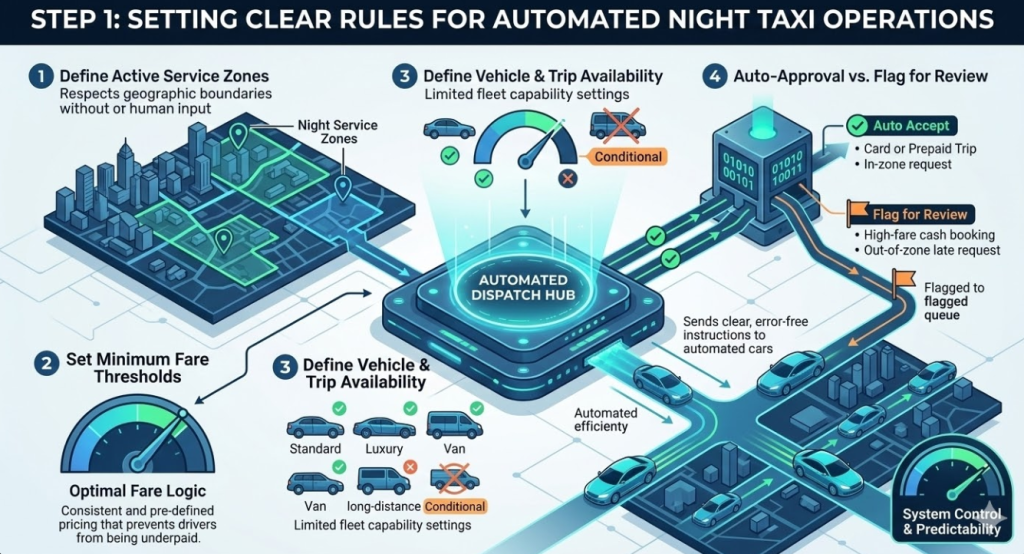
Before scaling down night staff, it is important to build a clear operational structure. That structure defines how your fleet behaves during late hours and allows the system to handle requests automatically. In practical terms, this means setting clear service boundaries, pricing logic, and booking conditions that your platform can apply without human intervention.
When these elements are properly configured, the system takes over routine decisions and taxi booking automation begins to work reliably.
Define Coverage, Pricing, and Vehicle Availability
Start by determining what your fleet should accept during night hours and what should be limited. This does not restrict business opportunities. Instead, it ensures that operations remain controlled and predictable.
Your taxi booking automation software should enforce these rules automatically so that each incoming request follows the same framework.
Typical night operation settings may include:
- Define active service zones after a specific time in the evening
- Set minimum fare thresholds for late-night trips
- Limit certain vehicle types if driver availability becomes low
- Restrict long-distance bookings when necessary
- Accept only airport transfers after midnight if demand requires it
- Configure automatic fare adjustments for night hours
Once these rules are established, bookings enter the system in a structured way. Dispatch decisions become easier and drivers receive clearer instructions.
Decide What Gets Auto-Approved and What Requires Review
Operating without a night call centre means that the system must distinguish between routine bookings and requests that require attention.
Some trips can safely move directly into dispatch. Others may need a flag for review before being accepted. A well-configured 24/7 taxi booking system can make these decisions automatically.
For example:
| Auto Accept | Flag for Review |
|---|---|
| Verified customer | High-fare cash booking |
| Card or prepaid trip | Incomplete pickup address |
| In-zone request | Out-of-zone late request |
By separating normal requests from higher-risk bookings, your platform keeps operations stable even during late hours. This approach allows fleets to manage night-time taxi bookings efficiently without relying on a full call centre team.
Read also: Why Phone-Based Taxi Booking Doesn’t Scale and Costs More Than You Think
Step 2: Shift Booking Intake to Structured Digital Channels
Removing call centre staff does not mean reducing service quality. It means replacing manual intake with structured digital channels that collect accurate booking information from the start.
Night operations work best when every request enters the system complete, validated, and ready for dispatch. When booking data arrives in a consistent format, drivers receive clearer instructions and the platform can process requests without delays.
The goal is simple: move booking intake away from phone conversations and toward systems that automatically collect the details you need.
Use a Web Booking Portal for Immediate Requests
The first layer of booking intake should be a web booking portal that allows customers to submit their trip details directly. Instead of calling an operator and explaining the trip step by step, passengers enter the information themselves.
A properly configured cloud taxi booking system checks the data before the booking is accepted. It validates pickup locations, requires mandatory fields, and shows the estimated fare before the request is confirmed.
Your booking portal should require the following information:
- Verified pickup location
- Complete drop-off address
- Contact number
- Vehicle selection
- Fare preview before submission
When customers see the price upfront and confirm their own trip details, the number of intake mistakes drops significantly. At the same time, the need for manual clarification disappears.
Enable Passenger App for Repeat Customers
Regular passengers should not have to type the same information every time they book a ride. A passenger app powered by taxi booking automation allows riders to save frequent pickup points, preferred vehicle types, and contact details.
This small improvement makes the booking process much faster. Fewer typing steps mean fewer errors and quicker confirmations.
Passenger apps also provide another important advantage. Customers can track their driver in real time. Instead of calling the fleet to ask for updates, they simply open the app and see where the driver is.
That visibility alone removes a large portion of late-night incoming calls.
Use AI Voice Intake for Late-Night Callers
Even with digital channels in place, some customers will still prefer to call. Instead of forwarding these calls to a human operator, an AI taxi booking system can handle the intake process automatically.
The system listens to the request, captures pickup and destination details, confirms key information, and converts the call into a structured booking inside the platform.
Across many service industries, a significant share of callers hang up if their call is not answered quickly. AI voice intake prevents this situation. Every late-night request is captured, validated, and prepared for dispatch without requiring a call centre operator.
Step 3: Standardize Booking Details to Prevent Night Errors
Night operations tend to fall apart when booking details arrive incomplete. If essential information is missing, dispatch slows down and drivers end up calling customers just to clarify basic details.
Standardization solves this problem. When every request enters the platform with the same required information, trips can move straight to dispatch without delays.
A structured process ensures that each booking inside your system is immediately usable and ready for action.
Make Critical Fields Mandatory
When a taxi fleet operates without call centre staff, the system must ensure that no trip is confirmed without complete information.
A properly configured 24/7 taxi booking system allows operators to enforce mandatory fields before a booking can be submitted. This guarantees that every request includes the details drivers need.
At a minimum, the system should require the following:
- Pickup address
- Landmark or gate reference
- Phone number
- Vehicle type selection
- Payment method
- Special notes or baggage details
By requiring these inputs at the booking stage, you remove the need for late-night clarification. Drivers receive complete trip details immediately, and dispatch decisions can move forward without interruption.
Add Confirmation Loops to Reduce Wrong Pickups
Mandatory fields improve data quality, but an additional step helps prevent common booking mistakes. Confirmation prompts give passengers one final opportunity to verify their trip details before submitting the request.
This step asks customers to confirm key elements such as pickup location, destination, and trip time.
Even a simple confirmation screen can prevent costly errors. A single incorrect pickup location can easily waste 20 to 30 minutes, delay the driver’s next job, and create unnecessary frustration for both the passenger and the fleet.
When the system repeats the most important details before final confirmation, dispatch corrections become far less frequent. That helps maintain driver availability and keeps operations running smoothly during busy night hours.
Read also: How Auto Dispatch Improves Efficiency in Scheduled Rides
Step 4: Automate Dispatch Decisions Instead of Manual Assignment
Once night staff is reduced, dispatch cannot rely on someone constantly monitoring a screen. The assignment process must follow predefined logic that runs automatically inside the platform.
Drivers should receive jobs through a system that already knows how to distribute requests. When dispatch rules are clearly configured, assignments move forward smoothly and drivers respond without delay.
This is where a well-configured taxi dispatch software becomes critical.
Choose the Right Dispatch Model
The dispatch model you select has a direct impact on how efficiently night operations run. Different fleets require different approaches depending on driver numbers, demand patterns, and service structure.
A modern system allows you to automate dispatch using several models. Each one has advantages depending on how your fleet operates.
Common automated dispatch methods include:
- Auto assign to the nearest available driver
- Broadcast trips to multiple drivers for quicker acceptance
- Nearest driver priority based on GPS distance
- Airport queue logic for terminal pickups
A simple comparison helps illustrate when each model works best:
| Dispatch Model | Best For | Risk |
|---|---|---|
| Auto Assign | Smaller fleets | Driver rejection delays |
| Broadcast | High-demand hours | Over-notification |
| Airport Queue | Structured terminals | Requires driver discipline |
Selecting the right dispatch structure reduces delays and keeps drivers moving without requiring manual supervision during the night.
Build Fallback Rules for Unaccepted Trips
Even with strong automation, some bookings will not be accepted immediately. Running operations without night staff means the system must already know what to do when this happens.
A reliable 24/7 taxi dispatch setup should include fallback logic that keeps the booking active until a driver confirms.
Typical fallback rules may include:
- Retry logic after a defined timeout
- Automatic expansion of the driver search radius
- Notification to a supervisor dashboard after repeated rejections
- Automatic rescheduling if no driver confirms within a defined time window
These rules prevent bookings from sitting idle in the system. Instead of waiting for a dispatcher to intervene, the platform adapts automatically.
The result is a continuous booking flow where night-time taxi bookings keep moving through the dispatch pipeline even when driver responses vary.
Step 5: Manage Payments and Risk at Night
Night operations always come with a bit more uncertainty. New riders book trips at the last minute, airport transfers appear suddenly, and cash requests are more common. All of this increases the risk of cancellations or no-shows.
When no one from your team is actively monitoring every booking, your payment setup must work as a safeguard. The system itself should apply rules that protect revenue and reduce unnecessary risk.
A well-configured platform allows fleets to control financial exposure while still keeping bookings moving smoothly.
Use Deposits or Split Payments for High-Risk Trips
Managing risk without call centre supervision requires clear payment rules inside the system. Instead of evaluating each booking manually, the platform applies predefined conditions when certain criteria are met.
For trips that carry higher uncertainty, deposits or split payments can be required before dispatch.
Typical safeguards may include:
- Partial payment at the moment of booking
- Card pre-authorization before dispatch
- Mandatory card payment for new customers
- Corporate account verification before trip approval
These rules become part of your structured approach to taxi booking system pricing during night hours. Rather than adjusting fares randomly, the system applies controlled financial conditions based on booking type.
This approach protects drivers from unnecessary trips and limits the number of unpaid bookings, which is especially important late at night when manual follow-up is limited.
Reduce Cancellations With Automated Confirmations
Clear communication plays a major role in reducing cancellations. Automated notifications help reassure customers that their booking has been received and processed.
A good system can automatically send:
- SMS confirmation after the booking is created
- App push notifications with trip details
- Driver assignment alerts
- Live driver ETA updates
When passengers receive immediate confirmation and can see the driver approaching in real time, uncertainty disappears. Customers feel confident that their ride is on the way, which significantly lowers the chance of cancellation.
It is worth considering the operational impact. Just two no-shows during a night shift can erase the profit from several completed trips.
Automated confirmations help prevent that loss and keep the fleet productive even when there is no staffed call centre monitoring every booking.
Step 6: Monitor Exceptions Instead of Monitoring Every Trip
Running night operations without staff does not mean giving up control. It simply means changing where your attention goes.
Instead of watching every single booking, you focus only on the trips that fall outside the normal process. Most requests move through the system automatically. Only exceptions need human attention.
This approach allows fleets to keep operations stable while relying on taxi booking automation to handle routine volume.
Build a Night Exception Dashboard
A well-designed dashboard inside your taxi booking automation software should highlight only the situations that require review. The idea is to filter out normal activity and surface only the cases where something needs attention.
When the dashboard focuses on exceptions, operators avoid unnecessary manual interference and can respond quickly to potential problems.
Your night exception checklist can include:
- Unassigned trips
- Failed payments
- Repeated cancellations
- Driver no response within the defined time window
When these alerts appear in real time, managers can step in only when necessary. The rest of the booking flow continues automatically without constant supervision.
Conduct a Morning Performance Review
Automation works best when it is regularly reviewed and adjusted. A short review each morning helps identify patterns from the previous night and keeps the system running smoothly.
Fleet managers should check the exceptions recorded during the night and evaluate whether operational rules need adjustment.
A structured review may include:
- Checking unassigned trips and understanding why they were rejected
- Reviewing payment failures and adjusting payment rules if needed
- Monitoring cancellation patterns
- Refining coverage zones or dispatch logic
Experienced fleet operators know that small daily adjustments improve system performance over time. Instead of reacting to problems as they appear, the fleet gradually builds a more reliable automated process.
With regular reviews and a clear exception dashboard, night-time taxi bookings remain controlled even when the fleet operates without call centre dependency.
Read also: Boost Efficiency and Profits with Cloud-Based Taxi Dispatch Software
Conclusion
Night management is not about answering more calls. It is about designing a system that does not depend on someone picking up the phone.
When your rules are clear, intake becomes structured, dispatch runs on logic, payments are protected, and only exceptions require attention. Under these conditions, night operations stop feeling chaotic and start becoming predictable.
You are no longer reacting to late bookings. You are controlling them.
A modern taxi dispatch software demo can show how structured intake, automated dispatch, and payment safeguards operate together in real time. Companies that want to go further often combine dispatch systems with tools like AI Integration to automate booking intake and call handling during late hours.
Instead of expanding call centre coverage, fleets build a framework that runs consistently every night.
The change is not about reducing service. It is about replacing manual dependency with reliable automation.
FAQs
1. Can taxi fleets really operate at night without call centre staff?
Yes, many taxi fleets already manage night operations without a full call centre team. The key is using a 24/7 taxi booking system that collects booking details automatically, validates trip data, and dispatches drivers based on predefined rules. When booking intake, dispatch logic, and payment rules are properly configured, most night requests can move through the system without manual intervention.
2. What happens if no driver accepts a night booking?
A well-configured taxi dispatch software includes fallback rules that automatically react when a trip is not accepted. The system can retry dispatch, expand the search radius, or broadcast the request to more drivers. These automated responses prevent bookings from remaining unassigned and keep the dispatch process moving even without staff supervision.
3. Is automation suitable for smaller taxi fleets?
Yes. In fact, smaller fleets often benefit the most from taxi booking automation. With fewer drivers and limited staff resources, automation helps maintain service availability without expanding operational costs. Even fleets with a small number of vehicles can manage bookings efficiently using structured digital intake and automated dispatch.
4. Will customers trust an automated taxi booking process?
Most customers already expect digital booking options. When passengers can see fare estimates, confirm trip details, and track their driver in real time, trust usually increases rather than decreases. Clear confirmations through SMS, app notifications, or email help reassure customers that their ride has been successfully scheduled.
5. How long does it take to implement a modern taxi booking system?
Implementation time depends on fleet size and system configuration, but many modern platforms can be deployed relatively quickly. Once booking rules, dispatch settings, and payment conditions are defined, fleets can begin using the 24/7 taxi booking system and gradually optimize their night operations through daily performance reviews.