


 Subscribe
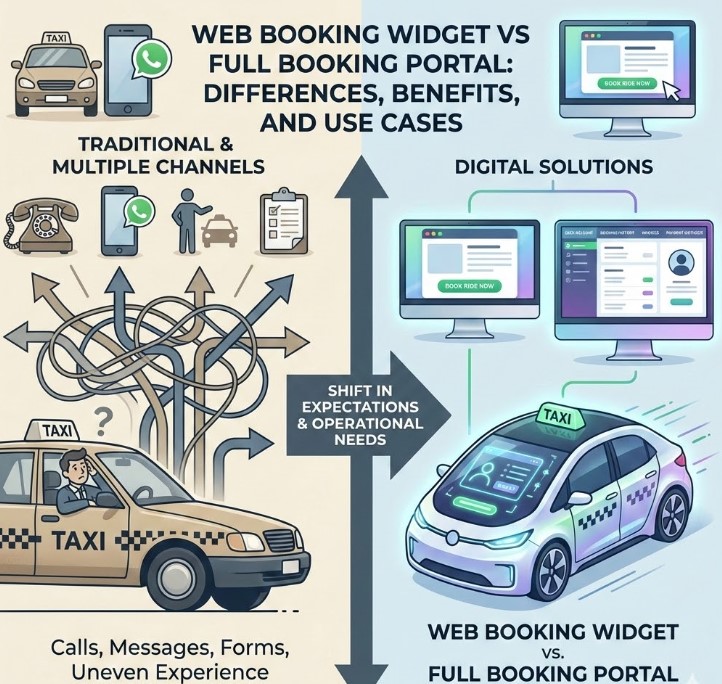
Taxi bookings now arrive through several channels at once. Some passengers still prefer calling a dispatcher and speaking to a real person. Others choose WhatsApp because it feels quick and informal. A growing share of customers simply expect to find a booking option directly on the company website and complete everything online.
This mix of channels often leads to an uneven experience. Customers are not always sure which option is best, and teams handling requests have to switch between calls, messages, and online forms throughout the day. Over time, this can slow response times and make it harder to keep bookings consistent.
As passenger expectations shift toward speed and convenience, many taxi operators start looking for digital tools that bring more order into the booking process. The goal is usually simple: make it easier for customers to book a ride while reducing manual work for the team behind the scenes.
In practice, two solutions usually come up first: a web booking widget and a full booking portal. Both allow customers to book rides online, but they are built for very different use cases and levels of operational complexity.
Understanding this difference matters before committing to one option. A lightweight booking form embedded on a website can be the right choice for operators who mainly handle one-off trips. Others may need a more advanced setup that supports user accounts, recurring bookings, saved payment details, invoicing, and ongoing customer relationships.
In this article, we look at both options in a clear and practical way. You will see what each solution actually does, how they differ in day-to-day use, and which one fits best with how your taxi business operates today and how it plans to grow tomorrow.
Let’s start by taking a closer look at how taxi companies traditionally received bookings.
Read also: Taxi Automation: Two Ways to Handle the Same Booking
How Taxi Companies Traditionally Received Bookings
- For decades, taxi bookings came through three primary channels:
- Phone calls where passengers called dispatchers, waited in queues, repeated their addresses, and hoped nothing got lost in translation
- Walk-in requests at taxi stands or hotel desks
- Manual text messages or WhatsApp messages that arrived faster than dispatchers could manage them
- These methods worked for a while. The industry grew on them.
- Yet they also carried clear risks:
- Calls were easy to mishear
- Details were easy to forget
- Paper notes could get lost
- Passengers waited too long for confirmation
- Dispatchers juggled too much, too fast, with too little structure
- This becomes very painful during peak hours.
- A missed call often becomes a missed booking
- The pressure increases when messages and calls arrive at the same time
- Small mistakes (wrong address, wrong time) quickly turn into real operational issues
- Eventually, operators needed something more reliable, more automated, and more scalable.
- So online booking tools entered the picture.
- But not all of them serve the same purpose
- That’s why the choice between a taxi web booker and a full booking portal matters more than ever
What Is a Web Booking Widget?
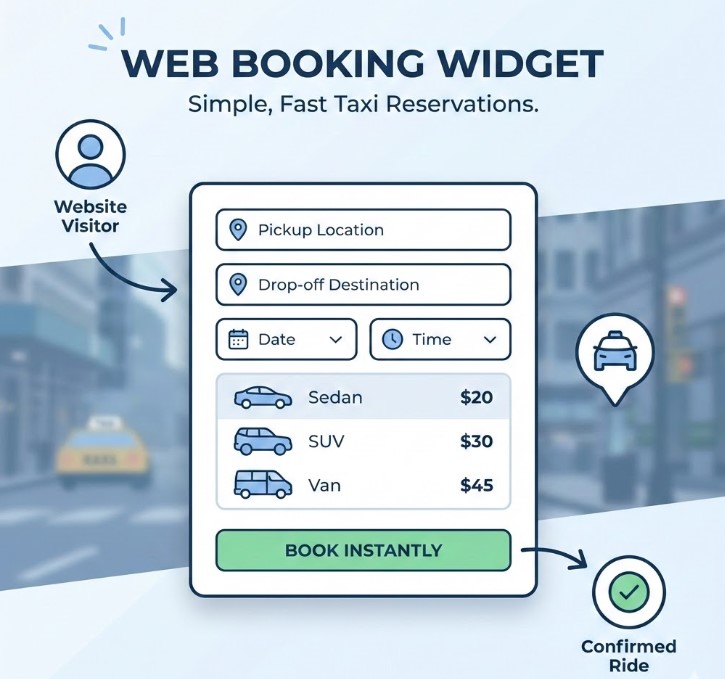
A web booking widget is a small booking tool that is embedded directly into a taxi company’s website. In practice, it works as a simple and focused online booking form for operators who want to offer fast, straightforward bookings without unnecessary steps.
From the passenger’s perspective, everything happens in one place. They open the website, enter the pickup and drop-off locations, choose a vehicle if needed, see the fare, and confirm the ride. The process is short and intuitive, with no distractions along the way.
The widget can be placed on the homepage or on any other page where bookings make sense. Its main role is to turn website visitors into confirmed bookings as quickly as possible. There is no need for users to leave the site or navigate through multiple screens.
One of the key characteristics of a web booking widget is what it doesn’t require. Passengers are not asked to create an account, log in, or manage a profile. There are no extra options that slow down the decision. Everything is built around one clear goal: making a taxi booking with the least amount of friction.
This type of tool works especially well when simplicity is the priority. For operators who mainly handle standard point-to-point rides, a web booking widget helps customers decide faster and book with confidence, without overcomplicating the experience.
What Is a Full Booking Portal?
A full booking portal is a standalone online booking system designed for passengers and corporate clients who need more control over their trips. Instead of submitting a single booking and closing the page, users log in to a dedicated platform where they can manage transportation on an ongoing basis.
This type of solution goes far beyond a simple booking form. A portal becomes a complete taxi booking system that supports more complex workflows and long-term customer relationships. It is built for businesses that handle more than just occasional point-to-point rides.
A full booking portal typically supports:
- User accounts where passengers can log in and manage their details
- Corporate profiles for companies booking rides for employees or clients
- Saved payment methods for faster and consistent billing
- Recurring bookings for regular routes and schedules
- Multi-service options such as airport transfers, hourly rides, or chauffeur services
- Custom fare rules based on client type, route, or contract
- Invoicing and billing tools for transparent financial tracking
- Wallets or vouchers for prepaid or promotional rides
- Special trip requirements such as meet-and-greet, extra luggage, or custom instructions
A full booking portal makes sense when taxi services go beyond casual daily rides. Operators offering airport transfers, chauffeur services, corporate travel, event transportation, or managing fleets across multiple cities need a structured environment where trips can be planned, adjusted, and reviewed. A dedicated portal turns that complexity into a clear and professional experience for both the customer and the operator.
Read also: WhatsApp & Contact Form VS CodiCo Dispatch Software
Web Booking Widget vs. Full Booking Portal: A Clear Comparison
Every taxi operator works in a slightly different setup. Some focus on quick, one-off rides, others manage complex bookings across services, clients, and locations. That’s why comparing a web booking widget with a full booking portal side by side helps clarify where each option truly makes sense.
Below is a practical comparison that highlights how the two solutions differ in daily use and long-term impact.
| Factor | Web Booking Widget | Full Booking Portal |
|---|---|---|
| Purpose | Fast online bookings | Complete booking management |
| Customer Type | Walk-in website visitors | Frequent travelers and corporate clients |
| Account Login | Not required | Required |
| Booking Flow | Very simple and direct | Advanced and customizable |
| Setup Time | Usually a few days | Around 3 to 5 weeks |
| Branding | Embedded within your website | Fully branded standalone portal |
| Ride Types | Mainly point-to-point trips | All ride types, including hourly, rentals, and airport services |
| Pricing Rules | Basic fare estimates | Dynamic pricing and custom corporate rates |
| Scalability | Limited by design | Grows together with your business |
| Best For | Small to mid-size taxi companies | Larger operators with multiple service lines |
| Industry Fit | Local taxis, hotels, shuttle services | Airport transfers, limo companies, PHOs |
This comparison works as a quick filter rather than a final answer. The right choice depends on how your business operates today and where it is heading next. Daily booking volume, client expectations, service complexity, and long-term growth plans all play a role in deciding whether a simple widget is enough or a full portal is the better foundation.
Use Cases That Help You Choose the Right Option
Looking at real situations often makes the decision much clearer. Different taxi businesses face different challenges, and each setup naturally points toward the solution that fits best. Below are common scenarios operators encounter and which option usually works better in each case.
Scenario A: Local City Taxi Operator
You want customers to book quickly without thinking too much. Most rides are simple pickup and drop-off trips. Long forms or extra steps only slow people down and increase the chance they leave the website.
Best choice: web booking widget.
It keeps the booking process short and clear, helps convert visitors into bookings, and shows availability without unnecessary friction.
Scenario B: Airport Transfer Company
Your clients usually book in advance. Bookings include flight numbers, arrival times, passenger counts, luggage details, and sometimes special pickup instructions. Return trips and group bookings are common.
Best choice: full booking portal.
It gives passengers a clear overview of their upcoming trips and gives your team better control over scheduling, reducing missed pickups and last-minute confusion.
Scenario C: Limo or Chauffeur Company
You work with VIPs, corporate clients, or event organizers. They expect a polished experience, clear invoices, saved preferences, and the ability to manage recurring bookings. The booking process itself reflects your brand.
Best choice: full booking portal.
A dedicated portal supports that premium experience and reinforces trust from the first booking to final billing.
Scenario D: Small Operator with Growing Demand
You started with a small team and simple workflows. Now bookings are increasing, dispatchers feel the pressure, and manual handling starts to cause delays. You need automation, but you are not ready for full complexity yet.
Best choice: start with a web booking widget and move to a full booking portal as demand grows.
Your booking system should support growth step by step, not force you into a setup that feels too heavy too early.
Read also: Essential Dispatch Programs for Running a Successful Taxi Business
Why the Right Booking Experience Matters More Than Ever
Passengers are used to smooth digital experiences. They book flights, hotels, and services in a few taps, and they expect taxi bookings to work the same way. Their fingers move fast, and their patience runs out just as quickly.
If a booking flow feels clunky, people leave. If it looks outdated, they switch to another provider. And if booking is only possible by phone, there is a real risk of losing younger passengers who simply won’t call anymore.
The right booking setup does more than accept rides. It actively supports your business by helping you:
- Boost online bookings by making the process clear and fast
- Reduce dispatcher workload and manual handling
- Improve booking accuracy and avoid misunderstandings
- Offer real 24/7 availability without extra staff
- Win corporate accounts that expect structured booking tools
- Reduce booking errors that lead to complaints or missed rides
- Build long-term customer trust through a consistent experience
At the same time, the choice between a web booking widget and a full booking portal is not a small or temporary decision. It directly affects how customers perceive your service and how efficiently your team operates. That choice shapes your booking experience, your internal workflows, and your ability to grow for years to come.
How Codico Helps You Pick the Right Solution
At Codico, we work with taxi and mobility operators of different sizes and business models. The focus is not on offering a one-size-fits-all product, but on helping operators choose a booking setup that actually fits how they work day to day.
The technology behind Codico’s booking tools connects the full operational flow: bookings, dispatch, drivers, payments, trips, and reporting. Everything runs within a single ecosystem, powered by Codico’s Taxi Dispatch Software, so online bookings translate directly into real operational actions.
Here is how Codico helps operators choose the right setup:
- If your goal is to increase online bookings with minimal friction, a web booking widget provides the fastest path from website visit to confirmed ride.
- If your operation depends on structured airport transfers, corporate clients, or recurring bookings, a full booking portal gives you the control and visibility you need.
- If your business needs both, Codico allows you to run a widget and a portal together without splitting data or workflows across different systems.
Because all tools are part of the same platform, operators are never locked into a single decision. Many start with a simple booking widget and later expand into a full portal as demand grows, services diversify, or corporate clients come on board.
In practice, operators using Codico have increased online bookings after introducing a streamlined web booking experience. Others have reduced operational errors by moving complex bookings into a structured portal environment. These results come from real businesses solving real challenges, not from theoretical models.
The idea is straightforward: choose the booking experience that works for you today, with the flexibility to grow and adapt tomorrow.
Final Thoughts: Choosing What Works for Your Business
There is no universal answer when it comes to choosing between a web booking widget and a full booking portal. Each option solves a different problem, and the right choice depends on how your taxi business actually operates, not on what looks more advanced on paper.
If your priority is speed, simplicity, and fast online conversions, a booking widget can remove friction and help customers book without hesitation. If your operation involves airport transfers, corporate accounts, recurring trips, or multiple service types, a full booking portal offers the structure and control needed to keep everything organized.
What matters most is that your booking experience matches your business reality. A tool that feels too simple can limit growth, while a system that is too complex can slow teams down and confuse customers. The goal is to support today’s workload while leaving room for tomorrow’s expansion.
This is where CoDiCo makes the difference. By offering flexible booking tools built on a single platform, CoDiCo allows operators to choose the setup that fits their current needs and evolve without disruption. Both widgets and portals are part of the same ecosystem, powered by reliable Taxi Dispatch Software, so bookings, dispatch, drivers, and payments stay fully connected.
In the end, the right booking experience is not about features. It is about clarity, efficiency, and trust. When passengers find it easy to book and operators find it easy to manage, the entire business runs smoother. Choosing the right solution today lays the foundation for sustainable growth in the years ahead.