


 Subscribe
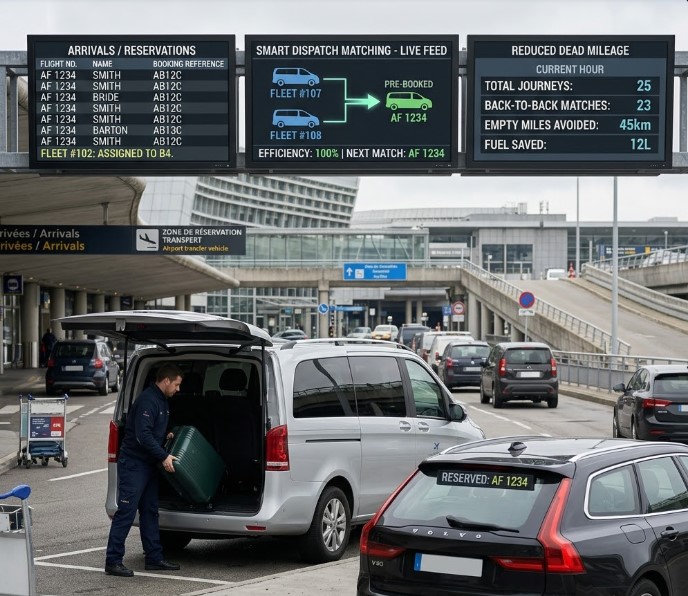
Your Driver Just Dropped a Passenger at the Airport. Now What?
He turns around and drives home. Empty. No passenger, no revenue – just fuel, driver time, and wear on the vehicle.
If this happens once, it’s manageable. If it happens 20 times a day across your fleet, you’re running an operation that pays to move vehicles for no return. That’s dead mileage – and for most airport transfer companies running 5 to 20 vehicles in Europe, it’s one of the most expensive problems hiding in plain sight.
This guide covers what dead mileage actually costs, why manual dispatch can’t fix it at scale, and how the right airport transfer fleet management system helps reduce empty returns through smarter routing, return-trip matching, and automated dispatch.
Table of Contents
- The Real Cost of Empty Returns
- Why Manual Dispatch Can’t Solve This
- How Smart Dispatch Reduces Empty Returns
- Three More Tools That Reduce Dead Mileage
- What This Looks Like in Practice
- The Mistake Most Operators Make
- Dead Mileage Is a Profitability Problem – and a Solvable One
The Real Cost of Empty Returns
Let’s put a number on it.
A typical airport transfer in Western Europe covers 40–60 km. If your driver completes a drop-off at Brussels Airport and drives back to Brussels city centre empty, that’s 30 km and roughly 40 minutes of driver time – with zero revenue attached.
For a fleet of 10 vehicles doing 5 airport runs each per day:
- 50 total airport trips
- If half the returns are empty: 25 empty runs per day
- 25 × 30 km = 750 km of dead mileage daily
- At €0.18/km fuel cost plus driver time, that’s easily €150–250 per day in direct costs
Over a month, that’s a figure that could fund another vehicle lease, a driver salary, or a serious marketing budget. According to transport industry data, dead mileage typically accounts for 15–30% of total kilometres driven in private hire and transfer operations – a significant drag on profitability that most operators underestimate.
The problem isn’t that drivers make empty returns occasionally. The problem is that without a proper system, empty returns are the default – not the exception.
Why Manual Dispatch Can’t Solve This
The instinct is to try to solve dead mileage manually: have a dispatcher watch the schedule, spot when a driver is heading to the airport, and find a matching pickup in time.
In practice, this doesn’t work at scale.
A dispatcher managing 8–15 vehicles simultaneously can’t reliably cross-reference departure times, arrival times, driver locations, and vehicle availability in real time – while also handling inbound calls, last-minute changes, flight delays, and driver communication.
The matching logic required to eliminate dead mileage needs to happen automatically, every time, for every booking:
“Driver A is dropping at Terminal 2 in 35 minutes. Booking B needs pickup from Terminal 1 in 50 minutes. Same airport. Vehicle class matches. Assign.”
A human can do this occasionally. A system does it consistently.
This is exactly where automated dispatch changes the economics of running a transfer fleet. For a deeper look at how this plays out in scheduled operations, see: How Auto Dispatch Improves Efficiency in Scheduled Rides.
How Smart Dispatch Reduces Empty Returns
A well-configured airport transfer dispatch software does one thing manual coordination can’t: it sees all bookings simultaneously and assigns drivers based on where they will be, not just where they are now.
Here’s the logic in three steps:
Future position tracking When a driver is assigned to take a passenger to Frankfurt Airport at 14:00, the system knows that driver will be available near Frankfurt Airport at approximately 14:45. That future position becomes a matching variable — immediately.
Proximity matching Any booking requiring a pickup from Frankfurt Airport between 14:30 and 15:15 is automatically matched against available drivers — including the driver who will already be there finishing the drop-off.
Automatic assignment If the match is valid – vehicle class, passenger capacity, timing – the system assigns the return pickup automatically. The driver receives the next job before completing the first one.
Result: the same driver who dropped a passenger at the airport picks someone up on the return. Dead mileage drops. Revenue per vehicle-hour increases. No dispatcher intervention required.
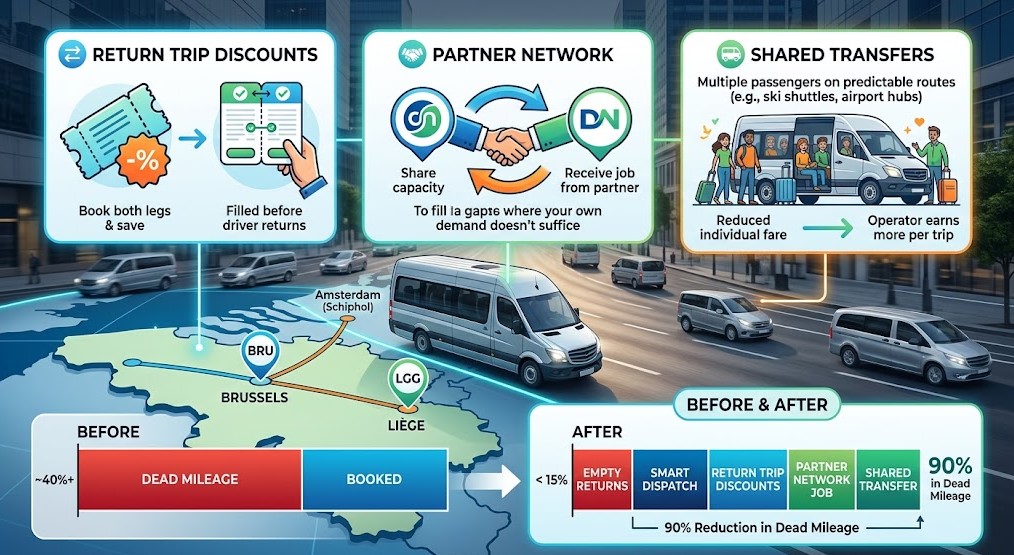
Three More Tools That Reduce Dead Mileage
Smart dispatch handles the core matching logic. Three additional tools compound the effect:
1. Return Trip Discounts
The simplest way to fill an empty return is to give the passenger a reason to book it before they leave.
A customer booking a transfer to the airport is a natural candidate for the return journey. A discount on the return trip — configurable directly in your pricing settings – gives them a concrete incentive to book both legs at once.
For your fleet, two confirmed trips from the same customer means the return slot is already filled before the driver completes the first leg. No matching needed – the booking is already there.
2. Partner Network
Not every empty return can be filled from your own bookings. If your fleet has a systematic imbalance – heavy outbound traffic in the morning, heavy inbound in the afternoon – you’ll have gaps that your own demand can’t fill.
A partner network solves this by allowing operators to share capacity. If your driver is finishing a drop-off at Amsterdam Schiphol and you have no return booking, a partner company with a pickup at Schiphol can assign that job to your driver. Both companies benefit, the vehicle doesn’t return empty, and your driver earns on what would have been a dead run.
This kind of cross-company capacity sharing is how larger operators have always worked. Modern dispatch platforms make it accessible to fleets of 5–20 vehicles – without the informal arrangements and commission disputes that come with manual partner coordination.
3. Shared Transfers
For routes with predictable demand – major airports, ski resort shuttles in France or Austria, corporate hub routes in Brussels or Amsterdam – shared transfers allow multiple passengers travelling the same direction to share a vehicle.
Each passenger pays less than a private transfer rate. The operator earns more per vehicle-kilometre. And the vehicle covers the route with a full load rather than a single passenger or no passenger at all.
💡 For operators running high-volume airport routes, shared transfers can reduce dead mileage while simultaneously improving revenue per trip one of the few optimisations that works in both directions at once.
What This Looks Like in Practice
Consider an airport transfer company operating 12 vehicles across Belgium, serving Brussels Airport (BRU) and Liège Airport (LGG).
In a typical scenario, an airport transfer company operating 12 vehicles across Belgium may see empty returns on a large share of airport drop-offs during peak hours. With automated future-position matching, return trip discounts, and partner capacity sharing, that share can be significantly reduced without adding more vehicles or drivers.
After: empty return rate dropped below 15%. The combination of automated future-position matching, return trip discounts, and partner network capacity sharing filled the gaps that manual coordination consistently missed.
No additional vehicles. No additional drivers. No price increases. The same fleet, running more efficiently because the system could see what the dispatcher couldn’t.
Related: Why Transfer Companies with 10+ Vehicles Need Dispatch Software to Automate Driver Scheduling
The Mistake Most Operators Make
The most common response to dead mileage is to accept it as a structural cost – “that’s just how airport transfers work.”
The second most common response is to hire a more experienced dispatcher.
Neither fixes the problem. Dead mileage isn’t a human attention problem. It’s a data processing problem. The matching logic required to eliminate empty returns consistently – across a fleet of 10+ vehicles, in real time, accounting for flight delays and last-minute bookings – is beyond what any dispatcher can handle manually as their workload grows.
Operators who eliminate dead mileage don’t work harder. They run their fleet through a system that works automatically.
Related: Taxi Business Automation: How to Save 6+ Hours a Day and Stop Losing Clients
Dead Mileage Is a Profitability Problem – and a Solvable One
Every empty return is a direct transfer of money from your revenue potential to your fuel costs and driver wages – with nothing to show for it. For a fleet of 10 vehicles, cutting empty returns by half can recover the equivalent of one vehicle’s worth of monthly operating costs.
The operators getting this right aren’t larger or better resourced. They’re running their airport transfer fleet management through a platform that matches drivers automatically, fills gaps through partner networks, and gives passengers a built-in reason to book the return.
That’s what CodiCo is built for – not to add complexity to your operations, but to remove the expensive inefficiency that manual coordination creates at scale.
If you’re running 5 to 20 vehicles across Belgium, Germany, France, Spain, or the Netherlands and want to see what this looks like for your fleet, view CodiCo pricing plans.
Related Articles
- How Auto Dispatch Improves Efficiency in Scheduled Rides
- Revenue Strategies: Increase Your Taxi Fleet’s Profit by 30% Without Hiring More Drivers
- How Much Money Are You Losing with Manual Ride Reservations?
Final Thoughts
Dead mileage doesn’t appear as a line item on your profit and loss statement. It hides in your fuel bills, your driver hours, and the gap between how many trips your fleet could complete and how many it actually does.
The fix isn’t working harder or hiring a better dispatcher. It’s giving your fleet a system that sees every booking, every driver position, and every opportunity to fill an empty return – and acts on it automatically, every time.
That’s the difference between a transfer business that grows and one that stays busy without getting more profitable.