


 Subscribe
You’re Losing Bookings to Companies That Don’t Even Own a Car
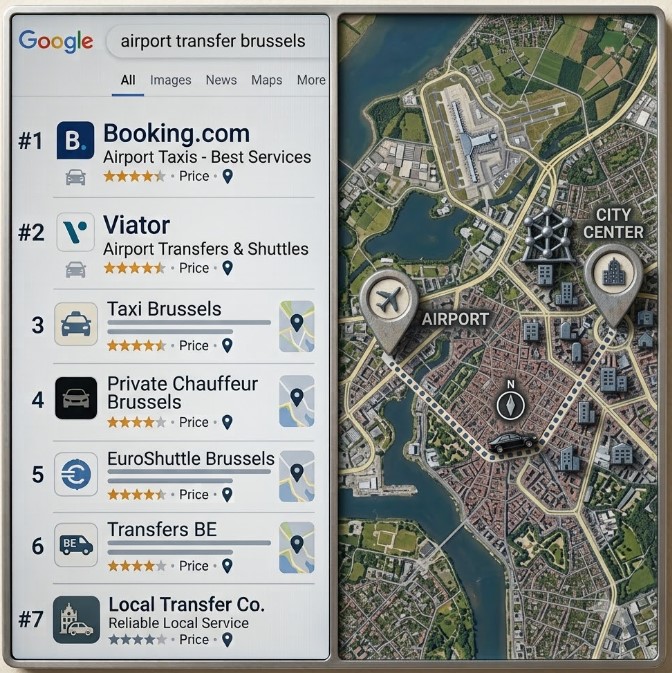
Here’s a frustrating truth every airport transfer operator in Europe knows: you do the actual work – the early morning pickups, the flight tracking, the meet & greet at the terminal – but it’s Booking.com, Viator, and TripAdvisor that collect the booking and take the margin.
Not because they’re better. Because they rank higher on Google.
The good news: they can’t own every search. Aggregators dominate broad queries like “airport taxi” or “airport transfer.” But the moment someone searches “Brussels Airport to Bruges private transfer” or “Amsterdam Schiphol to Rotterdam 7 passengers” – that territory is wide open. And that’s exactly where a focused SEO strategy wins.
This guide walks through exactly how to get there – step by step, without a marketing agency or a six-figure budget.
Table of Contents
- You’re Losing Bookings to Companies That Don’t Even Own a Car
- Why SEO Works Differently for Airport Transfer Companies
- Start with Google Business Profile
- Stop Competing on Generic Keywords – Target Routes Instead
- Create a Dedicated Landing Page for Every Route
- Build Your Site Like a Route Network
- Build Authority Through Local Citations and Partner Links
- Get the Technical Basics Right
- Build a Review System That Runs Automatically
- Use Search Console to Find Your Quick Wins
- The Conversion Problem: Don’t Let Good SEO Work Against You
- The 5 Mistakes That Kill Airport Transfer SEO
Why SEO Works Differently for Airport Transfer Companies
Most SEO advice is written for e-commerce or SaaS. Airport transfer businesses operate on different logic:
- Customers plan ahead. A corporate traveller flying into Frankfurt on Tuesday booked that transfer last Wednesday. They searched Google, compared options, and made a decision. That’s your window.
- Intent is extremely high. Someone searching “private transfer CDG airport to Paris 4th arrondissement” is ready to book. They’re not browsing – they’re choosing a provider.
- Routes are finite and rankable. Unlike a global retailer competing for millions of product keywords, you serve a defined set of airports, cities, and routes. You can systematically rank for all of them.
The companies that figure this out early build a compounding traffic machine. Every route page you publish today can bring bookings for years – without paying per click.
1: Start with Google Business Profile – and Take It Seriously
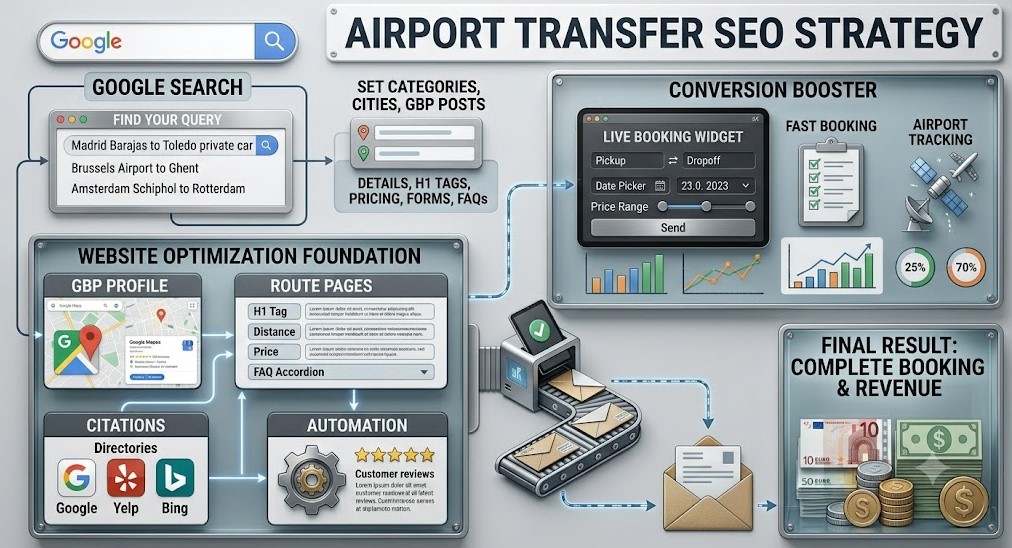
Google Business Profile (GBP) is the single highest-leverage SEO action for local service businesses. Most airport transfer operators set it up once and forget about it. That’s a mistake.
What to do:
- Set your primary category to “Airport Shuttle Service” (more specific beats generic).
- Set your service area carefully: the airport itself, nearby cities, and the regions where you actually operate. Don’t add every city you could theoretically drive to – Google rewards real, verifiable local presence.
- Upload real photos: your vehicles, your drivers in uniform, meet & greet signs, the inside of your cars. Stock photos rarely build the same trust as real vehicle and driver photos, and they usually convert worse.
- Add your routes directly to the “Services” section – e.g., “Brussels Airport to Ghent,” “Schiphol to The Hague.”
- Post updates at least once a week: seasonal offers, new routes, travel tips.
If you operate across multiple countries – say Germany and the Netherlands – create separate GBP listings for each operating base. Google ranks local results based on proximity, so a listing in Düsseldorf will outrank a listing in Amsterdam for local Düsseldorf queries.
2: Stop Competing on Generic Keywords – Target Routes Instead
This is the most important shift in mindset for airport transfer SEO.
Forget “airport taxi.” Forget “airport transfer.” You will never outrank Booking.com on those terms without millions in domain authority built over decades.
Instead, build around route-specific long-tail queries – what your actual customers type when they’re ready to book:
- “Heathrow Terminal 5 to Central London private transfer”
- “Barcelona El Prat airport transfer 6 passengers minivan”
- “Rome Fiumicino to Vatican chauffeur service”
- “Madrid Barajas to Toledo private car”
- “Paris CDG airport to Disneyland Paris transfer”
These searches have three things in common: lower competition, higher conversion rate, and real booking intent. With a decent existing domain and properly built route pages, many operators start seeing first-page movement on these terms within 3–6 months.
How to build your keyword list:
- Open Google and type your main airport name – watch the autocomplete suggestions. Each suggestion is a real search.
- Check Google Search Console (free) to see what queries already bring you impressions.
- Use tools like Ahrefs or Semrush – even the free versions – and search “[airport name] transfer.” Filter by keyword difficulty below 20.
One more thing specific to Europe: the same route is often searched in multiple languages. A customer looking for a Brussels airport transfer might search “airport transfer Brussels,” “luchthavenvervoer Zaventem,” “transfert aéroport Bruxelles,” or “Flughafentransfer Brüssel,” depending on their language and location.
If you operate in multilingual markets, build separate pages and metadata for each language instead of relying on one English page. A Belgian operator serving both Dutch and French speakers can lose part of the market if only one language is properly covered.
Build a spreadsheet: one row per route, with the target keyword, the page URL you’ll create, and the monthly search volume.
3: Create a Dedicated Landing Page for Every Route
One homepage cannot rank for 30 different routes. You need individual pages – one per route, properly optimized.
Each route page should include:
A clear, keyword-rich H1: “Private Airport Transfer: Amsterdam Schiphol to Rotterdam – Book Online”
Route-specific content:
- Distance in km, estimated journey time
- Which terminal your drivers pick up from
- What’s included (meet & greet, flight monitoring, free waiting time)
- Vehicle options available for that route
Pricing information: Even a price range (“from €89 for a standard saloon”) dramatically increases trust and time-on-page. Visitors who see no price usually leave.
A live booking form directly on the page: This is critical. If someone has to navigate to a separate page to book, you lose a significant percentage of them. An embeddable web booking form that shows real-time pricing and confirms the booking instantly removes every friction point between the visitor and the conversion.
Route-specific FAQs:
- “What happens if my flight is delayed?”
- “Do you offer child seats on this route?”
- “Can I pay by card in the vehicle?”
These FAQ sections serve two purposes: they answer real objections, and they capture featured snippet rankings on Google.
Customer reviews mentioning that specific route: A review that says “Excellent transfer from Schiphol to Rotterdam, driver was waiting at arrivals” does more for that page’s conversion than any copywriting.
4: Build Your Site Like a Route Network
Individual route pages only work if they’re connected. Your website structure should follow the same logic as your actual routes:
- Main airport page – one page per airport you serve (e.g., “Amsterdam Schiphol Airport Transfers”)
- City-to-airport pages – “Rotterdam to Schiphol Airport transfer”
- Airport-to-city pages – “Schiphol Airport to Rotterdam transfer”
- Route pages – individual pages for highest-intent journeys
- Supporting blog content – guides, tips, and area information that drives additional traffic
Link from your main airport page to each route page, and from each route page back to the airport page. If you serve multiple nearby destinations, cross-link between them naturally: Heathrow to Central London, Heathrow to Canary Wharf, Heathrow to Oxford. This internal linking structure helps Google understand which pages belong together – and which page should rank for each specific query.
5: Build Authority Through Local Citations and Partner Links
Google decides how trustworthy your site is partly by looking at who else links to you. For local businesses, this means citations (mentions of your name, address, and phone number) and partnerships.
Citations to build:
- Trustpilot, Google, Yelp, Foursquare
- Local business directories in each country you operate in
- Industry directories (private hire associations, transport platforms)
- Airport websites – some airports maintain a list of approved transfer providers. Getting listed there is both a referral source and a strong local signal.
Partnership links – underused and highly effective: Contact local hotels and ask to be listed on their “Getting Here” page as a recommended transfer provider. A link from a 4-star hotel in central Madrid pointing to your “Madrid Barajas transfer” page carries real weight – both as an SEO signal and as a direct source of referral bookings.
The same applies to corporate travel agencies, conference venues, and tourist accommodations. One good partnership can send you bookings for years.
💡 Start with 2–3 hotels closest to your main airport. Email their front desk or concierge manager directly – not the general inbox. A simple message offering a preferred rate for their guests and a commission per booking is enough to open the conversation.
6: Get the Technical Basics Right
You don’t need to be a developer. But a few technical issues can silently tank your rankings:
Page speed: Google measures Core Web Vitals as a ranking factor. Test every route page at PageSpeed Insights. If your mobile score is below 60, you have a problem. Most common culprits: uncompressed images, slow hosting, too many plugins.
Mobile-first design: The majority of airport transfer searches happen on smartphones – often at the airport itself. If your booking form requires pinching and zooming, you’re losing bookings.
HTTPS: Non-secure sites (HTTP) are flagged by browsers and can reduce trust, especially when customers enter personal or payment details. HTTPS is non-negotiable for any booking flow.
Schema markup: Adding LocalBusiness or TaxiService schema to your pages helps Google understand what you do and can produce rich results (star ratings, price ranges) directly in search. A developer can implement this in an afternoon.
7: Build a Review System That Runs Automatically
Reviews influence both rankings and conversions. A page with 40 reviews and a 4.8 rating will outperform a page with no reviews – in Google’s algorithm and in your visitors’ minds.
The problem: most customers don’t leave reviews unless prompted immediately after their trip. Waiting for them to do it voluntarily means you’ll collect a handful over years instead of dozens over months.
The solution is automation. A good airport transfer management system sends a review request automatically after every completed trip. If the rating is 4 stars or above, it prompts the customer to share it on Google or Trustpilot. If it’s below 4, it captures the feedback internally – protecting your public reputation while giving you operational intelligence.
This kind of automation turns every completed booking into a potential review, every single day — without your team doing anything manually.
8: Use Search Console to Find Your Quick Wins
Google Search Console shows you exactly what’s working and what isn’t – for free. If you haven’t set it up, do it today.
What to check weekly:
- Impressions with low clicks: Your page appears in Google but nobody clicks. Fix the title tag and meta description to be more compelling.
- Position 4–15 keywords: These are your quick wins. You’re almost ranking – a few improvements to the page content, one or two new backlinks, and you can move from position 8 to position 2.
- Unexpected queries: Sometimes you rank for searches you didn’t target. Build content around those too.
Consistency beats intensity in SEO. Checking Search Console weekly and making small improvements compounds into significant ranking gains over 6–12 months.
The Conversion Problem: Don’t Let Good SEO Work Against You
Here’s a scenario nobody talks about: you do everything right. You build route pages, you rank on Google, traffic starts coming in. And then you lose the clients anyway.
Not because your prices are wrong. Because the experience falls apart the moment someone tries to book.
No booking form – they leave. A form that doesn’t show the price instantly – they leave. A confirmation that never arrives – they call, you miss it, they book elsewhere. A driver who shows up late because nobody was tracking the flight – they leave a one-star review. And that review sits on your Google Business Profile, undermining every route page you spent months building.
When bookings are few, chaos is manageable. When SEO starts working and volume grows – chaos becomes expensive. Ten missed or mishandled rides in a month is ten bad reviews. Ten bad reviews on a small operator is a reputation problem that takes a year to fix.
This is the part of growth that catches most small fleet operators off guard. The SEO brings the clients. The operations have to be ready to handle them.
That’s where CodiCo comes in. Not as another tool to add to your stack, but as the operating system behind your growth.
When SEO starts bringing more visitors, CodiCo helps turn that demand into confirmed bookings: customers can get a price and book online, drivers stay connected to the right jobs, payments and commissions stay organised, and the whole operation stays under control.
Because more traffic is only valuable if your business is ready to handle it. Without the right dispatch system, growth creates missed rides, confused drivers, slow replies, unhappy customers, and bad reviews. With the right system in place, the same traffic becomes something much more useful: predictable bookings, cleaner operations, and a transfer business that can grow without chaos.
The 5 Mistakes That Kill Airport Transfer SEO
Before you go – a quick checklist of what to avoid:
- One homepage trying to rank for 30 routes. Build dedicated pages for each route.
- No review strategy. Hoping customers leave reviews on their own is not a plan.
- Generic titles like “Airport Transfer Services.” Be specific: “Private Transfer Brussels Airport to Ghent – 45 min, from €95.”
- No booking form on route pages. Every extra step to book loses you a percentage of visitors.
- Publishing pages and forgetting them. SEO is ongoing – update pages, add new reviews, improve content based on Search Console data.
Related Articles
- The Complete SEO Guide for Taxi Companies: 7 Steps to Drive More Traffic
- How to Build a Booking Page That Really Works for Airport Transfers and Taxi Companies
- How to Get More Taxi Bookings and Increase Ride Demand in 2026
Final Thoughts
Aggregators will always outrank you on broad terms. But they can’t own every route, every city pair, every long-tail variation your customers actually search.
Build route-specific pages. Target searches that have real booking intent. Collect reviews systematically. Fix the technical basics. And make sure the traffic you earn actually converts – with a booking experience that’s fast, clear, and professional.
SEO gets people to your website. Your booking and dispatch process decides whether they become real customers.
That’s the strategy that works for airport transfer companies in 2026: win the right searches, convert the demand quickly, and keep every ride under control once the bookings start coming in.