


 Subscribe
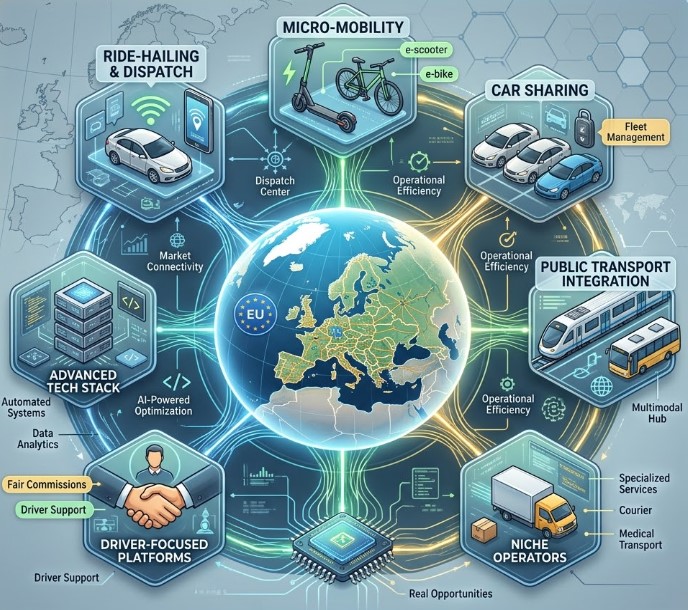
Planning to start a mobility company in Europe? If you’re aiming to build something that actually works in today’s market, it’s important to understand which business models are really delivering results and where the real opportunities still exist.
The European mobility market is often described as “saturated”, but that’s only part of the story. Competition is high, no doubt. At the same time, there are still plenty of gaps for local operators and niche mobility services that know how to position themselves properly. Large ride-hailing platforms come with their own drawbacks: high commissions, operational inefficiencies, and growing dissatisfaction among drivers. This creates space for new businesses that offer a more flexible and balanced approach.
If you’re planning to build a mobility business in Europe, success usually comes down to focus. Instead of trying to compete everywhere, it’s better to choose a clear niche and build around it. Strong branding helps, but it’s not enough on its own. Modern tools like taxi dispatch software, ride-hailing platforms, and automated booking systems play a critical role in scaling operations and keeping everything under control.
Below, we’ll walk through seven realistic ways to launch a mobility company in Europe, along with what each model requires to operate successfully in a competitive environment.
1. The Local Taxi App: Competing on Community, Not Capital
In many European countries, taxi drivers are becoming increasingly frustrated with high commissions and shrinking margins. Ireland is a good example of this shift. Drivers have openly protested and discussed moving away from global platforms like Uber, choosing instead to form local associations and launch their own mobile apps for taxi business.
A local taxi app doesn’t need to compete with global players on budget. It wins in a different way by focusing on things that actually matter to drivers:
- Flexible and transparent commission structures
- Direct communication with drivers
- Real human support instead of automated responses
- A strong local presence and identity
The real advantage here is trust. In many mid-sized European cities, relationships still play a big role. Drivers talk, share experiences, and tend to move toward platforms where they feel respected and fairly treated. If your business is positioned as transparent and driver-friendly, growth can happen naturally through word of mouth.
At the same time, community alone is not enough. The technical side has to meet modern expectations. Drivers and passengers are already used to the speed and reliability of global apps. If your platform has issues with GPS accuracy, crashes during peak hours, or unreliable payments, users won’t hesitate to switch back.
This is where having the right taxi dispatch software and a stable ride-hailing platform becomes critical. A well-built system ensures smooth operations, accurate tracking, and seamless payments, which directly impacts user retention.
Marketing also plays a role. Local positioning should be clear and consistent. Focus on your city, your drivers, and your service. At the same time, visibility matters, so investing in app store optimization and making your booking process easy to access can significantly improve adoption.
Read more: From Local to Global: Everything You Need to Start a Taxi Business Worldwide
2. Airport & Hotel Transfers: A Higher-Margin Entry Point
Instead of trying to compete in the broad ride-hailing market, many founders choose a more focused and often more profitable direction: airport and hotel transfers.
Airports bring consistent, predictable demand. Unlike city rides, where users compare prices and switch between apps, travelers usually care more about reliability and timing than saving a few euros. That’s why the average ticket value in airport transfer services is typically higher, and customers are more willing to pay for a smooth experience.
Another advantage is that this segment is still underserved in many European cities. There’s demand, but not always a well-structured service behind it.
If you’re planning to build an airport transfer business in Europe, it’s worth thinking beyond a standard app. In many cases, users don’t want to download yet another application, especially when they’re traveling. This is where web booking becomes essential.
A simple, mobile-friendly booking page can convert customers directly:
- from hotel reception desks
- via airport Wi-Fi
- through quick search queries like airport transfer booking online
Introducing fixed pricing zones is also a strong move. It removes uncertainty, builds trust, and simplifies decision-making for travelers who just want to know the final price upfront.
On the operational side, your system needs to handle more than just basic rides. A solid mobility platform should support:
- multiple service types (standard, executive, group transfers)
- multi-language interfaces
- flexible pricing logic
- pre-booking and scheduling
This type of setup allows you to deliver a more structured and reliable service, which is exactly what this segment demands.
3. Reinventing Driver Economics
One of the biggest opportunities in the European mobility market today lies in how you structure payments and commissions. This is often overlooked, but in reality, it can define whether drivers stay with your platform or leave.
Traditional ride-hailing platforms still rely heavily on percentage-based commissions. For many drivers, this model is becoming less attractive, especially as margins continue to shrink. As a result, more drivers are open to alternative approaches that offer stability and transparency.
Some of the models that are gaining traction include:
- Fixed weekly or monthly subscriptions
- Hybrid pricing (a lower commission combined with a small fixed fee)
- Fleet-based contracts
- Tiered commission systems based on performance or volume
The idea behind all of these is simple. When drivers clearly understand their costs and can predict their earnings, they are far more likely to stay loyal to a platform.
To make these models work at scale, automation is essential. A modern taxi dispatch system or mobility platform should handle:
- automatic payout calculations
- commission distribution
- transparent reporting for drivers
This removes the need for manual accounting, reduces errors, and minimizes conflicts. It also allows operators to focus on growth instead of administrative tasks.
In this context, pricing is not just a technical detail. It becomes part of your positioning. If drivers feel they earn more and deal with fewer complications on your platform, retention improves naturally. Over time, this creates a stronger, more stable supply side, which is critical for any mobility business in Europe.
4. Building for Scale From Day One
Some founders don’t think in terms of a single city. From the very beginning, they aim for national coverage or even multi-country expansion. If that’s your direction, then scalability and system stability become the foundation of everything.
At this level, your setup needs to handle growth without breaking. A serious mobility platform should be capable of supporting:
- Tens of thousands of drivers
- Millions of bookings per month
- Seasonal demand spikes during holidays, tourism peaks, and major events
- A pricing structure that doesn’t limit the number of drivers or orders
But scale is not just about volume. It’s about removing friction inside the business.
Manual processes are usually the first thing that slows growth down. What works with 20 drivers quickly becomes unmanageable with 200 or 2,000. This is why automation is not just a nice addition, it’s a requirement.
For example, a scalable taxi dispatch system should automate:
- driver onboarding and verification
- document expiration reminders
- order distribution and dispatching
- basic operational workflows
The goal is simple: reduce dependency on manual work wherever possible.
If scaling your ride-hailing business means hiring more dispatchers every time demand grows, your margins will start to disappear. Operational costs increase, while efficiency drops. That’s exactly what scalable systems are designed to prevent.
In the long run, automation is what allows a mobility business in Europe to grow sustainably without increasing costs at the same rate as revenue.
Read more: How to Choose the Right Taxi Dispatch Software – A Complete Buyer’s Guide
5. Already Have Drivers? Modernize the Network
In many parts of Europe, there are already established taxi businesses with solid foundations. They have fleets, a base of loyal drivers, and years of dispatch experience. What’s often missing is not demand or supply, but the right technology to support modern operations.
For these operators, speed matters more than anything else. The goal is not to build from scratch, but to upgrade quickly and start operating in a more efficient way. With the right white-label taxi software, launching a fully functional system within a few weeks is realistic. Trying to build the same setup internally or through external developers usually takes months and comes with higher risks.
If you’re moving in this direction, there are a few things that should not be compromised:
- Automated dispatch to remove manual workload
- Automated driver payouts for transparency and efficiency
- Modern customer and driver apps with a familiar, intuitive experience
- Simple onboarding for existing drivers, without unnecessary friction
- Full control over your branding, pricing, and services
- Reliable customer support that actually responds when issues appear
The transition from manual to automated operations can be a turning point. But only if the process itself is smooth. Complicated setups, technical dependencies, or the need for an in-house developer can slow everything down.
That’s why many operators prefer solutions that handle the technical side for them. A good mobility platform should allow you to focus on running and growing your business, not managing infrastructure or fixing system issues.
Read more: Ride-sharing vs Ride-hailing: Understand the Real Difference and Why It Truly Matters
6. The Premium Taxi Model: Competing on Trust, Not Price
Another way to build a strong position in a European city is to focus on the premium segment and create a fully independent brand. Instead of competing directly with mass-market platforms, this approach is about offering a more refined, reliable, and higher-quality experience.
A premium taxi service typically operates in a similar way to well-known ride-hailing apps, but with a clear difference in positioning. The focus shifts from price to comfort, consistency, and trust.
To make this model work, a few key elements are essential:
- A dedicated customer app with a smooth and polished experience
- A dedicated driver app designed for professional drivers
- Full white-label branding across all touchpoints
- An independent pricing strategy that reflects the premium nature of the service
Positioning plays a big role here. If your service is seen as reliable, professional, and locally accountable, many customers will choose it over global platforms, especially for important trips like airport transfers, business travel, or events.
Of course, the operational side has to match the promise. A premium brand without the right fleet will not hold up. Having access to high-quality vehicles and maintaining consistent service standards is part of the foundation.
Technology supports this positioning as well. With white-label taxi software, your brand remains visible across apps, booking flows, and customer communication. Over time, this builds something more valuable than just daily revenue, it creates brand equity that belongs entirely to your business.
7. Multi-Service Mobility Platforms: Expanding Beyond Standard Rides
As competition increases and margins become tighter, relying on a single service is becoming less sustainable. That’s why more operators are moving toward a multi-service mobility platform approach.
Instead of offering only standard rides, businesses are expanding their services to cover multiple segments within the same ecosystem. A well-structured platform can include:
- Executive and business-class vehicles
- Luxury transport services
- Car rental options
- Airport transfer services
- Corporate mobility solutions
- Food delivery
- Grocery delivery
- Other types of on-demand services
This kind of setup opens the door to cross-selling and testing different revenue streams. Over time, patterns start to emerge. For example, executive airport transfers may bring higher margins than regular city rides, while corporate transport services can provide stable, recurring income.
From a technical perspective, flexibility is critical. Your mobility platform should allow you to add or adjust services without rebuilding the system from scratch. This makes it easier to experiment, adapt, and scale based on what actually works in your market.
On the operational side, each service needs its own structure. That includes clear pricing logic, proper driver allocation, and supply management that matches demand.
The main advantage of this model is resilience. When your revenue is spread across multiple services, your business becomes less vulnerable to market fluctuations in any single segment. For a mobility business in Europe, this kind of diversification can make a significant difference in long-term stability.
Read more: How to Build a Business Plan for a Successful Taxi Business
Core Features Every Mobility Business in Europe Needs
No matter which direction you choose, there are a few core elements that every mobility business in Europe needs to get right from the start. These are not optional features, they are part of the foundation that supports growth, stability, and daily operations.
1. Native, High-Performance Apps
Your customer and driver apps need to work flawlessly. Users today are used to the standards set by global platforms, and expectations are extremely high.
There is no tolerance for:
- crashes during booking
- slow loading times
- inaccurate GPS tracking
A stable and responsive ride-hailing app directly affects user trust. If something feels unreliable, people simply switch to another service without hesitation.
2. Full White-Label Branding
Your brand should be visible at every step of the user journey.
That includes:
- app icons
- interface design
- payment screens
- notifications and emails
There should be no confusion about who provides the service. With white-label taxi software, you build your own identity instead of promoting a third-party platform. Over time, this becomes a real asset, not just a tool for operations.
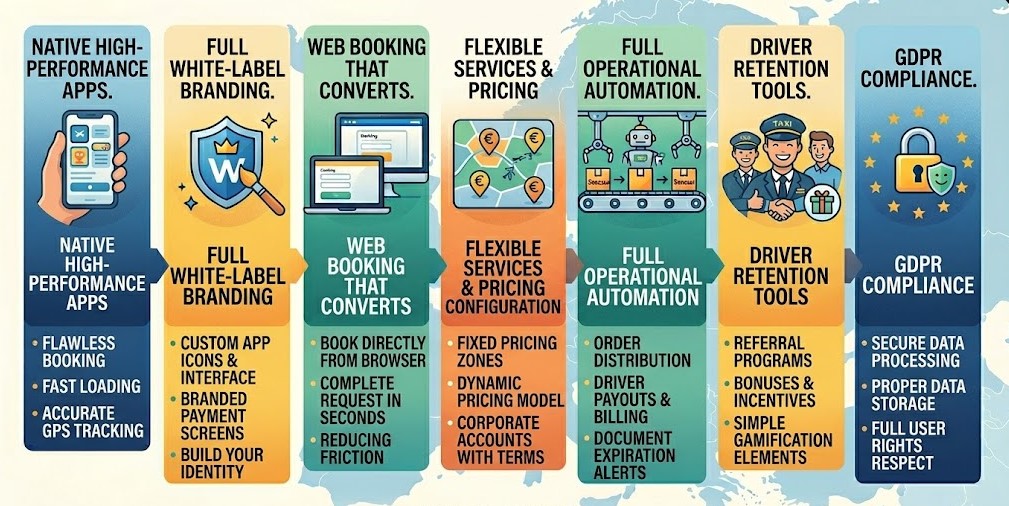
3. Web Booking That Converts
For many use cases, especially airport transfers and hotel bookings, not every customer wants to install an app.
A fast and simple online booking system can make a big difference. It allows users to:
- book directly from a browser
- complete a ride request in seconds
- avoid unnecessary steps
Reducing friction in the booking process almost always leads to higher conversion rates.
4. Flexible Services and Pricing Configuration
Every city and every segment works differently. Your system should allow you to adjust without limitations.
You should be able to set up:
- Fixed pricing zones for airport routes
- Dynamic pricing based on demand
- Corporate accounts with custom terms
- Pre-booked rides
- Subscription-based models
The more flexible your pricing is, the easier it becomes to adapt your strategy and respond to market changes.
5. Full Operational Automation
Manual processes slow everything down. At a small scale, it might be manageable, but as soon as your taxi business starts growing, it becomes a bottleneck.
A modern taxi dispatch system should automate:
- order distribution
- driver payouts
- billing and invoicing
- document expiration alerts
- performance tracking
Automation reduces operational pressure and helps maintain consistency across the business.
6. Driver Retention Tools
Drivers are the backbone of any mobility platform. Keeping them engaged is just as important as acquiring new customers.
Some of the most effective tools include:
- referral programs
- bonuses and incentive campaigns
- simple gamification elements
- transparent earnings tracking
When drivers feel supported and see clear benefits, retention improves naturally.
7. GDPR Compliance
Operating in Europe comes with strict legal requirements. GDPR compliance is not something you can overlook.
Your system must ensure:
- secure payment processing
- proper data storage
- full respect of user rights
Failing to meet these standards can lead to serious legal and financial consequences, so this part needs to be handled carefully from day one.
FAQ
1. What does it actually take to start a ride-hailing business in Europe?
Launching a ride-hailing business in Europe is mostly about getting the right setup in place early. You’ll need customer and driver apps, a system that handles bookings and dispatch, and a structure that complies with local transport rules.
On top of that, GDPR-compliant payments and automation are critical if you want to avoid operational issues from the start. Most companies today rely on ready-made mobility platforms to launch faster and stay focused on growth.
2. How much should you realistically budget to launch a taxi app in Europe?
There isn’t a single number, but the difference between approaches is huge. A custom-built taxi app can easily cost six figures and take months before it’s usable.
Using white-label taxi software is usually more practical. Instead of investing heavily in development, you allocate budget to things that actually drive growth:
- marketing and visibility
- driver acquisition
- operational setup
- ongoing platform costs
This approach allows you to enter the market faster and test your model without overcommitting.
3. Which licenses do you really need to run a taxi or ride-hailing business in Europe?
Requirements vary depending on the country and even the city, so there’s no universal checklist. Still, most mobility businesses in Europe will need:
- a valid transport operator license
- licensed drivers
- compliant and insured vehicles
- proper business registration
- full GDPR compliance for handling user data
If you’re planning services like airport transfers, expect additional rules or permits in some locations.
4. Should you build your own taxi app or go with a white-label solution?
It depends on your priorities. Building your own platform gives flexibility, but it comes with high costs, long timelines, and ongoing technical responsibility.
A white-label taxi platform offers a faster route to market. You get a working system from day one and can focus on operations, drivers, and customers instead of development. That’s why many mobility businesses in Europe choose this path, especially in the early stages.