


 Subscribe
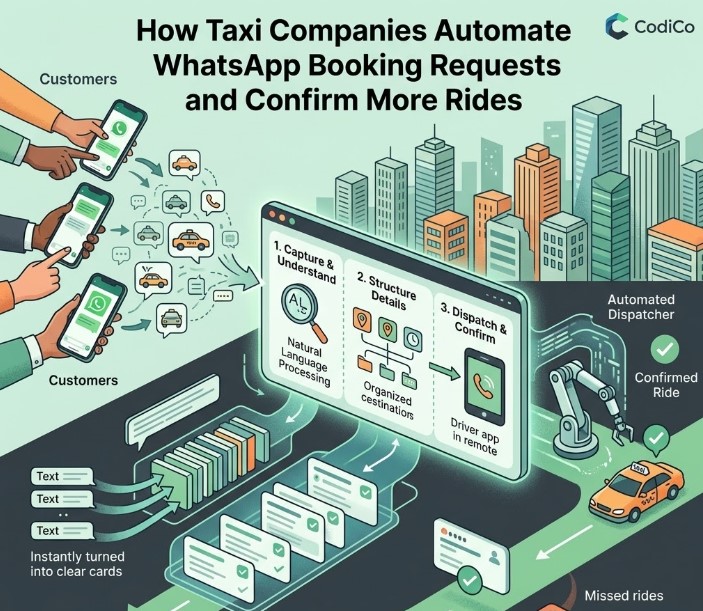
If many of your ride requests still come through WhatsApp, you are not alone. For taxi operators, WhatsApp is one of the easiest ways for customers to get in touch. It is quick, familiar, and simple: a customer sends a message, your team replies, the trip details are checked, and the booking is confirmed.
But the real issue is not whether customers use WhatsApp.
The real question is: are those WhatsApp messages becoming confirmed bookings every time, or are some ride requests getting delayed, missed, or lost during manual handling?
When bookings are managed by hand, even small gaps can cost you revenue. One unclear pickup address, a slow reply during a busy period, or a misunderstood travel time can turn a potential ride into a lost customer. And as the number of messages grows, it becomes harder for your team to keep every request under control.
This is where WhatsApp taxi booking software makes a real difference. It does not force customers to change the way they contact you. Instead, it helps your business capture each message, structure the booking details, and convert the request into a confirmed trip faster and more reliably.
In this article, you will see how taxi operators can move from manual WhatsApp chat handling to taxi booking automation, where every WhatsApp message can become a clear, trackable, and ready-to-dispatch booking.
Why WhatsApp Has Become a Common Booking Channel for Taxi Businesses
Before taxi operators can automate WhatsApp booking requests, it is important to understand why WhatsApp became such a common way for customers to request rides. The reason is simple: it removes friction from the first contact.
For the customer, WhatsApp feels faster than a phone call and easier than filling out a booking form. For the operator, it looks like a simple way to accept more requests without changing the existing workflow.
That is why many taxi businesses start using WhatsApp naturally, even before they think about proper taxi booking automation.
Customers Prefer Fast, Low-Effort Booking
Modern passengers expect quick communication. They do not always want to call a taxi office, wait for someone to answer, and repeat the same trip details several times. A short WhatsApp message feels easier, especially for scheduled rides, airport transfers, hotel pickups, and last-minute requests.
With taxi booking via WhatsApp, customers can usually:
- send a ride request in seconds;
- share a pickup location or live location;
- mention the travel time without making a call;
- send extra details such as luggage, flight number, or passenger count;
- continue the conversation from the same chat if plans change.
This makes WhatsApp a strong entry point for taxi bookings. But from an operational point of view, a message is still only a request. It becomes a confirmed booking only when all ride details are captured, checked, and entered into the dispatch process.
Read also: WhatsApp & Contact Form VS CodiCo Dispatch Software
WhatsApp Is Already Familiar to Customers and Operators
Another reason WhatsApp is widely used is that it requires almost no explanation. Customers already know how to use it, and most taxi operators already rely on it for daily communication.
This creates several practical advantages:
- no customer training is needed;
- no new app needs to be installed;
- operators can respond from a familiar interface;
- regular clients can contact the business directly;
- communication works well across mobile devices.
For small fleets, this makes WhatsApp an attractive starting point. A taxi business can begin accepting ride requests quickly without building a full booking system first.
However, this convenience also creates a hidden problem. Because WhatsApp is so easy to use, many operators treat it like a booking system, even though it was not built to manage ride data, booking status, dispatch logic, driver assignment, or customer confirmations.
WhatsApp Reduces the Barrier to Taking Bookings
For growing taxi businesses, WhatsApp often becomes the first digital booking channel because it does not require a large initial setup. A customer sends a message, the operator replies, and the ride can be arranged manually.
At the beginning, this feels efficient because there is:
- no complex setup;
- no long onboarding process;
- no separate booking portal for the customer;
- no change in customer behaviour;
- no delay before accepting the first requests.
This is why WhatsApp works well as a communication channel. The problem appears when the number of requests grows. More messages mean more manual checking, more back-and-forth conversations, and more chances for details to be missed.
At that point, WhatsApp alone is no longer enough. It can bring the request in, but it cannot reliably structure the booking, validate the trip details, update the booking status, or move the ride into dispatch without human work.
That is where WhatsApp taxi booking software becomes valuable. It keeps WhatsApp as the customer’s preferred contact channel, but adds the structure taxi operators need behind it. Each request can be captured, completed, and converted into a trackable booking instead of staying buried inside a chat thread.
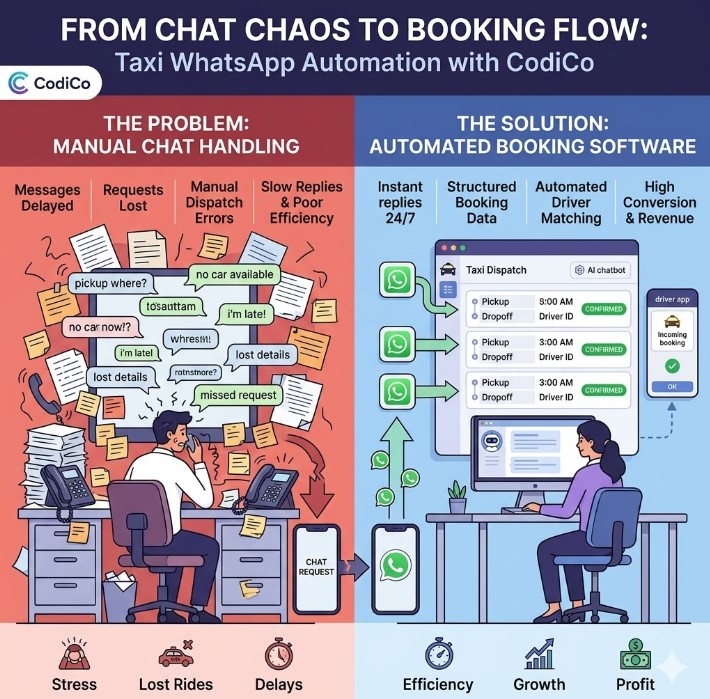
The Problem: Why WhatsApp Messages Don’t Always Become Reliable Bookings
Once WhatsApp becomes a regular source of ride requests, the main challenge is no longer communication. The real challenge is control.
A customer may send a message, your team may reply, and the ride may look like it is being arranged. But unless the request is complete, validated, and entered into the booking workflow, it is not yet a reliable booking. It is still just a conversation.
This is where many taxi operators start losing time, revenue, and customer trust.
Messages Often Arrive Without Complete Booking Details
WhatsApp messages are usually written in a casual way. Customers do not always know which details your team needs to confirm a ride correctly.
A typical message may look like this:
“Need a cab tomorrow morning.”
For the customer, that feels like a clear request. For the operator, it still leaves too many open questions:
- where should the driver pick up the passenger?
- what is the exact drop-off location?
- what time does “morning” mean?
- how many passengers are travelling?
- is there luggage, a flight number, or a special vehicle request?
Without these details, the operator cannot confirm the trip properly. The team has to ask follow-up questions, wait for replies, and keep the conversation open longer than necessary.
That is why manual WhatsApp handling often turns a simple ride request into a slow clarification process instead of a fast confirmed booking.
Manual Replies Slow Down the Booking Process
When every WhatsApp message depends on a human response, the quality of the booking process depends on staff availability.
During quiet hours, this may not feel like a problem. But during peak periods, evenings, weekends, airport rush hours, or seasonal demand, delays become much more visible.
Manual replies create several operational risks:
- customers wait longer for confirmation;
- different staff members may reply in different ways;
- important questions may be asked too late;
- the same customer may message multiple providers at once;
- the ride may be lost before your team finishes the booking.
For taxi businesses, speed matters. A fast reply is not just good customer service. It directly affects conversion. If a customer does not receive a clear answer quickly, they may book with another company before your operator has time to complete the request.
This is one of the reasons why many fleets start looking for taxi booking automation. They do not want WhatsApp to become a bottleneck during the busiest hours of the day.
Booking Details Can Get Lost Inside Chat Threads
WhatsApp is useful for communication, but it was not designed to manage structured taxi bookings. A chat thread can contain customer questions, location pins, price discussions, changes, confirmations, and driver updates all in the same place.
That makes it difficult to separate a real booking from the conversation around it.
Common issues include:
- trip details staying buried in long chat histories;
- no clear booking status;
- no structured record for pickup, drop-off, date, and time;
- no easy way for another staff member to take over the request;
- no central overview of all active WhatsApp bookings.
This becomes especially risky when several people manage the same inbox. One operator may think the booking has been confirmed, while another may still see it as an open request. A customer may believe the ride is arranged, while the dispatcher has not received the complete details yet.
At that point, the problem is not WhatsApp itself. The problem is that the booking information is not connected to a reliable operational system.
Dispatch Is Delayed When Ride Information Is Unclear
A dispatcher can only assign a driver properly when the booking details are complete. If the pickup point is vague, the time is unclear, or the destination is missing, dispatch becomes slower and less accurate.
This creates problems across the whole operation:
- drivers receive incomplete trip details;
- assignments are made later than they should be;
- dispatchers need to contact the operator again;
- customers receive slower confirmations;
- last-minute corrections create pressure on the team.
In a manual setup, every unclear WhatsApp message adds extra work. The operator has to clarify the request, rewrite the details, pass them to dispatch, and make sure the driver receives the correct information.
With higher message volume, this process becomes harder to control. More chats mean more interruptions, more chances for mistakes, and more time spent checking details instead of managing confirmed rides.
That is why WhatsApp taxi booking software matters. It helps turn casual messages into structured booking data, so every request can move from chat to dispatch with fewer delays and fewer errors.
Read also: Switching from WhatsApp to a Taxi App: Why It’s the Smart Move for Your Business
What Really Happens Behind Manual WhatsApp Taxi Bookings
At first, handling bookings through WhatsApp may seem simple. A customer sends a message, someone from the team replies, and the ride gets confirmed. But once booking volume starts growing, the process quickly becomes difficult to manage.
How the Workflow Usually Looks
Most manual booking operations follow the same pattern:
- A customer sends a booking request
- An operator opens and reads the message
- Missing details need to be clarified
- The customer replies again
- The booking is manually confirmed
- Trip details are forwarded to the dispatcher
Every stage depends entirely on human involvement. Nothing moves forward automatically.
Where Problems Start Appearing
The biggest issue with manual WhatsApp bookings is that even small delays create operational problems.
Common issues include:
- incomplete booking information
- repeated back and forth conversations
- typing mistakes during manual entry
- overlapping chats during busy periods
When multiple bookings arrive at the same time, operators are forced to switch between conversations constantly. This increases the chance of missed details, delayed responses, or incorrect ride information.
Over time, these small mistakes start affecting customer trust and overall service quality.
Why Manual Booking Stops Working as You Grow
Manual workflows may work for a small number of daily rides, but they become difficult to scale once demand increases.
As booking volume grows:
- message traffic becomes chaotic
- staff workload increases rapidly
- response times get longer
- dispatch coordination slows down
At a certain point, the team spends more time managing conversations than actually processing rides efficiently.
This is where many operators begin switching to taxi dispatch software or automated booking systems that centralize requests, reduce manual work, and improve response speed.
Expert Insight
If your operators spend more time replying to messages than confirming bookings, your booking process is already slowing down your business.
What Does “Turning Messages into Bookings Automatically” Really Mean?
Turning WhatsApp messages into bookings automatically is not just about sending faster replies. It means taking an unstructured customer message and moving it through a complete booking process, from first request to validated trip details, customer confirmation, and dispatch visibility.
For taxi operators, this is an important difference. A message in WhatsApp may show interest, but it does not become a real booking until the system has enough information to confirm the ride and prepare it for dispatch.
Automation Is Not the Same as a Quick Reply
Many taxi businesses first think of automation as a faster response. For example, a saved template, an auto-reply, or a chatbot greeting that says someone will answer soon.
That may improve communication, but it does not solve the booking problem.
A fast reply can still leave the operator with the same manual work:
- checking the pickup address;
- asking for the destination;
- confirming the date and time;
- calculating or checking the fare;
- copying the final details into another system.
So the goal is not only to answer faster. The goal is to complete the booking with less manual effort and fewer gaps.
A WhatsApp conversation becomes valuable when it moves beyond simple messaging and starts producing structured ride data that your team can actually use.
Every WhatsApp Request Needs to Become Structured Booking Data
For a ride to be confirmed properly, the information must be collected in a clear and consistent format. A customer may write casually, but your booking process cannot stay casual.
A reliable booking needs details such as:
- customer name and phone number;
- pickup location;
- drop-off location;
- date and time;
- number of passengers;
- luggage or special requests;
- trip type, vehicle type, or fare logic.
In a manual workflow, the operator has to collect these details through several messages. One customer may send everything at once. Another may send the pickup point first, then the time later, then change the destination after confirmation.
With WhatsApp taxi booking software, the process becomes more controlled. The system identifies what information is already available, asks for missing details, and organises the request into a standard booking format.
This is the real shift: the chat is no longer just a conversation. It becomes a structured booking input.
Automation Reduces Manual Dependency in the Booking Process
In a manual WhatsApp workflow, every stage depends on a person. Someone has to read the message, understand what the customer wants, ask the right follow-up questions, confirm the details, and pass the information to dispatch.
That creates pressure on the team, especially when several requests arrive at the same time.
With AI WhatsApp chatbot taxi booking, much of this first-line work can be handled automatically. The system can recognise booking intent, continue the conversation when details are missing, and guide the customer through the required steps.
This helps taxi operators reduce repetitive manual tasks such as:
- asking the same booking questions again and again;
- checking whether the customer provided enough information;
- rewriting trip details from chat into a booking form;
- sending basic confirmation messages;
- forwarding incomplete requests to dispatch.
The operator’s role becomes more focused. Instead of managing every chat line by line, the team can monitor exceptions, handle special cases, and keep the booking flow moving.
A Booking Must Connect Directly to Dispatch
A confirmed booking is only useful when it reaches the operational side of the business. If the ride stays inside WhatsApp, the dispatcher still has to copy the details, check the information, assign a driver, and update the customer manually.
That is where WhatsApp ride booking integration becomes important.
When WhatsApp is connected to a dispatch system, the booking can move from the customer conversation into the operational workflow without manual transfer. The dispatcher receives a complete ride request with the necessary details already organised.
This means:
- the booking is created inside the system;
- dispatchers can see the trip status;
- driver assignment can start faster;
- customer details are stored properly;
- the team avoids duplicate data entry.
In practice, turning messages into bookings automatically means building a bridge between WhatsApp and your dispatch process. WhatsApp remains the customer’s preferred contact channel, while the booking system handles structure, validation, confirmation, and operational control.
Read also: Why Taxi Companies Lose Bookings and How Automation Fixes It
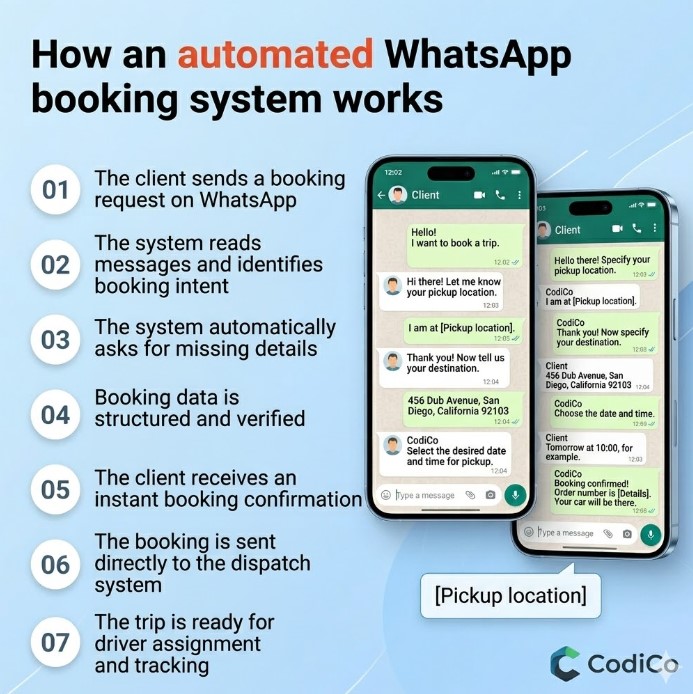
How an Automated WhatsApp Booking System Works Step by Step
To understand the value of automation, it helps to look at the full journey. A customer starts with a simple WhatsApp message, but the system turns that message into a complete booking that your dispatch team can use.
The process is not about removing WhatsApp. It is about connecting WhatsApp to a more reliable booking workflow, so every request can be captured, checked, confirmed, and prepared for driver assignment.
Step 1: The Customer Sends a Booking Request on WhatsApp
The process usually starts with a short message. The customer may write something simple, such as:
“I need a taxi from Airport Road to Downtown at 6 PM.”
“Can I book a cab for tomorrow morning?”
“Need pickup from my hotel to the office.”
For the customer, this feels clear enough. But from an operational point of view, the message may still be incomplete. It might include the pickup point but not the destination, or the time but not the date. Sometimes the customer gives a general request without enough details to create a confirmed ride.
At this stage, the message is still only a booking request. It needs to be understood, completed, and converted into structured trip data before it can move forward.
Step 2: The System Identifies the Booking Intent
This is where AI WhatsApp chatbot taxi booking becomes useful. Instead of waiting for an operator to read the message manually, the system detects that the customer wants to book a ride.
It then reads the available information and identifies the main booking elements, such as:
- pickup location;
- drop-off location;
- requested date;
- requested time;
- trip purpose or booking intent;
- possible ride type.
This step removes the first layer of manual work. The operator no longer needs to interpret every message from the beginning. The system can recognise that the conversation is not just a general question, but a potential taxi booking that should be moved into the booking flow.
Step 3: Missing Details Are Collected Automatically
Most WhatsApp booking requests are not complete at the first message. A customer may mention the pickup location but forget the destination. Another may say “tomorrow morning” without giving an exact time.
A proper WhatsApp chatbot for taxi booking does not leave the conversation open or unclear. It asks only for the missing details needed to complete the request.
For example, the system may ask:
- What is your drop-off location?
- What time do you need the ride?
- Is the booking for today or a later date?
- How many passengers will be travelling?
- Do you have luggage or a flight number to add?
This creates a guided booking flow. The customer does not need to know in advance which details the operator requires. The system collects the information in the right order and keeps the conversation focused on completing the booking.
This is the moment when WhatsApp stops being only a chat channel and starts working as part of the booking process.
Step 4: The Booking Data Is Structured and Validated
Once the necessary details are collected, the system organises them into a standard booking format. This is a key part of taxi booking automation, because it prevents important information from staying hidden inside a chat thread.
The booking record can include:
- customer name;
- customer phone number;
- pickup point;
- drop-off point;
- scheduled date and time;
- booking source;
- vehicle or trip type;
- fare logic or pricing conditions;
- special notes, such as luggage, child seat, or flight number.
Validation also happens at this stage. The system checks whether the request has enough information to move forward. If something important is missing, the booking should not be treated as complete.
This is one of the biggest differences between manual WhatsApp handling and an automated workflow. In a manual process, staff may accidentally confirm a ride with unclear details. In an automated process, incomplete requests can be flagged before they create problems for dispatchers, drivers, or customers.
Step 5: The Customer Receives a Clear Booking Confirmation
After the booking details are captured and validated, the customer receives a confirmation message on WhatsApp. This confirmation should not feel like a vague reply. It should clearly show that the request has been recorded as a real booking.
A proper confirmation can include:
- booking status;
- pickup and drop-off details;
- scheduled date and time;
- next step in the process;
- dispatch or driver assignment status, if available.
For the customer, this creates confidence. They know the message was not only seen, but converted into a confirmed booking.
For the taxi business, this improves conversion. A customer who receives a fast and clear confirmation is less likely to continue searching for another provider. This is one of the practical ways to increase taxi bookings with WhatsApp without adding more manual work for the team.
Step 6: The Booking Moves into the Dispatch System
This is where the operational value becomes clear. With WhatsApp ride booking integration, the confirmed booking does not remain inside WhatsApp. It moves into the central booking or dispatch system, where the team can manage it properly.
That means:
- dispatchers see a ready-to-assign trip;
- trip details are already organised;
- the booking status is visible;
- no one has to copy information manually from chat to software;
- the risk of duplicate entry or missing details is reduced.
This step closes the gap between customer communication and backend operations. WhatsApp remains the entry point, but the dispatch system becomes the place where the ride is controlled.
Step 7: The Trip Is Ready for Driver Assignment and Tracking
Once the booking enters the dispatch workflow, it becomes part of the normal operational process. Depending on how the taxi business works, the trip can then be assigned manually by a dispatcher or automatically based on availability, location, vehicle type, or scheduling rules.
From there, the booking can also support:
- driver assignment;
- real-time trip tracking;
- customer updates;
- driver notifications;
- status changes;
- operational reporting.
At this point, WhatsApp has done its job as the customer’s preferred contact channel. The message has become a structured booking, the booking has moved into dispatch, and the trip is ready to be managed like any other confirmed ride.
That is the real meaning of taxi booking via WhatsApp in a modern taxi operation. The customer starts the process in chat, but the system controls the booking outcome.
Read also: How to Get More Bookings: A Step-by-Step Guide with Expert Tips That Actually Work
Key Benefits for Taxi Operators Using Automated WhatsApp Booking
Automated WhatsApp booking gives taxi operators more than faster replies. It creates a controlled booking workflow where every request is captured, completed, and moved toward dispatch with fewer manual steps.
Faster Booking Confirmations
Customers do not want to wait while an operator checks messages, asks basic questions, and manually confirms the ride. With automated WhatsApp booking, the system can respond quickly, collect the required trip details, and send a clear confirmation once the booking is complete.
This reduces drop-offs and helps customers feel confident that their ride request has been properly recorded.
Fewer Booking Errors
Manual WhatsApp bookings often create mistakes because details are collected across several messages. A pickup point may be unclear, a time may be misunderstood, or an important note such as luggage or flight number may be missed.
With WhatsApp taxi booking software, ride details are collected in a structured format. Pickup, drop-off, date, time, passenger details, and special requests are easier to validate before the booking reaches dispatch.
This helps reduce confusion for operators, dispatchers, drivers, and customers.
Better Dispatcher Efficiency
Dispatchers should not spend their time searching through chat threads or asking operators to clarify missing details. Their job is to manage rides, assign drivers, and keep the operation moving.
When WhatsApp requests are converted into ready-to-assign bookings, dispatchers receive clearer information from the start. This helps them make faster decisions and reduces unnecessary back-and-forth communication.
The result is a smoother workflow between customer communication, booking management, and driver assignment.
Higher Booking Conversion Rates
Every unanswered or unclear WhatsApp message is a potential lost ride. If a customer waits too long, they may contact another provider. If they do not receive a clear confirmation, they may not trust that the ride is arranged.
Automation helps guide each message toward completion. Instead of leaving the conversation open, the system asks for missing details, validates the request, and moves the customer closer to a confirmed ride.
This is one of the most practical ways to increase taxi bookings with WhatsApp without depending only on more staff.
More Requests Handled Without More Manual Work
As a taxi business grows, WhatsApp message volume can increase quickly. More customers, more airport transfers, more scheduled rides, and more repeat bookings all create extra pressure on the team.
Automated WhatsApp booking helps operators handle more requests at the same time. The system can manage basic booking steps, collect information, and prepare the ride for dispatch while your team focuses on exceptions, urgent cases, and service quality.
This makes growth easier because the business can process more bookings without turning every extra request into extra manual work.
Stronger Connection With Other Dispatch Features
The real value appears when WhatsApp booking automation works together with the wider dispatch system. Once a booking is created, it can connect with other operational tools that help taxi companies manage the full ride journey.
For example:
- Automated Dispatch can help assign confirmed rides faster based on availability and operational rules.
- Live Driver Tracking gives the team better visibility after the booking is accepted.
- Pricing Settings help keep fare logic more consistent across different ride types, zones, and routes.
- Schedule Module supports planned rides, airport transfers, and future bookings that need reliable timing.
- Driver Management helps keep assignments, driver availability, and ride execution more organised.
- Custom Zones can support local pricing, airport areas, service regions, and zone-based operations.
- Express Booking Entry helps the team create or adjust bookings quickly when manual input is still needed.
- Web Booking Form and Mobile Apps give customers additional booking channels beyond WhatsApp.
This is important because WhatsApp should not work as an isolated inbox. It should become one part of a complete booking and dispatch workflow.
Final Thoughts
WhatsApp already brings taxi operators a steady flow of ride requests. The challenge is making sure those messages do not stay as loose conversations, but become complete, confirmed, and dispatch-ready bookings.
When WhatsApp bookings are handled manually, details can be missed, replies can be delayed, and dispatchers may receive incomplete information. This slows down the operation and makes it harder to convert every request into a real ride.
With WhatsApp taxi booking software, each message can be captured, structured, validated, and converted into a ready-to-assign booking. Your team moves from reacting to chats to managing a clear booking workflow.
And when this process connects with tools like Automated Dispatch, Live Driver Tracking, Pricing Settings, Schedule Module, Driver Management, and Custom Zones, WhatsApp becomes much more than a messaging channel. It becomes a reliable entry point into your full taxi dispatch operation.
For taxi companies, this means faster confirmations, fewer missed requests, better dispatcher visibility, and a smoother path from customer message to completed ride.
Turn WhatsApp booking requests into confirmed rides and manage them through a smarter taxi dispatch workflow with CodiCo.