


 Subscribe
Every taxi trip starts long before the driver arrives. It starts with the booking details.
A pickup address, flight number, arrival time, passenger name, phone number, luggage note or destination may look like simple information. But when one detail is missing, misunderstood or entered incorrectly, the whole trip can start to fall apart. Drivers may arrive at the wrong location. Dispatchers have to interrupt their workflow to correct the booking. Customers start calling again, asking where the car is. A small mistake at the taxi booking stage can quickly become a delayed pickup, a cancelled ride, a frustrated passenger and lost revenue for the operator.
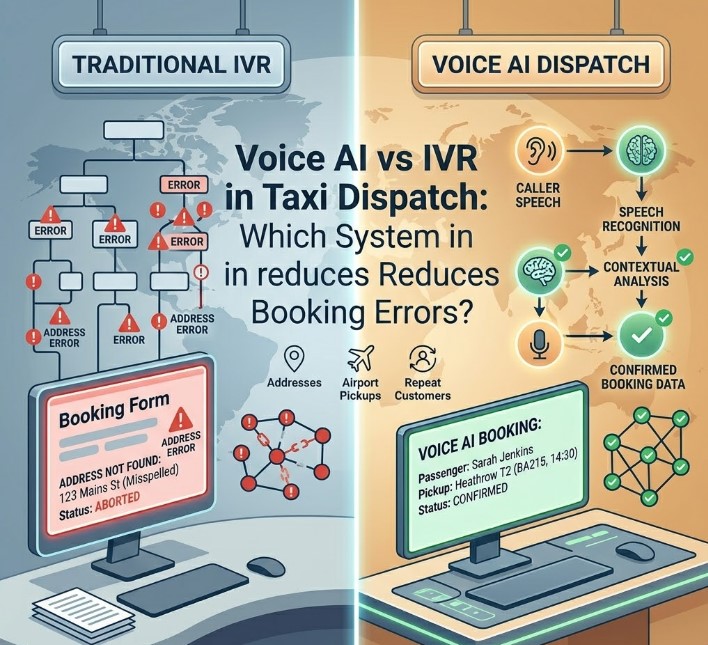
This is why many taxi businesses are rethinking how they handle incoming calls. Some still rely on a traditional IVR taxi booking system to route customers through menus and connect them to the right department. Others are moving toward voice AI taxi booking, where the system can hold a natural conversation, ask follow-up questions and capture booking data with more context.
But the real question is not simply whether automation is useful. For taxi companies, the more important question is whether the system improves booking accuracy in daily operations.
In this guide, we will compare IVR vs voice AI for taxi booking from a practical dispatch perspective. You will see where traditional IVR helps, where it creates friction, and how Voice AI can reduce booking errors when calls involve addresses, airport pickups, repeat customers, accents, noisy environments or last-minute changes.
Why Taxi Booking Errors Start Before Dispatch
What Traditional IVR Gets Right and Where It Fails in Taxi Booking
A traditional IVR taxi booking system is built around structure. The customer follows a fixed path, chooses options through keypad inputs or responds to basic voice prompts, and the system collects booking details step by step.
For taxi companies, this can look efficient at first. IVR is predictable, familiar and relatively easy to deploy. It helps filter incoming calls and can reduce the number of simple requests that reach dispatchers directly.
But IVR works best only when the customer’s request fits the system’s structure.
When IVR Can Still Handle Simple Taxi Calls
IVR can still be useful in controlled booking scenarios, especially when the passenger request is short, repetitive and easy to classify.
It usually performs better with:
- repeat bookings with saved locations;
- low call volume environments;
- simple routes with predictable pickup and drop-off points;
- basic confirmations, such as “same address as last time”;
- calls where the customer only needs to choose between clear menu options.
In these cases, traditional systems can save time. The IVR does not need to understand a full conversation. It only needs to collect a limited input and pass it into the booking flow.
Why IVR Struggles With Real Passenger Requests
Real-world taxi operations are much less predictable.
Passengers often speak naturally. They add context, change details mid-call or describe the pickup point in a way that does not fit a menu. A customer may say they are near a hotel side entrance, outside a train station exit, at a specific airport terminal or next to a landmark that is easier to explain than select.
This is where IVR starts to create friction.
Common problems include:
- complex spoken instructions that the system cannot process properly;
- wrong menu selections when the customer is unsure which option to choose;
- missing confirmation before the booking is created;
- limited understanding of accents, background noise or unclear pronunciation;
- incomplete pickup details being sent directly into dispatch.
The system may capture what was selected, but not what the passenger actually meant.
Once the booking is created, the error moves into operations. A driver receives incomplete information. A customer calls again to correct the details. Dispatchers have to step in manually. What looked like an automated booking becomes another issue for the taxi company to fix.
Read Also: Why Phone-Based Taxi Booking Doesn’t Scale and Costs More Than You Think
How Voice AI Turns Taxi Calls Into Accurate Bookings
Voice AI changes the booking process because it starts from the way passengers actually speak.
A traditional menu expects the customer to follow the system. A voice AI taxi booking system works in the opposite direction: it listens to the request, identifies the customer intent and guides the conversation toward a complete booking. The passenger does not need to search for the right option or repeat information in a rigid format. They can explain what they need in normal language.
This matters in taxi operations because real calls are rarely perfectly structured. A customer might say, “I need a car from the airport, terminal two, but my flight is delayed,” or “Pick me up near the side entrance of the hotel, not the main door.” A menu can struggle with this kind of detail. Voice AI is designed to capture the context behind the request, not only isolated keywords.
Why Conversation-Based Booking Works Better Than Menus
The biggest difference is that Voice AI can keep the booking process structured without making the caller feel restricted.
It can:
- understand natural speech patterns;
- identify pickup and drop-off details inside a longer sentence;
- capture context, not just selected options;
- ask follow-up questions when information is missing;
- confirm details before creating a booking;
- reduce the chance of incomplete data reaching dispatch.
This shift is important for booking accuracy. The system does not simply record what the customer says. It interprets the request, checks whether the key details are complete and confirms them before the booking is created.
For the passenger, the experience feels more natural. For the taxi company, the result is more controlled. The customer speaks normally, while the system quietly structures the information in the background: pickup point, destination, timing, contact details, flight information, special notes and any changes mentioned during the call.
That is where Voice AI becomes more than call automation. It becomes a filter between the messy reality of human conversation and the operational need for clean booking data. Instead of sending unclear information into dispatch, it helps create a booking that drivers and dispatchers can actually work with.
Read also: Why Taxi Companies Lose Bookings and How Automation Fixes It
IVR vs Voice AI: Which System Protects Taxi Booking Accuracy?
When you compare IVR vs Voice AI for Taxi Booking, the real difference is not only the way each system answers calls. The bigger question is how each system handles mistakes before they reach dispatch.
An IVR taxi booking system usually focuses on moving the caller through a fixed flow as quickly as possible. An AI voice booking system focuses on understanding the request, checking the details and confirming the information before the booking is created.
That difference has a direct impact on accuracy.
| Factor | IVR Taxi Booking System | AI Voice Booking System |
|---|---|---|
| Interaction | Menu-based | Conversational |
| Flexibility | Low | High |
| Confirmation | Often missing | Built in |
| Error handling | Reactive | Preventive |
| Scalability | Limited | Strong |
IVR captures selected input. Voice AI tries to understand whether that input is complete and correct.
This matters because taxi booking errors usually do not appear as obvious failures during the call. The system may accept the request, create the booking and send it forward. The problem only becomes visible later, when the driver cannot find the passenger, the customer calls back or the dispatcher has to correct the trip manually.
Why IVR Errors Grow When Call Volume Increases
As taxi operations grow, the limitations of IVR become easier to see.
During peak hours, customers are often in a hurry. They may rush through menu options, choose the closest available selection or skip details because the system does not ask in a natural way. At the same time, dispatchers are already under pressure, drivers are waiting for clear instructions and every unclear booking creates extra work.
Common problems at scale include:
- call volume increasing pressure on the whole booking flow;
- customers rushing through inputs or choosing the wrong menu option;
- no validation layer before the trip reaches dispatch;
- incomplete pickup details being passed to drivers;
- errors moving into operations instead of being corrected during the call.
The system does not adapt when pressure increases. It simply processes more calls using the same rigid structure. If that structure does not confirm details properly, more bookings can also mean more errors.
This is the real scaling problem with IVR. Higher call volume does not automatically mean better performance. For many taxi companies, it means more wrong pickup points, more customer callbacks, more dispatcher interventions and more time lost after the booking has already been created.
Expert Tip: Check Where Location Errors Really Come From
Track repeat driver callbacks for location confirmation and compare them with the original booking sources.
If a large share of callbacks comes from IVR bookings, the issue may not be driver performance. It may be the intake process. This kind of tracking helps taxi operators see whether their booking system is creating hidden inefficiencies before the trip even starts.
Read also: How Taxi Companies Automate WhatsApp Booking Requests and Confirm More Rides
How Voice AI Stops Booking Errors Before They Reach Dispatch
The main advantage of Voice AI is not that it answers calls automatically. The real value is that it can catch weak or incomplete booking details before they become a problem for dispatchers and drivers.
In taxi operations, this matters because most booking errors are easier to fix during the call than after the trip has already entered dispatch. Once the driver receives unclear information, the cost of correction becomes higher. The customer may need to call again, the dispatcher has to step in, and the driver loses time on the road.
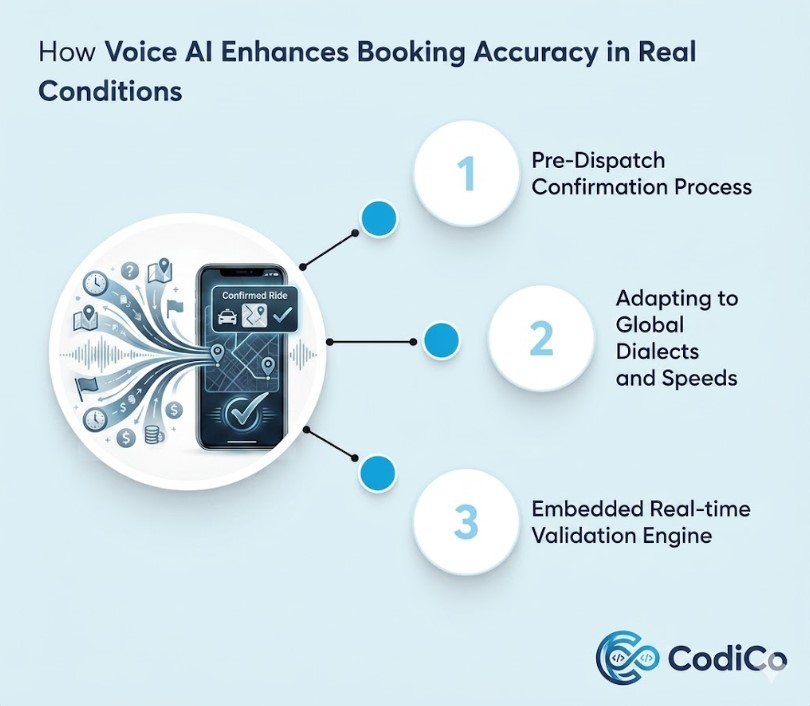
Voice AI reduces this risk by adding several accuracy checks inside the booking flow.
Confirming Trip Details Before the Booking Is Sent
A strong AI voice booking system does not create a trip immediately after the customer gives the first answer. It repeats the key details and gives the passenger a chance to confirm them before the booking is finalized.
This usually includes:
- pickup location;
- drop-off location;
- pickup time;
- passenger name and phone number;
- airport terminal or flight number;
- special notes, such as luggage, child seats or accessibility needs.
This step may look simple, but it is one of the most important parts of confirmation before dispatch. If the pickup point is wrong, the customer can correct it while still on the call. If the destination was misheard, the system can ask again before the driver receives the booking.
For taxi companies, this prevents many small mistakes from turning into operational problems.
Understanding Accents, Noise and Natural Speech
Real taxi calls are not always clean. Customers call from airports, train stations, busy streets, hotel lobbies or moving cars. They may speak quickly, use different accents, switch languages or describe a location in a way that does not match a standard menu.
This is where Voice AI has a clear advantage over rigid call flows. With advanced speech recognition, the system can process different language and accent variations, identify unclear input and ask for clarification when something does not sound reliable.
For example, if a street name is uncertain or the pickup point sounds incomplete, Voice AI can slow the booking down for a moment and ask a follow-up question. That is better than sending a weak booking directly into dispatch.
This helps reduce mistakes caused by pronunciation, background noise and incomplete customer input.
Validating Booking Data Before Dispatch
Voice AI also works as a built-in validation layer. It does not only listen to what the customer says. It checks whether the captured information is complete and consistent enough to create a usable booking.
If something is missing, the system can prompt the customer again. If the pickup location needs more detail, it can ask for a landmark, entrance, terminal or postcode. If the time is unclear, it can confirm whether the customer means now, later today or a scheduled pickup.
Only validated data should move forward into dispatch.
That is the difference between automation that simply accepts input and automation that protects booking accuracy. Voice AI helps make sure the booking is not just created quickly, but created with enough detail for dispatchers and drivers to act on it.
Expert Tip: Use Correction Data to Improve Booking Quality
Use structured logs from your AI voice booking system to track correction patterns.
If customers often correct pickup locations, airport terminals or timing details, those patterns can show where your booking flow needs improvement. Over time, this helps taxi operators understand recurring gaps in customer input and improve long-term accuracy across the whole dispatch process.
Read also: How to Use AI in Your Taxi Business: Practical Steps That Work
Why Booking Accuracy Improves the Whole Taxi Experience
Booking accuracy is not just an internal performance metric. Customers may never see your dispatch screen, but they feel the result of every wrong or incomplete booking.
When the pickup location is correct, the driver arrives where the passenger expects. When the destination is clear, the route starts faster. When the time, flight number or special request is confirmed properly, the customer does not need to call again and repeat the same information.
This has a direct impact on daily taxi operations.
When bookings are accurate from the start:
- delays and cancellations become less frequent;
- dispatchers spend less time correcting avoidable mistakes;
- customers trust the service more;
- drivers complete more trips without unnecessary waiting;
- call queues stay cleaner during busy periods;
- operational pressure becomes easier to manage.
The difference is visible in the way the whole service runs. Instead of reacting to problems after the booking is already in dispatch, the system helps prevent those problems earlier in the call.
For customers, this creates a smoother experience. For taxi companies, it means fewer manual corrections, better driver productivity and more predictable operations during peak hours.
When IVR Becomes Too Costly for Taxi Operations
Not every taxi business needs to move from IVR to Voice AI immediately. If call volume is low, routes are simple and most customers use saved locations, a traditional IVR setup may still be enough.
But there are clear signs that the current system is starting to limit the business.
You should review your call handling process if you see:
- frequent booking errors;
- high dispatcher workload;
- growing call volume during peak hours;
- customer complaints about pickup issues;
- drivers calling back to confirm locations;
- repeated corrections after the booking has already been created.
When these issues appear regularly, the problem is not necessarily your dispatch team. Your team may be working hard to fix mistakes that the booking system should have prevented earlier.
This is where Voice AI becomes more relevant. It does not replace operational discipline, but it adds a stronger layer of understanding, confirmation and validation before the trip reaches dispatch.
If the system handling the booking cannot check unclear details, confirm key information or adapt to natural customer speech, then accuracy depends too much on manual correction. At scale, that becomes expensive.
Expert Tip: Measure Corrections After Booking Creation
Measure your booking-to-dispatch correction time.
If dispatchers spend significant time fixing pickup points, clarifying destinations, calling customers back or updating trip notes after the booking is created, your current system may lack pre-dispatch validation.
This metric is useful because it shows where the real cost sits. The issue may not be the number of calls you receive, but the amount of work required after each imperfect booking.
Why Validation Defines Real Booking Accuracy
Automation alone does not solve taxi booking errors. A system can answer calls, collect input and create bookings quickly, but if the information is incomplete or wrong, the problem simply moves faster into dispatch.
This is where the real difference between IVR and Voice AI becomes clear. Traditional IVR systems helped taxi companies reduce some manual effort, but they were mainly designed to collect input. They follow a fixed path, accept selected options and pass those details forward. What they often lack is a strong validation step before the booking reaches operations.
Voice AI changes that process. Instead of only recording what the customer says, an AI voice booking system can confirm key details, check missing information and ask follow-up questions before the trip is created. That makes the booking flow more reliable, especially when passengers describe pickup points, airport terminals, hotel entrances, flight delays or last-minute changes in natural language.
For taxi operators, this matters because accurate bookings lead to smoother dispatch, better driver utilization and stronger customer trust. Errors decrease not because dispatchers work harder, but because the system prevents more problems before they reach the team.
If your goal is to improve booking accuracy as call volume grows, moving from IVR to Voice AI becomes more than a technical upgrade. It becomes a practical step toward cleaner booking data, fewer avoidable corrections and more stable taxi operations.
For taxi companies using CodiCo, this is where a connected automated dispatch system becomes especially important. Accurate booking details should not sit separately from daily operations. They need to move into dispatch clearly, consistently and with enough information for drivers and dispatchers to act without unnecessary follow-up.
The same applies to the taxi booking process. A structured booking flow helps operators collect the right information from the start, whether the request comes through a call, a form or a dispatcher. When booking data is cleaner before it reaches dispatch, the whole operation becomes easier to manage.
For growing taxi businesses, the future of booking accuracy is not just faster automation. It is better validation before dispatch. IVR can still support simple call flows, but Voice AI is better suited for operations where customers speak naturally, details change quickly and every booking needs to reach the driver with clear, usable information.
FAQs
1. What is the main difference between IVR and Voice AI in taxi booking?
IVR follows fixed menu inputs, while Voice AI understands natural speech, confirms trip details and validates booking data before dispatch. This makes Voice AI more flexible when customers describe pickup points, airport terminals, time changes or special requests in their own words.
2. Does Voice AI reduce taxi booking errors?
Yes. Voice AI can reduce taxi booking errors by asking follow-up questions, confirming pickup and drop-off details, and checking whether the booking information is complete before it reaches dispatch. This helps prevent wrong locations, missing notes and unclear customer instructions.
3. Is IVR still useful for taxi businesses?
IVR can still be useful for simple and repetitive taxi bookings, especially when customers use saved locations or follow predictable routes. However, it becomes less effective when calls involve natural speech, accents, noisy environments, last-minute changes or detailed pickup instructions.
4. How does Voice AI handle different accents and languages?
Voice AI uses speech recognition and language processing to understand different accents, speaking speeds and language variations. When the input is unclear, the system can ask the customer to repeat or clarify the detail before creating the booking.
5. When should a taxi business switch from IVR to Voice AI?
A taxi business should consider switching from IVR to Voice AI when booking errors increase, dispatchers spend too much time correcting trip details, call volume grows, or customers often complain about pickup issues. These signs usually show that the current system lacks proper pre-dispatch validation.