
















In practice, the companies that last are the ones that get the unglamorous parts right from day one: licensing, insurance, pricing and a reliable way to take and dispatch bookings. This guide walks you through each step, with a focus on the UK and Europe. The same logic applies in the US, Canada and Australia, but licensing rules differ, so always check with your local authority before you invest.
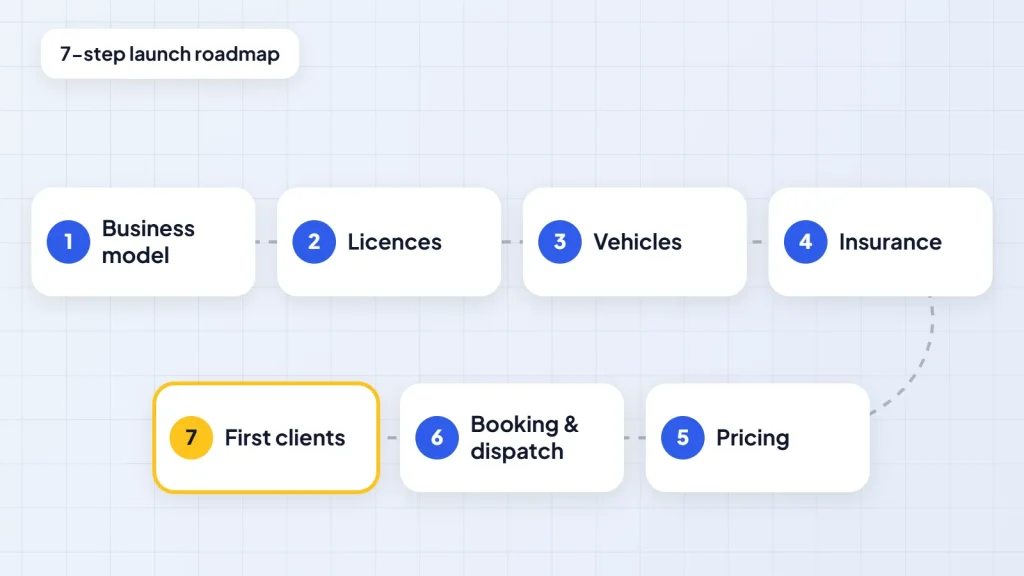
1. Decide what kind of chauffeur business you are
“Chauffeur service” covers several different businesses. Choosing one first makes every later decision (vehicles, pricing, marketing) easier.
| Model | Typical clients | What matters most |
|---|---|---|
| Airport transfers | Travellers, hotels, travel agents | Flight tracking, punctuality, meet and greet |
| Corporate / executive | Companies, PAs, event organisers | Monthly invoicing, discretion, account management |
| Events and weddings | Private clients, planners | Vehicle presentation, packages, seasonal demand |
| Roadshows and hourly hire | Finance, media, VIP guests | Flexible hourly rates, experienced drivers |
| Subcontracting | Other operators, booking platforms | Low cost per trip, fast acceptance |
Most successful operators start with one or two models and add others later. Airport transfers are a common entry point because demand is steady all year and bookings can come from online platforms, not only from your own marketing.
2. Get the right licences
This is the step new operators most often underestimate. Driving paying passengers without the correct licences can void your insurance and lead to fines or prosecution.
United Kingdom
Chauffeur work is regulated as private hire. You normally need three things from the same licensing authority: a private hire operator licence for the business, a private hire vehicle licence for each car, and a private hire driver licence for each driver (which includes background checks and a medical). In London this is Transport for London; elsewhere it is your local council. Rules on vehicle age, signage and record keeping vary between councils. Our step-by-step guide on starting a private hire business in the UK covers the licensing process in more detail.
European Union
Each country has its own system. Some examples of what to look for:
- France: VTC (voiture de transport avec chauffeur). The company registers in the VTC register and drivers hold a VTC card.
- Germany: Mietwagen with driver, licensed under the Passenger Transport Act; drivers need a passenger transport permit.
- Netherlands: a taxi transport licence for the company and a driver card for each driver.
- Belgium and Spain: licences are issued regionally or by city, and rules can differ even between neighbouring areas.
US, Canada and Australia
Licensing is usually handled at state, province or city level, and airports often require their own permit for pick-ups.
Practical tip: ask the licensing office for its full list of conditions before you buy a car. Vehicle age, size and colour limits can rule out the model you had in mind.
3. Choose your vehicles
Your fleet is your brand. Start with what your target clients expect, not with what looks impressive.
- Executive saloon: the workhorse for airport and corporate jobs.
- Executive MPV or van: families, groups and travellers with lots of luggage; often the most profitable airport vehicle.
- Luxury saloon: VIP and premium corporate work at higher rates.
- Minibus: event and group transfers.
Buying, leasing and partnering with owner-drivers each have trade-offs. Leasing keeps cash free in the first year; owner-drivers let you scale without capital but give you less control over quality. Many operators combine their own core cars with trusted partner drivers for peak days.
4. Sort out insurance
Standard car insurance does not cover paid passenger transport. You will need hire-and-reward (private hire) motor insurance for every vehicle, and usually public liability insurance as well. If you employ staff, employer’s liability insurance is typically required too. Get quotes early: for new businesses, insurance is often one of the largest costs and can change your pricing.
5. Work out your costs and pricing
Before you set prices, list every cost per vehicle per month:
- vehicle lease or finance, insurance, fuel or charging, maintenance and tyres, cleaning
- licence fees and renewals
- driver pay or partner commission
- software, phone and website
- marketing and platform fees
Then decide how you charge. Chauffeur companies commonly use a mix of:
| Pricing method | Best for |
|---|---|
| Fixed price per route (e.g. city centre to airport) | Airport transfers, repeat routes |
| Distance-based (base fare + price per km or mile) | One-way trips of any length |
| Hourly with a minimum | Roadshows, events, as-directed hire |
| Packages | Weddings, tours |
| Corporate rate card | Account clients with monthly invoices |
Add clear rules for waiting time, night and holiday surcharges, extra stops and child seats. Clients accept surcharges they can see in advance; they complain about the ones they discover on the invoice. A flexible pricing system lets you set fixed routes, zones and surcharges once and quote them automatically.
If you are also comparing this with a regular taxi operation, our guide to taxi business startup costs breaks down the main cost lines in more detail.
6. Set up booking and dispatch
In the first weeks it is tempting to run everything from WhatsApp and a spreadsheet. It works for five jobs a day; it breaks at twenty. Double bookings, missed flight changes and lost invoices are the usual result.
From the start, you want:
- An online booking form on your website that shows the price instantly and takes payment. See how a booking form for your website works.
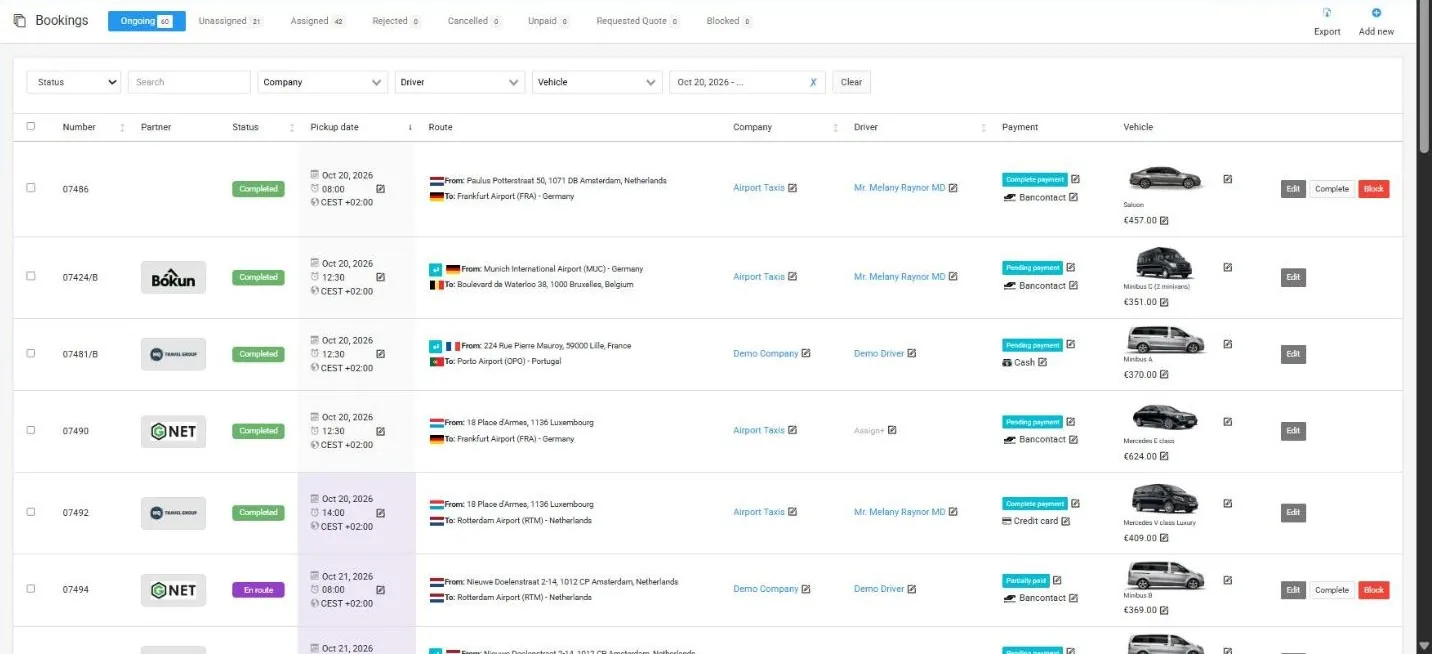
- A dispatch dashboard where you see every job, assign drivers and react to changes.
- A driver app so drivers receive jobs, navigate and update their status without phone calls. Here is what a dedicated driver app does.
- Flight tracking for airport pickups, so drivers adjust to delays.
- Automatic client notifications: booking confirmation, driver details, “driver has arrived”.
- Invoicing for corporate accounts, ideally generated from completed jobs with automatic invoices.
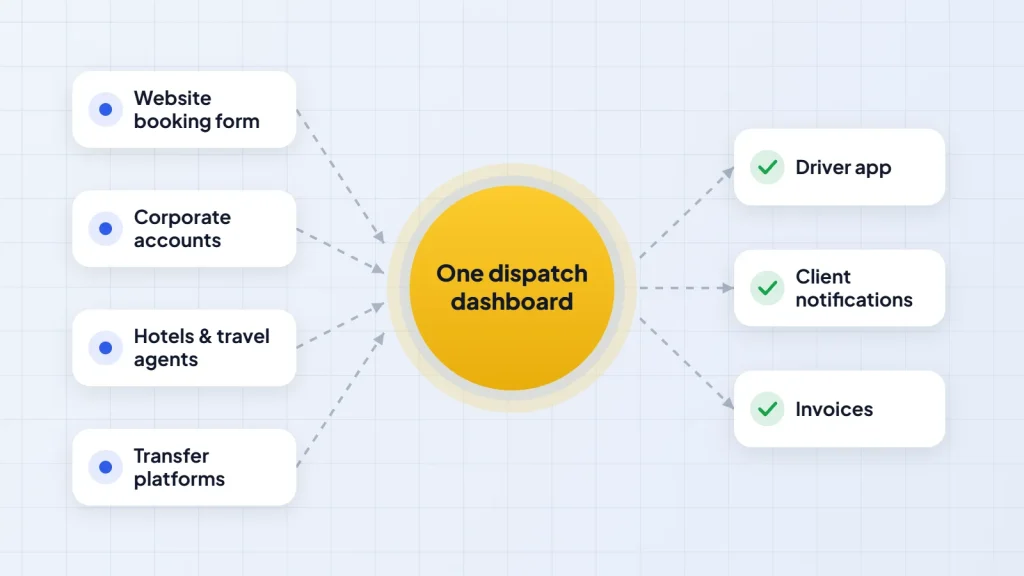
Chauffeur dispatch software brings these together in one place, so a small team can handle many more bookings without extra office staff. Live tracking also lets you answer the most common client question, “where is my driver?”, in seconds.
7. Win your first clients
New chauffeur companies rarely grow from paid ads alone. These channels usually work better early on:
- Booking platforms. Airport transfer marketplaces send ready-made bookings. Margins are lower, but they fill empty hours and build reviews. Connecting them to your system through integrated booking channels saves retyping every job.
- Hotels and serviced apartments. Offer reception staff a simple way to book and a reliable fixed price.
- Local businesses. Law firms, consultancies and event venues need regular, discreet transport. Offer a corporate account with monthly invoicing.
- Travel agents and DMCs. They value fast confirmations and English-speaking drivers.
- Your own website and Google Business Profile. Local searches such as “chauffeur company + city” bring clients who are ready to book. Reviews matter a lot here.
- Other operators. Subcontracting overflow work keeps cars busy in quiet periods, and a partner network lets you pass on jobs you cannot cover.
Whatever the channel, reliability is your real marketing. One missed airport pickup can cost you a corporate account; ten perfect ones usually bring a referral.
A simple launch checklist
- Business model and target clients chosen
- Company registered and bank account opened
- Operator, vehicle and driver licences applied for
- Hire-and-reward and liability insurance in place
- Vehicles bought, leased or partner drivers signed
- Cost sheet and price list ready
- Website with online booking and payment live
- Dispatch software and driver app set up
- Terms and conditions, cancellation policy and privacy policy published
- First outreach to hotels, businesses and platforms
For a full written plan you can show a bank or investor, see how to build a business plan for a taxi business. Most of the structure applies to chauffeur companies too.
FAQ
Is a chauffeur business profitable?
It can be, especially with a good share of airport and corporate work, where prices are higher and demand is steady. Profit depends mostly on how busy each vehicle is, so filling quiet hours (for example through platforms or subcontracting) matters as much as the price per trip.
Do I need a licence to start a chauffeur business?
In almost every country, yes. In the UK you need private hire operator, vehicle and driver licences; in EU countries the rules are national or regional (for example VTC in France). Check with your local licensing authority before you start.
How many cars do I need to start?
Many operators start with one or two vehicles, often driven by the owner, and add partner drivers before buying more cars.
What is the difference between a chauffeur service and a taxi?
Chauffeur services are pre-booked, usually with a fixed or agreed price and a higher standard of vehicle and service. Taxis can typically be hailed on the street or at ranks, depending on local rules.
What software does a chauffeur company need?
At minimum: online booking with payment, a dispatch dashboard, a driver app, flight tracking for airport jobs and invoicing for corporate clients, ideally in one system.
Conclusion
Starting a chauffeur business is less about the car and more about the system around it: the right licences, honest pricing, reliable drivers and a booking process clients trust. Get these right in the first months and growth becomes a question of adding vehicles, not fixing problems.
CodiCo Dispatch Software gives chauffeur and airport transfer companies online booking, dispatch, driver apps and connections to major transfer platforms, with 0% commission. See plans and prices and set up your dispatch system in a few minutes.